

50 years ago, we thought we could change the world
Advertisement
Read this article for free:
or
Already have an account? Log in here »
To continue reading, please subscribe:

Digital Subscription
One year of digital access for only $205*
- Enjoy unlimited reading on winnipegfreepress.com
- Read the E-Edition, our digital replica newspaper
- Access News Break, our award-winning app
- Play interactive puzzles
*First annual payment billed as $205.00 + GST for one year. This annual subscription will automatically renew at $233.00 + GST every 52 weeks (10% off the regular annual price of $259.35). Offer available to new and qualified returning subscribers only. Cancel any time.
To continue reading, please subscribe:
Add Free Press access to your Brandon Sun subscription for only an additional
$1 for the first 4 weeks*
- Enjoy unlimited reading on winnipegfreepress.com
- Read the E-Edition, our digital replica newspaper
- Access News Break, our award-winning app
- Play interactive puzzles
*Your next Brandon Sun subscription payment will increase by $1.00 and you will be charged $17.95 plus GST for four weeks. After four weeks, your payment will increase to $24.95 plus GST every four weeks.
Read unlimited articles for free today:
or
Already have an account? Log in here »
Winnipeg, 50 years ago.
We began as a small loose unorganized group of teaching friends and educators who shared the same political and social convictions.
We defined ourselves as socialists, feminists and political activists. We were a cross section of educational minds — language arts and social studies teachers, an art teacher, an early childhood educator, a Winnipeg school trustee, a school principal — making our group quite representative of school culture at the time.
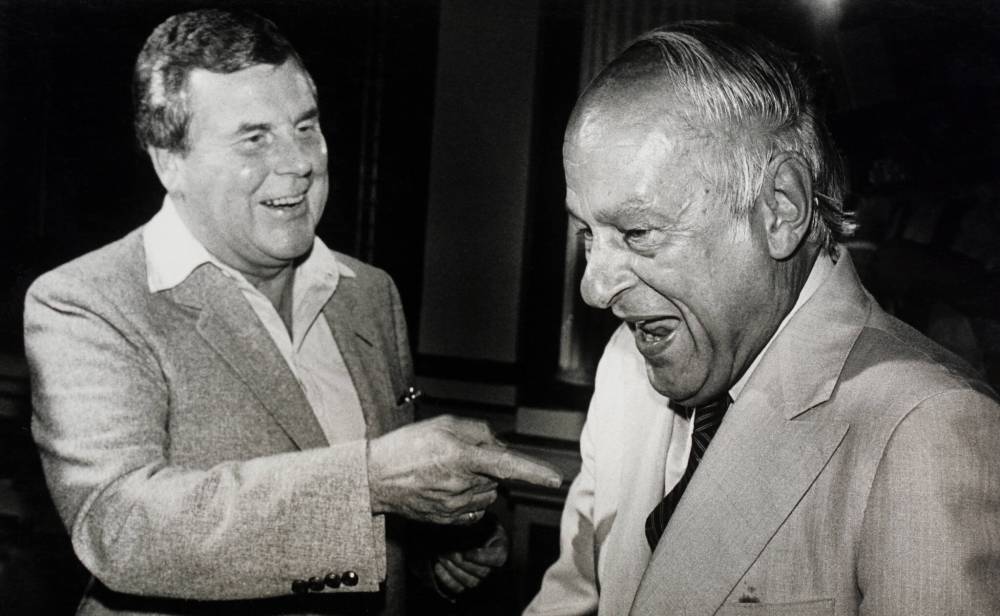
KEN GIGLIOTTI / WINNIPEG FREE PRESS
Manitoba Premier Sterling Lyon greets Quebec Premier Rene Levesque at a First Ministers’ Meeting at the Fort Gary Hotel. Lyon might never have known he was part of the impetus for a group of teachers trying to effect change.
Our questions and discussions about politics, education and society arose from a diversity of backgrounds, yet reflected a progressive cohesiveness. The political climate in Manitoba helped bring us together. Sterling Lyon was premier and his Conservative government was pursuing policies that we strongly opposed. To us, his government represented a determined assault on many of the social and political values we believed in, particularly related to education. Eventually we decided that perhaps we should do more than talk. And so the Socialist Teachers Education Movement — STEM — was born.
We began meeting regularly on Sunday mornings, usually in the living room of one of our homes. Coffee flowed and discussions centred around inequality, racism, sexism, world peace and the disenfranchisement of children, particularly in the core area of Winnipeg. We often discussed an agreed-upon reading assignment. Our principal (but not only) intellectual guide was Antonio Gramsci, the Italian Marxist philosopher and political theorist.
Gramsci gave us a vocabulary for understanding what we were seeing around us and provided us with a theoretical underpinning. Quite remarkably he defined what we were attempting to do and provided us with a motivating energy.
We weren’t clandestine and certainly weren’t conspiratorial. Nothing about us suggested anything beyond political action in the domain of education. But in those early days, we kept a relatively low profile. We were teachers after all, and openly identifying ourselves as socialists was not necessarily the safest way to advance our teaching/educational careers.
It wasn’t enough to understand the world; we had to ask what we could actually do to change things for the better. That became something of a STEM preoccupation. We spent hours discussing education, capitalism and social inequality. But sooner or later the inevitable question arose: What can be done to affect change?
That question gradually moved us beyond Sunday morning discussions. We became more innovative in our classrooms. We became active in our local teacher organizations and also in the Manitoba Teachers’ Society.
STEM became the source and inspiration for lessons in our classrooms and a beacon for actions in our professional organizations.
In our classrooms, we supplemented the prescribed curricula using critical enquiry by examining multiple points of view rather than just encouraging non-conformity. For instance, in history, teaching students about working class history and the struggles workers engaged in for a better life. We wanted students to understand that Canadian history wasn’t simply the story of prime ministers, businessmen and institutions; working people had helped shape it, too.
Our art teaching members encouraged their students to express their feelings and thoughts in creative ways, ways that questioned existing norms and values.
We constantly challenged our students to ask why things were the way they were.
One of our members, during a particularly bitter strike at Griffin Steel, took his students to the picket line. It was certainly not the kind of field trip school administrators would endorse. But it was a real life learning experience.
Another member invited the Nellie McClung Theatre Group to perform at their school. The presentation emphasized sexist attitudes and inequities in society. The principal at the time took exception to it: “radical, not suitable for teenagers.” But the kids loved it and learned about life outside of textbooks. The learning activities we undertook were aimed at being socially transformative. We were actually trying to bring real life issues into the classroom.
And sometimes there was a price to pay. The Soviet Union was part of the Grade 7 Geography Curriculum, and a STEM member encouraged a student(s) as part of an end of unit activity to write to the Soviet Embassy in Ottawa for information about their country.
A short time later, a large box arrived at his home. It contained books, publications and among other things several unmistakable pieces of Soviet propaganda. His mother, a school board trustee, was not amused. The teacher was accused of “teaching communism.” The school board saw him as some sort of pariah.
The principal, to his credit, rose to his defence.
Nevertheless, the incident made the point rather dramatically: alternative political ideas were not welcome in Manitoba’s classrooms. We continued to assert that to learn about any political or cultural situation is not an endorsement of it, but rather it is an opportunity to better understand the complexity of the issue.
STEM jumped into the politics of our profession. One issue, among others we championed, was the right of teachers to strike. Manitoba teachers had lost that right in 1956 when the province replaced it with compulsory arbitration.
But while we could bargain collectively, there was a limitation: disputes concerning class size and composition could not be taken to arbitration. We believed teachers should have the same fundamental bargaining rights available to many other workers and teachers in other provinces. STEM prepared a motion for the annual general meeting of the Manitoba Teachers’ Society calling for the restoration of the right to strike.
It was defeated. In retrospect, that defeat was instructive. It wasn’t simply a case of government opposition. Many teachers themselves were not convinced that having the right to strike was desirable. That is still the case today and represents a major handicap regarding reducing class sizes to teachable levels. Manitoba and Prince Edward Island still remain the only two provinces in Canada where teachers cannot go on strike.
STEM continued into the early 1980s. By then we were more public.
We published a newsletter and we organized two conferences. Our first featured George Martell, a well-known author, socialist educator and activist. For the second conference, we brought in the president of the B.C. Teachers’ Federation, a strong advocate of teachers having the right to strike.
For a small organization that had begun around Sunday morning living room discussions, we were rather pleased with ourselves and the support we were receiving. STEM did influence and the support we received was noteworthy.
But movements, like everything else, have a life cycle. By the middle of the 1980s, STEM was no longer a viable organization. There was no dramatic collapse. Life simply intervened.
Our spirit and drive drained elsewhere. Families called for more of our time and teaching became increasingly demanding. The workload seemed never-ending. People moved on to graduate studies, academic teaching, administration, counselling and second language teaching. One member went on to teach in Winnipeg’s inner city, working to improve the outlook for some of the most oppressed and marginalized students anywhere.
The energy that had sustained our Sunday meetings gradually dissipated and STEM faded away.
But it didn’t disappear entirely. For many of us, the commitment to bringing progressive and socialist ideas into education continued long after our organization itself ceased to exist.
Looking back, we were not powerful.

We didn’t change the education system.
We didn’t win many of the battles we chose to fight. Perhaps, “movement” was too ambitious a title. Countless teachers, educators and the broader community articulated their support for us and what we were trying to do. We believed that teaching was more than delivering a curriculum. We held that education had something to do with the kind of society we wanted to create — and that teachers had a responsibility to help students understand the world critically rather than simply accept it as they found it. That responsibility is still needed today.
Those were, in many ways halcyon days… politically turbulent, intellectually exciting and sometimes a little reckless. We strove to create more progressive environments across our classrooms and workplaces.
STEM represented a brief and perhaps largely forgotten moment in Manitoba’s educational history when a handful of teachers decided that what happened in our classrooms and places of work mattered. And we wanted to do something about it.
Robert Milan and Miriam Cooley, two of the founding members of STEM, are both retired.