

A way of seeing, a vision for living
Advertisement
Read this article for free:
or
Already have an account? Log in here »
To continue reading, please subscribe:

Digital Subscription
One year of digital access for only $205*
- Enjoy unlimited reading on winnipegfreepress.com
- Read the E-Edition, our digital replica newspaper
- Access News Break, our award-winning app
- Play interactive puzzles
*First annual payment billed as $205.00 + GST for one year. This annual subscription will automatically renew at $233.00 + GST every 52 weeks (10% off the regular annual price of $259.35). Offer available to new and qualified returning subscribers only. Cancel any time.
To continue reading, please subscribe:
Add Free Press access to your Brandon Sun subscription for only an additional
$1 for the first 4 weeks*
- Enjoy unlimited reading on winnipegfreepress.com
- Read the E-Edition, our digital replica newspaper
- Access News Break, our award-winning app
- Play interactive puzzles
*Your next Brandon Sun subscription payment will increase by $1.00 and you will be charged $17.95 plus GST for four weeks. After four weeks, your payment will increase to $24.95 plus GST every four weeks.
Read unlimited articles for free today:
or
Already have an account? Log in here »
In Ways of Seeing, John Berger reminds us that seeing precedes words.
We encounter the world before we learn to name it, and the images we make carry something of how we understand it. Looking involves choices: what we attend to, what we overlook, what our experience allows us to recognize.
An artist’s work can make us conscious of those choices, inviting us to see through another person’s eyes. It is one reason a painting can change our experience of a place we thought we knew.
Stephen Borys photo
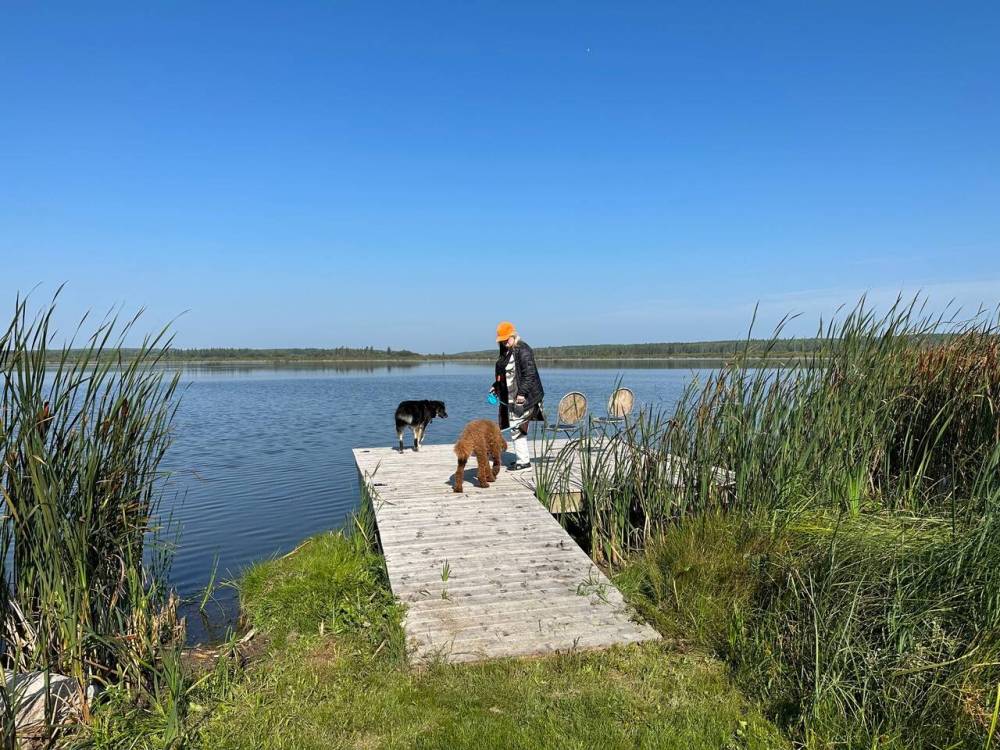
Wanda Koop with her dogs at the lake.
I thought of this standing on a dock with artist Wanda Koop, listening as she described the changing light across the water: landscape and colour before detail, atmosphere before composition.
The shoreline, trees and sky were familiar enough. Her attention to them made me look again. I began to notice relationships between things, the way colour could organize a view before I had named its parts. The scene became a field of shifting intervals, edges and reflections.
Listening to Wanda, I became aware of the difference between recognizing a landscape and attending to it.
There was no canvas between us and the view, yet I could sense the artist’s eye at work.
Wanda never stops seeing as an artist. Creativity is not simply something she does; it is how she experiences the world.
Throughout my museum career, time spent with artists has been a great privilege. I visit their studios to see what they are creating, ask questions and get to know them. These encounters often deepen my understanding of unfamiliar art or challenge an established interpretation.
Such visits reveal something of the observation, discipline and uncertainty behind the finished object. Occasionally, they offer a glimpse of a vision that reaches into the life of a community.
No artist owes us this. Making art is demanding, and an artwork can contribute profoundly to public life on its own. But when an artist’s imagination also creates opportunities for others, I find it deeply inspiring. Wanda is such an artist.
I first saw Wanda’s Green Room (1995) installed at a National Gallery of Canada acquisitions committee meeting, when my curatorial colleagues and I were considering it for the permanent collection. Four monumental paintings shared their luminous green with the gallery walls. Fluorescent orange circles interrupted atmospheric landscapes.
The work challenged the distinction between looking at a painting and inhabiting its visual field. Colour, scale and an unexpected mark made the act of looking itself part of the subject.
That openness also shapes how Wanda lives. Her artmaking, mentorship, community activism and philanthropy express a conviction that creativity belongs in everyday life. Her attention extends to the people and possibilities around her.
In 1998, Wanda founded Art City in Winnipeg’s West Broadway neighbourhood. This artist-run, not-for-profit community centre offers free art programming to people of all ages and abilities, with professional artists, materials and meals. Its fundraising events and parades are among the city’s most spirited and imaginative celebrations.
At the heart of Art City is a simple invitation — your ideas deserve attention. Wanda’s mentoring of younger artists carries a similar message: the work matters, and someone believes in your capacity to make it.
For years, Wanda has also imagined the Wanda Koop Centre for the Arts (WKCA). Some initially called it “Art City for Adults,” capturing its spirit of access and participation. The vision joins community artmaking with the spaces and support artists need to sustain their work.
The WKCA aims to build community through art and art education while preserving and sharing Wanda’s artistic legacy. Envisioned in Winnipeg’s cultural district, it will bring together apartments for artists and cultural workers, studios, live/work units, exhibition galleries, workshop facilities, and common areas for programs and gatherings.
Wanda’s own art remains foundational to the project. Caring for her collection and archives, documenting her oeuvre, and presenting her art through exhibitions and scholarship will help future audiences understand her achievement. Her work will be studied and exhibited where other artists are developing their own.
For a curator, that proximity matters. An archive can illuminate the decisions behind a painting; the painting can send someone back to the archive with a new question. Within a working arts centre, sustained study and artistic discovery can inform one another.
I can count on one hand the places I know in North America that successfully combine an artist’s legacy, spaces to live and work, and community artmaking. Inner-City Arts in Los Angeles, designed by Michael Maltzan, offers a point of comparison, minus the artist residences. That rarity has inspired me to work with Wanda and chair the WKCA board of directors. I have seen the force of her vision in her paintings and its generosity in her commitment to others.
The centre’s promise depends on what happens both inside and outside the studio. A workshop, studio visit or informal conversation can spark a collaboration or change a work’s direction. Affordable space and a supportive community can help an artist keep working. Realizing these goals requires sound planning, resources, partnerships and long-term care.

We often speak about legacy as though it begins when an artist’s career has ended. Wanda is building hers in the present.
The WKCA offers a way for her art to remain visible and accessible while supporting creative lives that will take directions of their own.
I think again of my visits to the lake, and of listening to Wanda describe the light. She helped me see more in a place I was already looking at. Through her community initiatives, she has offered others a chance to discover what they might see and make for themselves.
The sustaining power of her vision lies in that possibility — what begins with one artist can continue through the work of many.
Stephen Borys is president and CEO of Civic Muse, an arts and cultural consulting practice based in Winnipeg. www.civicmuse.ca