

Long-term care best when public
Advertisement
Read this article for free:
or
Already have an account? Log in here »
To continue reading, please subscribe:

Digital Subscription
One year of digital access for only $205*
- Enjoy unlimited reading on winnipegfreepress.com
- Read the E-Edition, our digital replica newspaper
- Access News Break, our award-winning app
- Play interactive puzzles
*First annual payment billed as $205.00 + GST for one year. This annual subscription will automatically renew at $233.00 + GST every 52 weeks (10% off the regular annual price of $259.35). Offer available to new and qualified returning subscribers only. Cancel any time.
To continue reading, please subscribe:
Add Free Press access to your Brandon Sun subscription for only an additional
$1 for the first 4 weeks*
- Enjoy unlimited reading on winnipegfreepress.com
- Read the E-Edition, our digital replica newspaper
- Access News Break, our award-winning app
- Play interactive puzzles
*Your next Brandon Sun subscription payment will increase by $1.00 and you will be charged $17.95 plus GST for four weeks. After four weeks, your payment will increase to $24.95 plus GST every four weeks.
Read unlimited articles for free today:
or
Already have an account? Log in here »
Long-term care remains in crisis in Manitoba. As a result, too many Manitobans fear what will happen to them and their relatives as they age and develop more complex health needs.
While some public support does exist, too much of the labour of caring for our relatives as we age is privatized onto individual family members, most often women in these families. This adds additional stress and workload onto these individuals, who must essentially act as unpaid caregivers for their loved ones as they age.
For those without such family support, the circumstances are even more challenging.
Free Press files
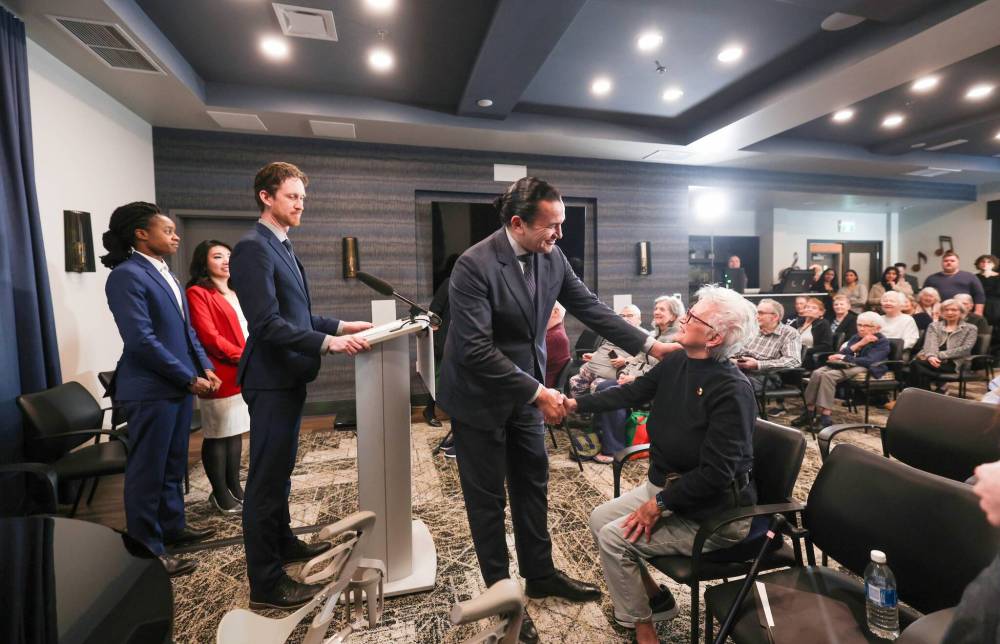
Premier Wab Kinew chats with resident Elaine Cowan at the March 2026 announcement of a new seniors home to be built in Bridgwater.
In Manitoba, personal care homes (PCH) are a mix of private for-profit, public and private not-for-profit operations. Recently, private for-profit care homes have been back in the news for all the wrong reasons.
Residents of the privately operated Shaftesbury Park Retirement Residence found out in mid-June that they would be losing access to their home-care program. The company that runs the facility — All Seniors Care — made this announcement after firing approximately 70 health-care aides who worked in the program immediately following their certification as CUPE members. This case is still before the labour board, with CUPE accusing the company of union-busting tactics.
This past February, another example of the failures of the private, for-profit LTC model was making headlines. What was then known as the Golden Door Geriatric Centre was set to close its doors and, with it, Manitoba faced the loss of 78 PCH beds.
Thankfully, the province stepped in and expropriated the private care home, and it has now been renamed Prairie Crocus Manor. All 78-beds are reported as being full.
This is an important victory, but it is also a sign that reliable access to high-quality, long-term care and the profit motive don’t mix.
Not-for-profit care homes can also have a place within this model, but the profit motive must be kept out of health care, including long-term care. Research consistently shows that in private, for-profit PCHs, profit is generated by lean services and depressed wages, as these facilities cut corners on resident care, including emotional and social support, to boost their profit margins.
While this study has yet to be replicated in Manitoba, a research study conducted by B.C.’s seniors advocate found that non-profit care homes spent 25 per cent more on direct patient care than their for-profit counterparts.
Private, for-profit care homes can be deadly environments for these reasons.
We saw this most viscerally during the COVID-19 pandemic, when privately operated care homes saw some of the worst outbreaks across the country. Manitoba had some of the highest per capita deaths in long-term care homes, with outbreaks in two private, for-profit care homes operated by the Ontario company Revera Inc.
Even now, for-profit care homes pose health risks to their residents while demanding understaffed workers do more with less in order for these companies to generate more profits for shareholders. This is a shameful way to treat our elderly community members, and it is no way to run a health-care system.
The provincial government has shown that it is motivated to invest in long-term care and to support better wages and working conditions for health-care workers. This is a crucial foundation that must be built on further.

While the goal of a fully public, non-profit long-term care-home system in Manitoba may be far off, there is much we can do to improve the conditions of work and care in these PCHs in the shorter term.
One crucial step is to legislate minimum standards of hours of care per resident per day. The Canadian standard, established by Health Standards Organization (2023), puts this minimum at 4.1 hours per day. Thus far, Manitoba falls well below that standard.
Increasing staffing to meet this target and go beyond it will improve the quality of care and the lives of PCH residents, while also helping to reduce burnout and stem attrition of staff in these facilities.
It would be a win for all Manitobans, who deserve to live in a province where all of us can reasonably hope to age with dignity and access to holistic, high-quality care at all stages of our lives.
Noah Schulz is provincial director of the Manitoba Health Coalition.