

Options for selling U.S. alcohol in Canada
Advertisement
Read this article for free:
or
Already have an account? Log in here »
To continue reading, please subscribe:

Digital Subscription
One year of digital access for only $205*
- Enjoy unlimited reading on winnipegfreepress.com
- Read the E-Edition, our digital replica newspaper
- Access News Break, our award-winning app
- Play interactive puzzles
*First annual payment billed as $205.00 + GST for one year. This annual subscription will automatically renew at $233.00 + GST every 52 weeks (10% off the regular annual price of $259.35). Offer available to new and qualified returning subscribers only. Cancel any time.
To continue reading, please subscribe:
Add Free Press access to your Brandon Sun subscription for only an additional
$1 for the first 4 weeks*
- Enjoy unlimited reading on winnipegfreepress.com
- Read the E-Edition, our digital replica newspaper
- Access News Break, our award-winning app
- Play interactive puzzles
*Your next Brandon Sun subscription payment will increase by $1.00 and you will be charged $17.95 plus GST for four weeks. After four weeks, your payment will increase to $24.95 plus GST every four weeks.
Read unlimited articles for free today:
or
Already have an account? Log in here »
“Don’t buy it. Let it sit on the shelves.” — Manitoba Premier Wab Kinew
U.S. President Donald Trump had threatened to impose tariffs of 50 per cent by Aug. 19 on over 500 Canadian items worth $28 billion. This would threaten 56,000 Canadian jobs and five per cent of our exports.
These tariffs were justified by Sec. 338 of the Smoot-Hawley Tariff Act of 1930. Unfortunately, Trump forgets that President Herbert Hoover signed it despite the objection of over 1,200 economists. A trade war escalated so that U.S. exports and imports both fell by two-thirds. This exacerbated the Great Depression.
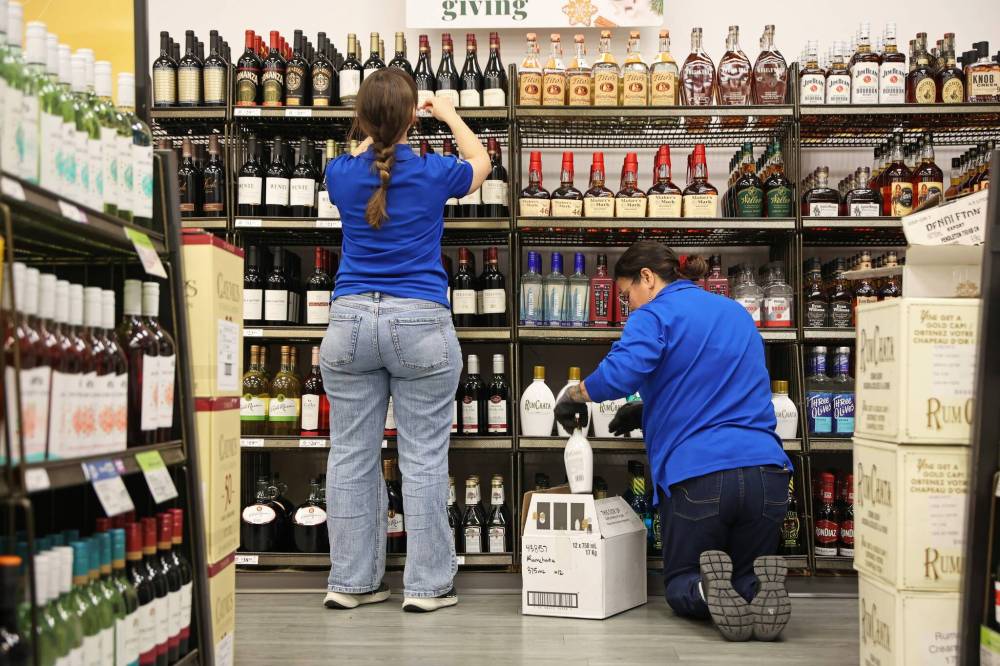
Brandon Sun files
Manitoba Liquor Mart employees stock American alcohol on shelves in December 2025. In Manitoba, U.S. stock which had been removed from shelves earlier in the year was sold for two weeks before Christmas, with proceeds donated to local charities.
A major cause for Trump’s new tariffs is supposedly the irritant that most Canadian provinces no longer sell U.S. alcohol.
Most provinces and territories took U.S. liquor off their shelves in early 2025. British Columbia offloaded and resold its inventory to private channels. Most provinces had temporary sales, with profits directed to provincial charities. Ontario kept its $79.1 million in U.S. products locked away in warehouses; Quebec still holds an inventory worth $17 million. The British Columbia liquor board in the past would not pre-pay, but rather purchased many products on consignment; several other provinces did the same. Several months later, Alberta and Saskatchewan reversed their stance, although U.S. liquor was subject to a 25 per cent federal tariff until August, 2025.
B.C. Premier David Eby and Ontario Premier Doug Ford have been especially vocal in refusing to put U.S. alcohol back on the shelves. However this has represented a loss to B.C. wineries of $200,000 to $700,000 annually. Also, half of Canadian spirits — worth $1 billion per year — had been sold to the U.S.
Eric Duhaime, leader of the Quebec Conservative Party, recently indicated that removing U.S. alcohol from the shelves was a mistake.
President Trump admitted that Canadian imports of U.S. alcohol had dropped by 81 per cent. The Liquor Control Board of Ontario was the largest single customer for American alcohol, with yearly purchases of $965 million. Annual U.S. alcohol imports to British Columbia had been $400 million, to Manitoba $80 million, and to Nova Scotia $18 million. The U.S. had been the fourth-largest wine supplier to Quebec, with annual sales of $66 million.
During the trade negotiation, Prime Minister Mark Carney asked premiers to do a 180-degree shift and put U.S. alcohol back on the shelves. Note, however, that a Nanos poll revealed that 80.9 per cent of B.C. residents and 69 per cent of Canadians would continue to boycott U.S. alcohol. A Pollara Strategic Insights poll released by the Toronto Star on Aug. 19 found that only 15 per cent opposed the prohibition of American liquor and wine sales.
I therefore propose a unified, Team Canada approach with major price restrictions.
All the premiers should agree to sell some U.S. alcohol. Ontario and Quebec should put warehoused items back on the shelves and Manitoba and other provinces should order a token number of U.S. alcohol products, but only on consignment.
Of great importance is that all items should now include a prominent, clearly marked surtax roughly equal to the illegal tariffs on steel, aluminum, copper, etc., plus lumber and autos and any other any other significant U.S. tariffs.
Alberta refuses to restrict or impose export taxes on oil sent to the U.S. and favours Donald Trump’s call for a revival of a pipeline much like Keystone XL. Saskatchewan maintains the same approach to potash exports. However, both provinces can do their part by agreeing to add provincial surtaxes.
If and when Trump, U.S. Commerce Secretary Howard Lutnick, and Trade Representative Jamieson Greer agree to reduce or cancel all of their tariffs, each province and Ottawa would then do the same proportionately, and CUSMA negotiations could proceed.

Despite Trump’s frequent comments to the contrary, the United States does need Canada, and we still have much leverage. We provide the U.S. with 25 per cent of its crude oil, 85 per cent of its potash, half of its aluminum, 25 per cent of its softwood lumber, and one-third of its uranium.
As New Brunswick Premier Susan Holt stated, “It’s not coming back onto the shelves until the U.S. does something to take us back to the free and fair trade we used to have.”
Economist David R. Henderson wrote in February 2025, “One of the most important gains in economic freedom since World War II has been the worldwide reduction in tariff rates. It took years of negotiation to achieve that result. It would be a tragedy if Trump blew it.”
The United States should recall the result of the tariff war in the 1930s and the words of Winston Churchill: “Those that fail to learn from history are doomed to repeat it.”
Retired Ottawa physician Dr. Charles S. Shaver was born in Montreal. The views here are his own.