

Ask civic candidates to do the math
Advertisement
Read this article for free:
or
Already have an account? Log in here »
To continue reading, please subscribe:

Digital Subscription
One year of digital access for only $205*
- Enjoy unlimited reading on winnipegfreepress.com
- Read the E-Edition, our digital replica newspaper
- Access News Break, our award-winning app
- Play interactive puzzles
*First annual payment billed as $205.00 + GST for one year. This annual subscription will automatically renew at $233.00 + GST every 52 weeks (10% off the regular annual price of $259.35). Offer available to new and qualified returning subscribers only. Cancel any time.
To continue reading, please subscribe:
Add Free Press access to your Brandon Sun subscription for only an additional
$1 for the first 4 weeks*
- Enjoy unlimited reading on winnipegfreepress.com
- Read the E-Edition, our digital replica newspaper
- Access News Break, our award-winning app
- Play interactive puzzles
*Your next Brandon Sun subscription payment will increase by $1.00 and you will be charged $17.95 plus GST for four weeks. After four weeks, your payment will increase to $24.95 plus GST every four weeks.
Read unlimited articles for free today:
or
Already have an account? Log in here »
As Winnipeg voters prepare for a municipal election this October, a well-worn campaign playbook is already emerging.
Candidates across the city will knock on doors promising lower taxes, fewer potholes, shiny new recreation centres and grand road expansions designed to alleviate congestion.
It is a familiar refrain, but it is also one completely disconnected from the city’s financial reality.
MIKAELA MACKENZIE / FREE PRESS
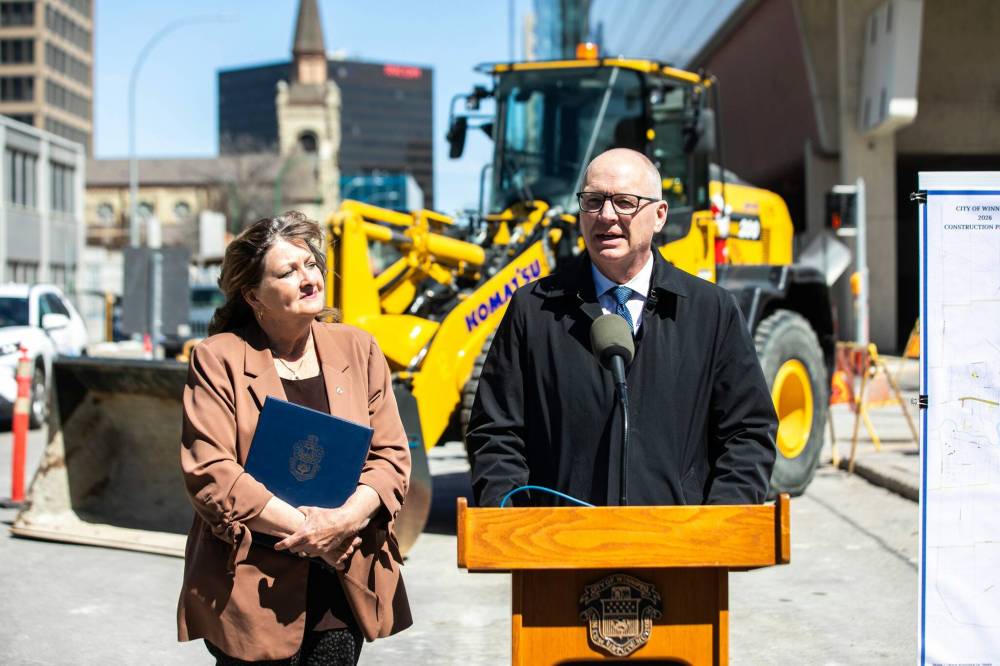
Mayor Scott Gillingham and Coun. Janice Lukes (Waverley West) announce this summer’s road construction projects. Max Schreckenbach argues ‘It is politically easy to make announcements or cut ribbons on new projects.’
While city council is legally mandated to produce a balanced operating budget every year, they do so only after scrambling to close a seemingly never-ending series of unexpected shortfalls — how many years in a row has the city cited “above-average snowfall” to explain budget pressures?
For decades, Winnipeg has tried to manage this gap through a combination of property tax hikes, increasing fees, drawing on various reserves and deferring maintenance.
But as any homeowner knows, deferring essential repairs isn’t a strategy; it’s a loan with high interest.
If we want to stop watching our roads disintegrate while our municipal services are stretched to the brink, voters must stop accepting easy promises and demand that candidates propose serious solutions.
As the city’s own 2026 budget update explicitly documents, Winnipeg’s next multi-year budget cycle faces a structural shortfall of $150 million in 2028; that is approximately equivalent to an 18 per cent property tax increase.
The solution proposed in the city’s budget? The next council will deal with it!
To understand the root cause of that $150-million shortfall, we have to take a deeper look at how we build our city.
Decades of low-density sprawl have yielded quick development fees, but create massive long-term liabilities.
These areas do not even generate enough tax revenue to cover replacement costs for the infrastructure required to service them (roads, sewers, pipes, etc.), let alone contributing to the city’s coffers for recreation and other amenities.
Conversely, mature, higher-density neighbourhoods produce far more revenue, using significantly less infrastructure per capita.
By starving established areas of basic maintenance to subsidize outward growth, Winnipeg has built a physical footprint far larger than its tax base can afford to maintain.
The fundamental breakdown in municipal governance isn’t inefficiency or overspending on the part of city staff; rather, it is a shortage of political courage by elected leadership.
City leaders routinely choose short-term political comfort over long-term fiscal honesty. It is politically easy to make announcements or cut ribbons on new projects.
It is much more difficult to admit that an underfunded city cannot afford the infrastructure that it already has.
When candidates knock on your door this campaign season asking for your vote, we must stop accepting simplistic solutions and start demanding honest answers.
Real accountability means pressing candidates on whether they will prioritize maintenance over expansion, how they intend to better utilize the city’s existing resources and infrastructure, and even what low-value infrastructure they would be prepared to right-size or decommission.

We need candidates who offer genuine fiscal transparency rather than simplistic slogans, such as “I will bring back the old transit system.”
Winnipeg cannot tax its way out of a $150-million multi-year shortfall, nor can it cut its way out through minor administrative efficiencies.
We must build our way out differently by maximizing the productivity of the land we have already serviced rather than piling ever more liabilities onto our already overfull plate.
In October 2026, Winnipeggers shouldn’t vote for the candidates who tell us we can have it all without paying for it. We should vote for the ones brave enough to do the math.
Max Schreckenbach is an (almost) lifelong resident of Winnipeg passionate about building on its history for a more sustainable future.