

Prepare to be … blutterbunged?
Advertisement
Read this article for free:
or
Already have an account? Log in here »
To continue reading, please subscribe:

Digital Subscription
One year of digital access for only $205*
- Enjoy unlimited reading on winnipegfreepress.com
- Read the E-Edition, our digital replica newspaper
- Access News Break, our award-winning app
- Play interactive puzzles
*First annual payment billed as $205.00 + GST for one year. This annual subscription will automatically renew at $233.00 + GST every 52 weeks (10% off the regular annual price of $259.35). Offer available to new and qualified returning subscribers only. Cancel any time.
To continue reading, please subscribe:
Add Free Press access to your Brandon Sun subscription for only an additional
$1 for the first 4 weeks*
- Enjoy unlimited reading on winnipegfreepress.com
- Read the E-Edition, our digital replica newspaper
- Access News Break, our award-winning app
- Play interactive puzzles
*Your next Brandon Sun subscription payment will increase by $1.00 and you will be charged $17.95 plus GST for four weeks. After four weeks, your payment will increase to $24.95 plus GST every four weeks.
Read unlimited articles for free today:
or
Already have an account? Log in here »
Are you not blutterbunged?
If Russell Crowe’s second-century gladiator character had uttered a 19th century equivalent of “Are you not entertained?” that fit the mood of today’s 21st century, that would be it.
Definitions first. Blutterbunged is an obscure regional dialect word from England that means everything from astonished to confounded to bemused or shocked into speechlessness. Its composition suggests something both more and less, namely blustering bloviation (that’s the more part) and empty words (that’s the empty part). These days we would more naturally punctuate our reaction to an event or statement with a profanity. But you get the drift.
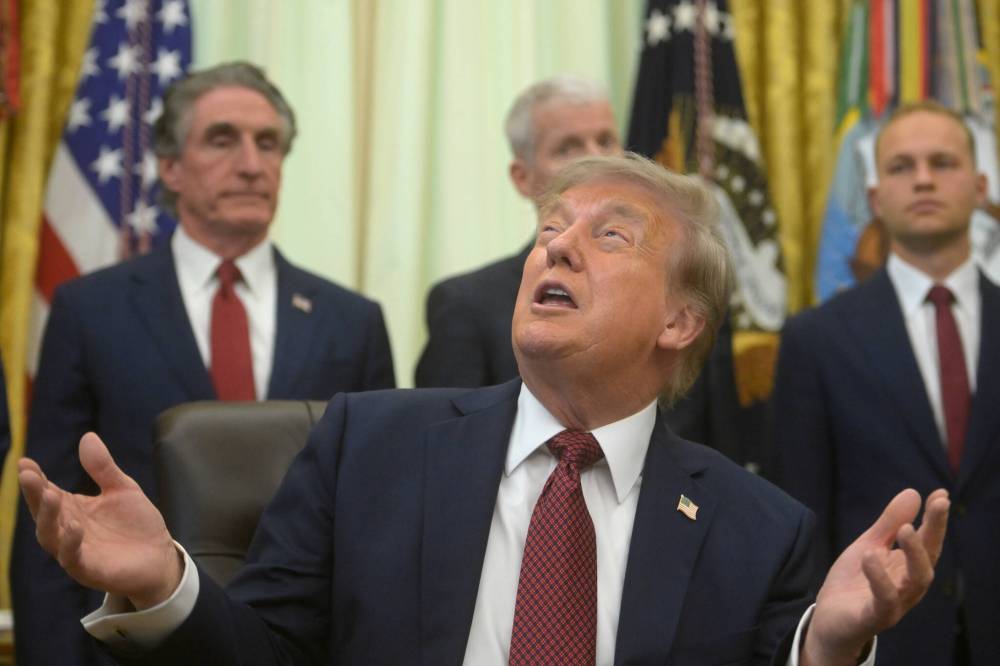
The Associated Press files
U.S. President Donald Trump — and many other politicians — depend on confusion, outrage, hyperbole and anger to keep the public off balance.
Unearthed by lexicologist Susie Dent, it speaks volumes about our times that it fits now. That we need to reach back hundreds of years to find the right word to adequately capture a contemporary civic reaction to what the hell is going on in politics and the world today.
The shocks come daily, amplified by partisan influencers and societal manipulators via social media to gain power or money or both.
The downside is obvious and omnipresent. A public square meting out rough justice to whoever or whatever is caught in the crosshairs. We are quickly drawn in — entertained — and just as quickly dismissed to make way for the latest volley and victim. Rising polarization, rude discourse, ruined reputations, and retreat from shared realities or truths is all left in its wake.
Paying attention to all this is bad enough. But there is something worse. Not paying attention — if there is too much of ‘everything, all at once’ that the implications of what is being said trickles away like water off a duck’s back. It never registers.
Ask yourself if you are blutterbunged or not by President Donald Trump’s latest ramblings about bombing Iran, imposing tariffs over wildfire smoke, or annexing Greenland?
Or another Russian missile attack on Kyiv or Israeli bombing in Gaza or Lebanon?
Or even a Canadian company president musing about giving rich people more votes than poor Canadians?
Each of these episodes generates massive online reactions followed by vicious cycles of counteractions more akin to circular firing squad behaviour than anything sensible or, once depleted, even germane to the original topic.
Saying is not doing. We know that. Or used to. More and more we think it is.
Our society is caught in an entrapment cycle of galloping after the latest online stupidity. Oscar Wilde famously described English country fox hunting as “the unspeakable in pursuit of the uneatable.” Nothing is “unspeakable” in today’s relentless pursuit for likes, followers, and engagement, with vapid, fleeting validation being the only prize at the close of the hunt.
In truth, it is all attention-seeking distraction. Unless it reveals underlying truths that merit deeper attention.
We don’t have to react to everything Trump says but we need to pay attention to what it might mean and react to that. Calling Canada the 51st state is clearly condescending. But it reflects a view of our country as a vassal, not a friend or ally.
It means we must prepare for American tariff policy designed to weaken us politically and economically, not just secure more advantageous trading arrangements for them. That is what we must counter with distinctly sovereign policy alternatives to make us resilient for what’s ahead, not just get a deal, any deal, with the United States.
Similarly, there is no real danger of Canadian voting rights being undermined. They are guaranteed by the Charter of Rights and Freedoms (Section 3, if you care to look). But that doesn’t mean all is well with our democracy, that it is perfectly stable and performing as well as it should.
Radical expressions of change can reflect underlying tensions that require tending. It is the outcomes our democracy is producing — or not producing — and the citizen satisfaction that goes with it that will ultimately determine its enduring value.

We have become inured to the sights and sounds of another day of protests about Israel and Palestine. It is a conflict Canada cannot control or influence on its own. So, we turn the page or ignore the protest signs. We tut-tut about violent language or shocking behaviour of those protesters; meanwhile, the conflict is corroding community trust, creating conflict here, not just the Middle East, that is seeping into our streets, homes, churches, and lives.
When politicians or advocates or influencers pile one wild, wilful declaration unto another it is deliberate to “flood the zone”, exhausting opponents or distracting citizens to avoid scrutiny. It is insidious because it is effective.
Responding to every single outrage with one of your own is now the established, perpetuating procedure. We hurl right back, thinking the danger is in letting it pass. But the real danger is not pausing to let it pass; rather it is not pausing to consider and address the deeper meanings and implications underneath.
Social media is modern day’s opium for the masses. It dulls the senses at best, destroys our faculty to think at worst. At this rate, what it takes to be blutterbunged back to reality may be too late, too dark and too dear to envisage.
David McLaughlin is a former clerk of the executive council and cabinet secretary in the Manitoba government.