

Teachers’ Idea Fund was always a bad idea
Advertisement
Read this article for free:
or
Already have an account? Log in here »
To continue reading, please subscribe:

Digital Subscription
One year of digital access for only $205*
- Enjoy unlimited reading on winnipegfreepress.com
- Read the E-Edition, our digital replica newspaper
- Access News Break, our award-winning app
- Play interactive puzzles
*First annual payment billed as $205.00 + GST for one year. This annual subscription will automatically renew at $233.00 + GST every 52 weeks (10% off the regular annual price of $259.35). Offer available to new and qualified returning subscribers only. Cancel any time.
To continue reading, please subscribe:
Add Free Press access to your Brandon Sun subscription for only an additional
$1 for the first 4 weeks*
- Enjoy unlimited reading on winnipegfreepress.com
- Read the E-Edition, our digital replica newspaper
- Access News Break, our award-winning app
- Play interactive puzzles
*Your next Brandon Sun subscription payment will increase by $1.00 and you will be charged $17.95 plus GST for four weeks. After four weeks, your payment will increase to $24.95 plus GST every four weeks.
Read unlimited articles for free today:
or
Already have an account? Log in here »
Hey there, time traveller!
This article was published 02/11/2024 (652 days ago), so information in it may no longer be current.
Last week, the Free Press reported that the NDP government is putting the Teachers’ Idea Fund on hold and that it will likely discontinue the program entirely given the differing priorities of this current government.
The Teachers’ Idea Fund, described as “an investment in the ideas and innovations of front-line teachers, staff and school leaders,” was initiated in 2021 under the previous Progressive-Conservative government. The government created the $25-million fund (to be spent over a five-year term), to which teachers could apply for up to $25,000 for new short-term projects.
Teachers who have received funding in the past are understandably disappointed to hear the news because it means they can no longer access funds for their initiatives. Teachers who have accessed these funds are obviously committed to offering rich programming to their students and are understandably frustrated at the loss of financial resources to support their good work.

MIKAELA MACKENZIE / WINNIPEG FREE PRESS Files
Jennifer Lamoureux, divisional teacher team leader for Indigenous Education in Seven Oaks, shows the new language app at Riverbend Community School in 2022. Ojibwa and other bilingual programs at Seven Oaks School Division are examples of programs the community deemed of interest, and which both need and deserve long-term funding.
However, the Teachers’ Idea Fund, although a means by which teachers could initiate or support enriching programs, is not based in a commitment to teachers or to public education. Rather, it was a means by which the government could create the illusion of supporting an education system it had been actively defunding. In fact, according to a recent report titled Funding Our Way: Rebalancing Revenues and Spending for a Fair and Prosperous Manitoba, the government’s tax cuts and rebates since 2016 have resulted in $1.6 billion of lost revenues annually, ultimately undermining our ability to fund social services, such as education.
Government reports indicate teachers applied to the fund for programs to support student mental health and wellness, literacy, Indigenous cultural programs, outdoor education and professional learning groups, to name a few. Yet, these are not merely “good ideas.” These are core elements of our curriculum and integral to a robust public education system. Teachers should not be forced to apply for money to support programs that should be fully funded in the first place.
Good teaching is not comprised of a random smattering of nifty tricks and neat ideas. Rather, good teaching is a thoughtfully orchestrated engagement of curriculum with carefully considered pedagogy designed intentionally for a diverse group of students in particular communities. This work cannot be funded by sprinkling relatively small sums of money on random projects while ignoring other teachers who do not have the time or energy to submit these applications. Funding schools in this way is like using a watering can on a farmer’s field, drizzling sparse resources to some, while starving others.

Importantly, robust funding does not mean all schools should look the same. All of our province’s schools should be funded to support the programs their teachers, communities and school boards determine to be in the best interest of that community. For example, the Ojibwe and Punjabi bilingual programs in the Seven Oaks School Division were initiated through the advocacy of the community and the support of the school board and are dependent on long-term funding. The long-standing and division-wide fiddling program in the Frontier School Division involves over 2,000 students from across communities in the province’s largest school division, again dependent on a financial commitment that funds educators, travel, instruments and so on.
There are teacher-initiated programs like the Omazinibii’geg Artist Collective, a school-based program led by a tireless teacher at Children of the Earth School in the Winnipeg School Division. Although this highly successful program has been running for years and has some funding, it also relies heavily on fundraising and funding from outside organizations. These programs are not just neat ideas, they are initiated at the grassroots, reflective of community priorities and cultural interests and aimed at providing enriching educational experiences to their communities’ students — and they all require and deserve sustained funding so the acorns of these good ideas are allowed to take root and grow into robust and long-standing oak trees. Without sustained financial commitments, good ideas will come and go, programs will flounder and schools and their students will be worse off.
The NDP government has signalled its interest in disbanding the Teachers’ Idea Fund in favour of priorities such as nutrition programs and smaller class sizes — important concerns of a public education system indeed. Yet, as Molly McCracken wrote in the Oct. 31 Free Press, the government’s ongoing tax cuts and rebates continue to erode our public services, creating greater inequities between the rich and the rest. We need our government to implement progressive tax reform that includes reversing tax cuts for the wealthy and for corporations making record-breaking profits, while also generating more money for reinvestment into social services such as education.
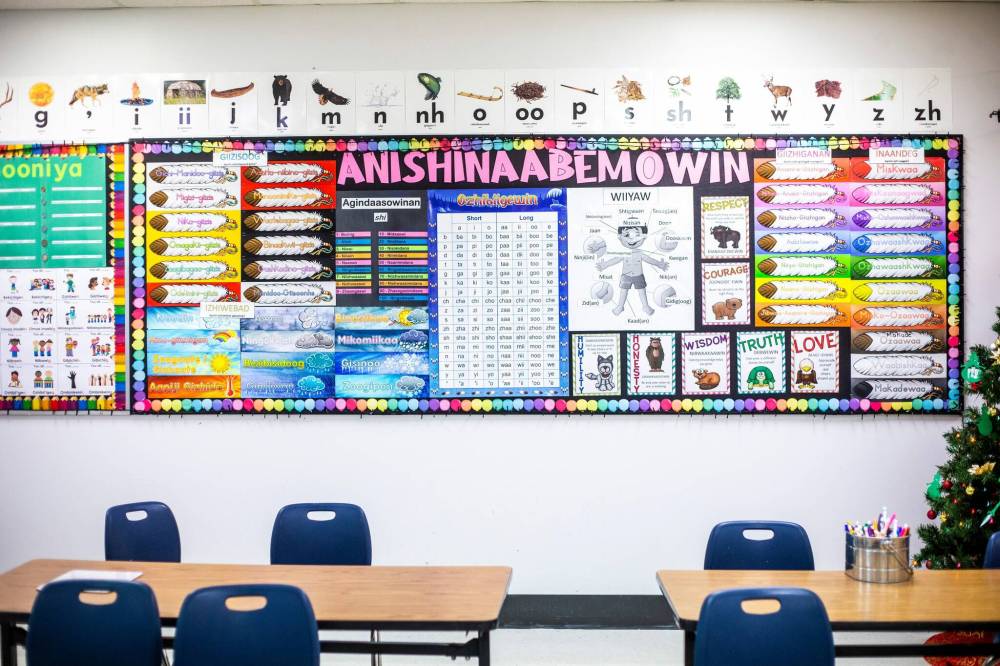
MIKAELA MACKENZIE / WINNIPEG FREE PRESS Ojibwa language posters at Riverbend Community School in Winnipeg on Monday, Dec. 12, 2022. For Maggie story. Winnipeg Free Press 2022.
This kind of progressive tax reform is badly needed so our education system can be consistently and adequately funded, so our students can have access to art, language, vocational, athletic and other academically-enriching programs. After all, education is an investment we all benefit from. Our teachers and school boards should be able to offer and sustain programs that are reflective of their communities’ and their students’ diverse interests, and that uphold the ideals of our public schools as rich and vibrant places our children deserve.
Melanie Janzen is a professor in the faculty of education at the University of Manitoba and the co-author of the recently published book, Feeling Obligated: Teaching in Neoliberal Times.