

Roe v. Wade’s undoing isn’t reason for Canadians to be smug. It’s reason for us to finally do better
Advertisement
Read this article for free:
or
Already have an account? Log in here »
To continue reading, please subscribe:

Digital Subscription
One year of digital access for only $205*
- Enjoy unlimited reading on winnipegfreepress.com
- Read the E-Edition, our digital replica newspaper
- Access News Break, our award-winning app
- Play interactive puzzles
*First annual payment billed as $205.00 + GST for one year. This annual subscription will automatically renew at $233.00 + GST every 52 weeks (10% off the regular annual price of $259.35). Offer available to new and qualified returning subscribers only. Cancel any time.
To continue reading, please subscribe:
Add Free Press access to your Brandon Sun subscription for only an additional
$1 for the first 4 weeks*
- Enjoy unlimited reading on winnipegfreepress.com
- Read the E-Edition, our digital replica newspaper
- Access News Break, our award-winning app
- Play interactive puzzles
*Your next Brandon Sun subscription payment will increase by $1.00 and you will be charged $17.95 plus GST for four weeks. After four weeks, your payment will increase to $24.95 plus GST every four weeks.
Read unlimited articles for free today:
or
Already have an account? Log in here »
Hey there, time traveller!
This article was published 04/05/2022 (1586 days ago), so information in it may no longer be current.
I once drove a friend to her abortion. She was in her early 20s and drinking a lot, with occasional suicidal thoughts. She had neither a lot of money nor a partner, and she had fallen behind on her birth control pills. She had been raised Catholic, and had wanted to be a mother her whole life. And while Catholicism hadn’t stuck with her, she thought hard about consequences, and hell.
But she wasn’t ready to be a mom. Her doctor made the appointment: the Vancouver clinic was sterile and cold and businesslike. She was quiet on the car ride back to her apartment; we picked her up some soup. The emotional recovery was harder than the physical one, but the safe, easy access to the procedure was so important. She had two kids in her early 30s, and she was so much healthier in every way; all three are thriving. Those became the happiest years of her life.
Lots of women have stories like that. This is about Roe v. Wade, of course, and the U.S. Supreme Court’s draft decision to strike down the landmark American abortion case. It is the culmination of decades of devoted, fanatical and sometimes violent organizing that started with defending segregation, and the wave of states set to criminalize abortion — sometimes with no exceptions for rape, or even ectopic pregnancies, and maybe dovetailing with the private tracking of women who cross state lines — will be regressive and cruel. It is a monstrous ruling, and will result in monstrous policy.
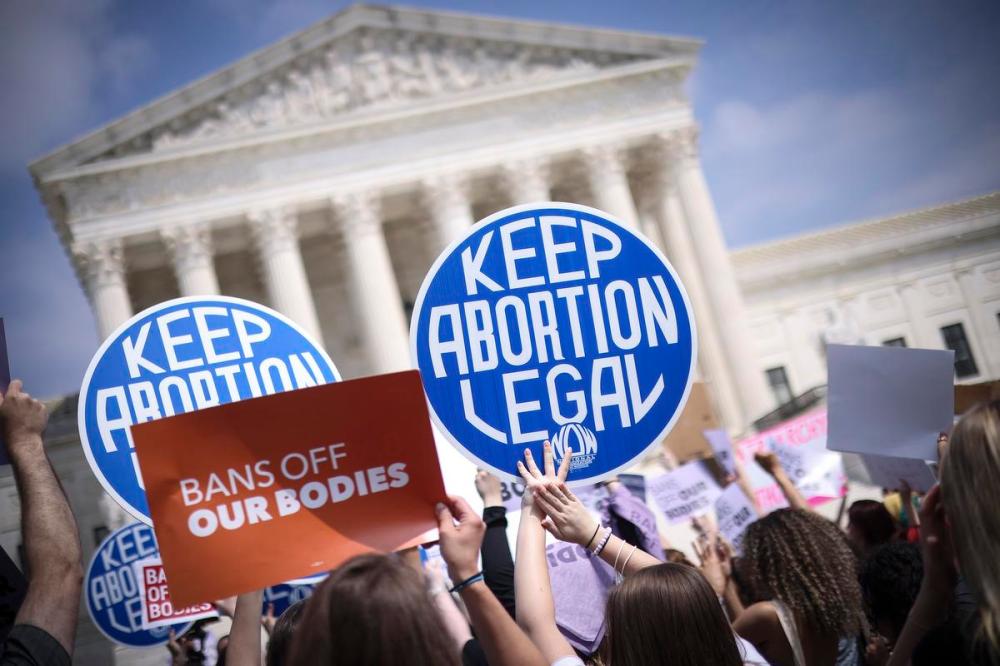
So naturally, Canada reacted. Some in Canada’s anti-abortion movement predicted a flowering of anti-abortion sentiment. The Bloc Québécois put forth a pro-choice motion that received a standing ovation from the federal Liberals, NDP and Greens while Conservatives largely sat silently; the Conservatives were initially ordered to keep quiet about Roe before a wave of statements that had to be carefully parsed were shuffled forward, with some more admirable than others.
There is clearly an anti-abortion constituency in Canada’s conservative movement, but this is a profoundly pro-choice country: polling shows that between three-quarters to fourth-fifths of Canadians describe themselves as such. Every politician assures voters that abortion is settled law in Canada, and when compared to the viciousness of the fight in the United States, it is easy to feel complacent. Our Supreme Court isn’t a partisan project, a federal criminalization of abortion isn’t likely, Leslyn Lewis won’t win the Conservative leadership this time, and while Doug Ford may have some anti-abortion friends in the caucus, he says he won’t change the laws in Ontario. We’re not the U.S. What a relief.
Now, that sort of trademark smugness is a dangerous way to measure Canada, and as the United States descends into a dark, lunatic phase of its history — and it could get very dark indeed — the gravitational pull, especially on Canada’s conservative movement, is likely to be even more tidal than it’s been. Measuring ourselves by the United States is a recipe for mediocrity, or much worse.
But in this case, the seismic demise of Roe v. Wade should force Canada to actually examine itself, and how it can be better.
“We’re sort of forced to look at ourselves and get educated about what our system is, what our problems are,” says Jocelyn Downie, a professional of law and medicine at Dalhousie University in Halifax. “And then we look for moments which are opportunities for reform of policy and practice.”
Downie was involved in the fight over Prince Edward Island’s abortion policy — until 2017 the province would not allow abortions but would pay for women to leave the island to undergo the procedure somewhere else. Like all bans or limitations of safe access to abortion, it favoured those with means.
“It was privileged,” says Downie. “Wealthy folk would just quote-unquote go shopping in Halifax or in New Brunswick, but it’s the 14-year-old girl who doesn’t have the money to get on the bus or can’t get away and all those woman with two children already and doesn’t have the childcare. That’s who it disproportionately harms, and we had to litigate to get that changed. Now, we did get a change, but … the people who are most harmed by this are rural women. That’s where access is a problem, right?”

And that’s what should change. New Brunswick recently banned funding for abortions outside three designated hospitals, which is why the federal Liberals included a plank in their 2021 election platform that threatened federal health transfer penalties unless access to reproductive health was ensured. But that would have to be robustly enforced, and likely isn’t enough in a patchwork sea of unequal access.
Ontario has abortion deserts that aren’t so functionally different from the situation in P.E.I., and is one of several provinces that allows Catholic hospitals to opt out of providing certain procedures. Manitoba, Saskatchewan, Nova Scotia, P.E.I., Nunavut and the Northwest Territories have no safe access zone legislation. Those jurisdictions, plus Newfoundland and the Yukon, all limit coverage to 16 weeks or fewer; the Supreme Court case that seems to have toppled Roe involved Mississippi banning abortions at 15 weeks. The threshold for fetal viability is approximately 24 weeks, which is the threshold only in Ontario, Quebec and British Columbia.
Canada’s abortion fight won’t go the way of the United States — though remember, 35 per cent of the population can deliver a majority, and our Conservative Party is becoming a convoy party, day by day — but this should be an opportunity to enact and codify better access to a critical medical procedure, and the widespread ability to perform it safely. The feds, the provinces, everyone. As Downie says, “We should hold ourselves up to our values, not to their contrast. And our values tell us we should be working to ensure access.”
That’s it. We can be better than just being better than the United States, and we will regrettably need to remember that more and more, as time goes on. Now would be an excellent time to prove it.
Bruce Arthur is a Toronto-based columnist for the Star. Follow him on Twitter: @bruce_arthur