

Province tabs $5M for potash mine growth
Loan announcement checks boxes for Port of Churchill potential, critical mineral production goals

Advertisement
Read this article for free:
or
Already have an account? Log in here »
To continue reading, please subscribe:
Digital Subscription
One year of digital access for only $1.44 a week*
- Enjoy unlimited reading on winnipegfreepress.com
- Read the E-Edition, our digital replica newspaper
- Access News Break, our award-winning app
- Play interactive puzzles
*Billed as $5.77 plus GST every four weeks. After 52 weeks, price increases to the regular rate of $19.95 plus GST every four weeks. Offer available to new and qualified returning subscribers only. Cancel any time.
To continue reading, please subscribe:
Add Free Press access to your Brandon Sun subscription for only an additional
$1 for the first 4 weeks*
- Enjoy unlimited reading on winnipegfreepress.com
- Read the E-Edition, our digital replica newspaper
- Access News Break, our award-winning app
- Play interactive puzzles
*Your next Brandon Sun subscription payment will increase by $1.00 and you will be charged $17.95 plus GST for four weeks. After four weeks, your payment will increase to $24.95 plus GST every four weeks.
Read unlimited articles for free today:
or
Already have an account? Log in here »
Manitoba’s only potash mine aims to more than double production after netting a $5 million loan from the province.
“When we have money, we drill more wells,” said Daymon Guillas, president of the Potash and Agri Development Corporation of Manitoba.
Last winter marked PADCOM’s first commercial production cycle. Workers at the Harrowby site, near Russell, mined roughly 10,000 tons of potash, a fertilizer component.
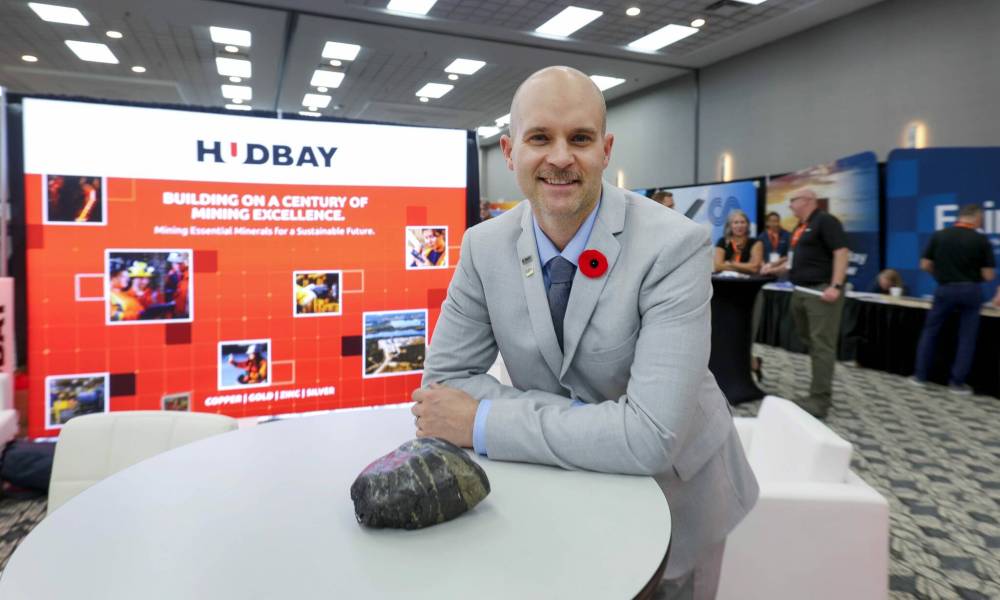
RUTH BONNEVILLE / FREE PRESS
Ashton Crone is president of the Mining Association of Manitoba Inc.
Government funding announced Monday will allow PADCOM to mine at least 22,000 tons this winter, Guillas said.
He aims to have a new well pairing built in December. PADCOM uses wells to pump potash out of a five-acre pond; it has one well pairing, but the pond can fit two more, according to Guillas.
Staff retrieve potash by pumping hot brine into the wells. The brine dissolves the potash. A solution saturated in potash comes out and crystallizes on the cool pond.
The incoming well pairing should produce about 22,000 tons of potash annually for 21 to 25 years, Guillas said.
Meantime, he’s working to also get $5 million from private investors. If done soon, PADCOM will build its third well pairing, also in December.
“We’ll get it,” Guillas said, at the Victoria Inn in Winnipeg, where he attended the Central Canada Mineral Exploration Convention.
“When people see the government’s interest live, it gives them the level of comfort that Manitoba is really in support of (this).”
PADCOM has promises for $5 million in new investment; it’s waiting on signed deals, Guillas said.
Mining Minister Jamie Moses made the loan announcement Monday morning, addressing a conference room full of industry professionals at the convention.
Moses noted PADCOM’s 2026 shipment through the Port of Churchill.
“We want to accelerate their growth,” he said.
The provincial government has set a goal of tripling critical mineral production in the next five years.
PADCOM could mine between 22,000 and 50,000 tons of potash this winter if all three well pairings are operational, Guillas said. The new wells would start mid-January; operations would end in April, he said.
He’s hoping to mine 250,000 tons annually in the next three years. “The demand is high,” Guillas said.
In February, Nutrien was projecting potash demand to grow for a fourth consecutive year, The Canadian Press reported at the time.
Guillas pointed to more desire for food — especially proteins — as a driver.
Saskatchewan is the world’s largest potash producer. In 2024, the province’s mines produced about 25 million tons of muriate of potash. It housed Canada’s only active mines.

RUTH BONNEVILLE / FREE PRESS
Daymon Guillas, president of PADCOM, says he is working to get an additional $5 million from private investors to expand the operation, located near Russell.
PADCOM shipped 20 tons of potash through the Port of Churchill this year. Guillas said he hopes to send a “couple thousand” tons next year.
Most of the company’s potash is bought and distributed by Saskatchewan-based Aberhart Farms. Manitoba and Saskatchewan farmers also pick up potash on site, to avoid shipping costs.
“We make the most money selling it closest to home,” Guillas said. “But we want to support Churchill and want to continue to build our clients in England, Belgium, France, Germany.”
Shipments through Churchill will increase as production does, Guillas said. He’s planning for more ponds and wells — and production of one million tons annually — in the future.
Guillas, the Manitoba Métis Federation and Canadian investors have spent $30 million on the potash mine to date, Guillas said.
The MMF is an equity shareholder. PADCOM has proposed to profit share with three regional First Nations communities, but hasn’t inked deals, Guillas said.
He didn’t provide other investors’ names but said they come from Brandon, Winnipeg, British Columbia and Ontario. They’re in similar businesses or are friends, Guillas said.
Manitoba’s potash mine was highlighted at the Canada Investment Summit in Toronto in September.

Guillas said he sees “potential” with three Canadian investors, though nothing has been signed. He’s also talking with federal and provincial governments, he said.
John Morris, co-director of the Mining Association of Manitoba Inc., called the $5 million loan for PADCOM “fantastic news.”
“What that will do is create even greater interest internationally,” Morris said. “That is going to be a very big change for PADCOM, in terms of their operation.”
PADCOM plans to place four to five per cent of its net profits into a social economic development fund for community life projects and small-business loans, Guillas said.
gabrielle.piche@winnipegfreepress.com
Gabby is a big fan of people, writing and learning. She graduated from Red River College’s Creative Communications program in the spring of 2020.
Our newsroom depends on a growing audience of readers to power our journalism. If you are not a paid reader, please consider becoming a subscriber.
Our newsroom depends on its audience of readers to power our journalism. Thank you for your support.
Advertisement Advertise With Us
Advertisement Advertise With Us