

Building generational equity
Habitat for Humanity increasingly helps growing swath of middle-income Canadians in larger markets
Advertisement
Read this article for free:
or
Already have an account? Log in here »
To continue reading, please subscribe:
Digital Subscription
One year of digital access for only $1.44 a week*
- Enjoy unlimited reading on winnipegfreepress.com
- Read the E-Edition, our digital replica newspaper
- Access News Break, our award-winning app
- Play interactive puzzles
*Billed as $5.77 plus GST every four weeks. After 52 weeks, price increases to the regular rate of $19.95 plus GST every four weeks. Offer available to new and qualified returning subscribers only. Cancel any time.
To continue reading, please subscribe:
Add Free Press access to your Brandon Sun subscription for only an additional
$1 for the first 4 weeks*
- Enjoy unlimited reading on winnipegfreepress.com
- Read the E-Edition, our digital replica newspaper
- Access News Break, our award-winning app
- Play interactive puzzles
*Your next Brandon Sun subscription payment will increase by $1.00 and you will be charged $17.95 plus GST for four weeks. After four weeks, your payment will increase to $24.95 plus GST every four weeks.
Read unlimited articles for free today:
or
Already have an account? Log in here »
Ayobimpe Omisore is a Winnipeg single mother of four who knows all too well about working just to make the rent.
A little more than a year ago, she was struggling to pay $2,400 a month for a two-bedroom unit in St. Norbert.
She picked up extra shifts whenever she could as a health-care aide to keep up with the costs.
Habitat for Humanity
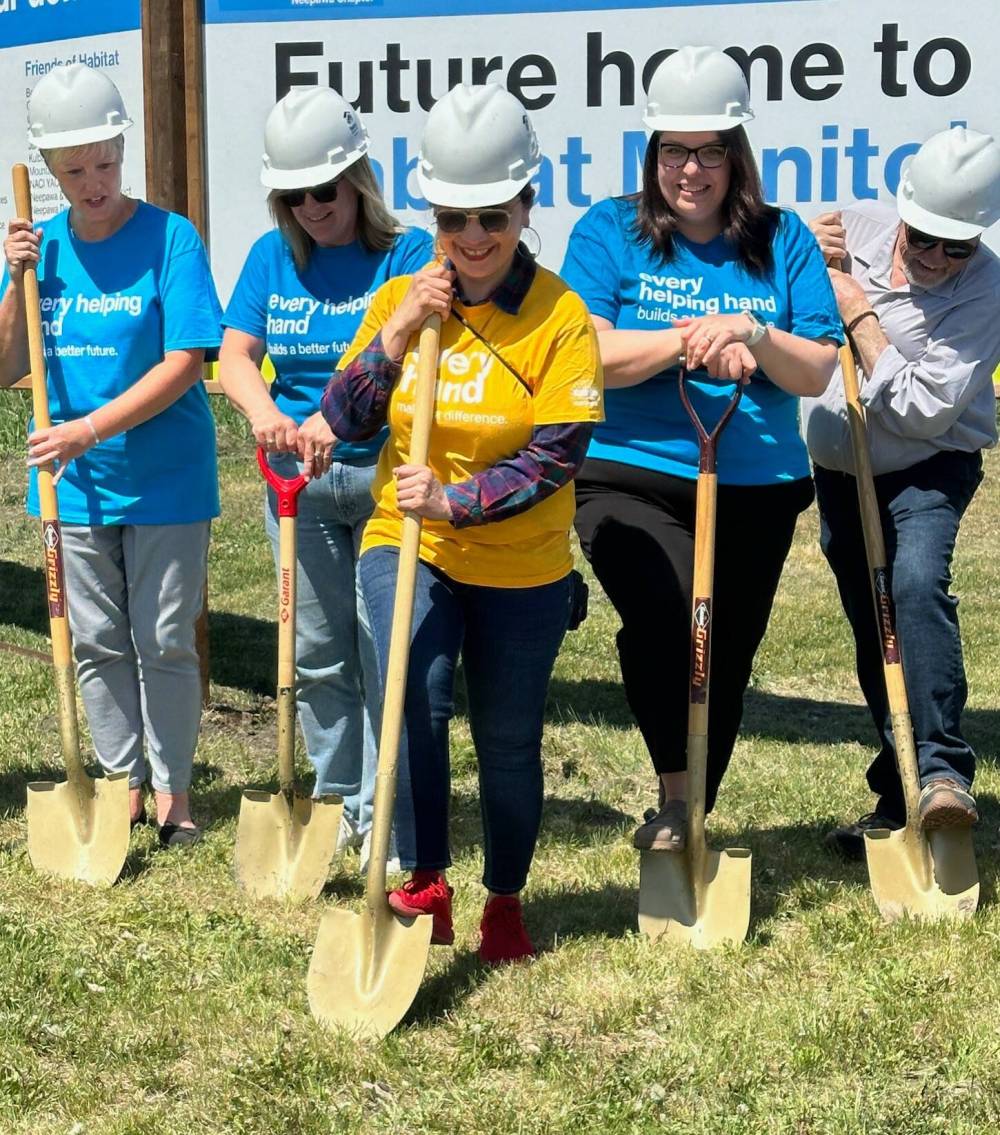
Ritchel Quezon (centre) pushes a shovel into the grass at the site of her future Habitat for Humanity home in Neepawa. Habitat helps dozens of local families each year reach homeownership.
“I was lamenting about it at work one day, and a colleague said, ‘If you’re paying this much on rent, I think you can afford a mortgage,’” says Omisore, who came to Canada four years ago from Nigeria where she worked as a logistics manager.
Her co-worker mentioned Habitat for Humanity and how it would help her purchase a home by providing the down payment (paid for by her with 500 hours of sweat equity) and mortgage payments tailored to 27 per cent of her income for 15 years.
That was in July last year.
Within three months, she had completed the hours — working at Habitat’s warehouse. And by December, her family was in a townhome all their own. “I’m paying half of what I used to pay before,” Omisore says.
She and her family are among the dozens of lower-income Manitoba families Habitat helps become homeowners each year.
The need has always been more than what it can provide, and demand keeps growing despite Winnipeg’s relatively affordable housing, says Jamie Hall, CEO of Habitat Manitoba.
“I pray for the day that we’re running out of families that we can serve and we have to go start looking for them,” he says, noting Habitat never has to solicit its services.
Nor does it keep a waiting list, which would be lengthy.
It always has several applications for each new build or renovated home project it undertakes. This year, it has more than 30 projects, he adds.
Winnipeg is among the few remaining large cities where Habitat continues to serve strictly low-income families.
High housing costs plague major markets like Toronto and Vancouver, and a recent study by Habitat for Humanity International shows many non-homeowning Canadians are losing hope. It found Canada ranks last among 22 nations for the percentage of non-homeowners surveyed who believe they will own a home. Just 40 per cent of respondents here reported they expect to ever own a home.
“That’s a real challenge when Canada has the worst pessimism among nations,” says Pedro Barata, president and CEO for Habitat for Humanity Canada.
He further points to Census data from 2011 and 2021 showing declining homeownership rates among younger Canadians, largely driven by soaring home prices.
“Traditionally, we have served a more (economically) modest segment of the population because that’s where the need really was.”
Barata adds that has changed in markets like Toronto, where the average aggregate price of a home was a little more than $1 million in September, down almost 17 per cent from the 2022 peak. Despite the decrease, housing inflation there has been very high. The average price was about $245,000 in 2000, for example, reflecting roughly a 308 per cent increase by 2026.
Habitat is “evolving” to meet the need, helping more lower, middle-class applicants in larger cities, he adds.
“Now we serve more families that are in the workforce family range,” he says, noting wages in Canada have not kept pace with housing costs.
“If you are in your 30s and under, don’t have wealthy parents, and are having a hard time finding stable, well-paying employment, how in the world are you going to get a down payment and pay a large mortgage?”
Winnipeg — like other mid-sized cities — remains an affordability outlier. The average price of a detached home in September was about $467,000.
While significantly lower — especially given Toronto’s figure includes its slumping condominium market — housing in here has still seen price inflation, Hall says.
“I bought my first house in 1994 for $80,000, and that same house now is probably selling for over $300,000,” he says, adding he recently helped his daughter with a down payment for a home and co-signed on the mortgage.
He points to having “generational equity” in his home to tap into to help his adult child, but not all would-be first-time buyers have that financial backing.
Hall adds he worries many young families will miss out on the fundamental social and economic benefits of home ownership.
Indeed, ownership offers many such benefits in our society. Hall points to a Deloitte study for Habitat from last year showing that homeowning families note better physical (73 per cent) and mental health (79 per cent); 41 per cent of adults can get additional education, and 51 per cent of families state they are financially more secure.
“Home ownership allows a family to invest in themselves and do better.”
The Habitat for Humanity model helps families gain “generational equity” that provides a cascade of economic and social benefits.
“If you work hard, your kids will be better off than you are because of the generational equity.”
He further notes individuals are expected to have enough equity after 15 years to get a conventional mortgage and buy out Habitat, repaying the original down payment, so it can use those funds to help more families.
For Omisore, owning a home can be summed up in one word: relief.
“I’m not having to pick extra shifts all the time,” she says.

Now, she can spend more time with her children, helping them with homework and cooking YouTube recipes with them. Omisore also back in school, taking nursing.
The Habitat program has allowed her to own an affordable home, but it has given here much more:
“It gives me more time … to live,” she says. “It’s not just work, work, work anymore to make rent.”
Joel Schlesinger is a Winnipeg-based freelance journalist
joelschles@gmail.com