

Multiple factors add up to difficult harvest

Advertisement
Read this article for free:
or
Already have an account? Log in here »
To continue reading, please subscribe:

Digital Subscription
One year of digital access for only $205*
- Enjoy unlimited reading on winnipegfreepress.com
- Read the E-Edition, our digital replica newspaper
- Access News Break, our award-winning app
- Play interactive puzzles
*First annual payment billed as $205.00 + GST for one year. This annual subscription will automatically renew at $233.00 + GST every 52 weeks (10% off the regular annual price of $259.35). Offer available to new and qualified returning subscribers only. Cancel any time.
To continue reading, please subscribe:
Add Free Press access to your Brandon Sun subscription for only an additional
$1 for the first 4 weeks*
- Enjoy unlimited reading on winnipegfreepress.com
- Read the E-Edition, our digital replica newspaper
- Access News Break, our award-winning app
- Play interactive puzzles
*Your next Brandon Sun subscription payment will increase by $1.00 and you will be charged $17.95 plus GST for four weeks. After four weeks, your payment will increase to $24.95 plus GST every four weeks.
Read unlimited articles for free today:
or
Already have an account? Log in here »
Earlier this month, farmers sent agriculture publications some heartbreaking photos showing how heavy rains across the Prairies had pummelled a promising harvest.
An idled combine up to its axles in a flooded Saskatchewan field, straw bales surrounded by water and field equipment stranded on the far side of a washed-out section told the obvious story.
The Sept. 6-7 event was just the latest in a series of heavy rainfall events that have plagued this year’s growing season. Similar deluges hit different regions July 15-17, Aug. 14, and Aug. 31 — some of which were accompanied by tornadoes.
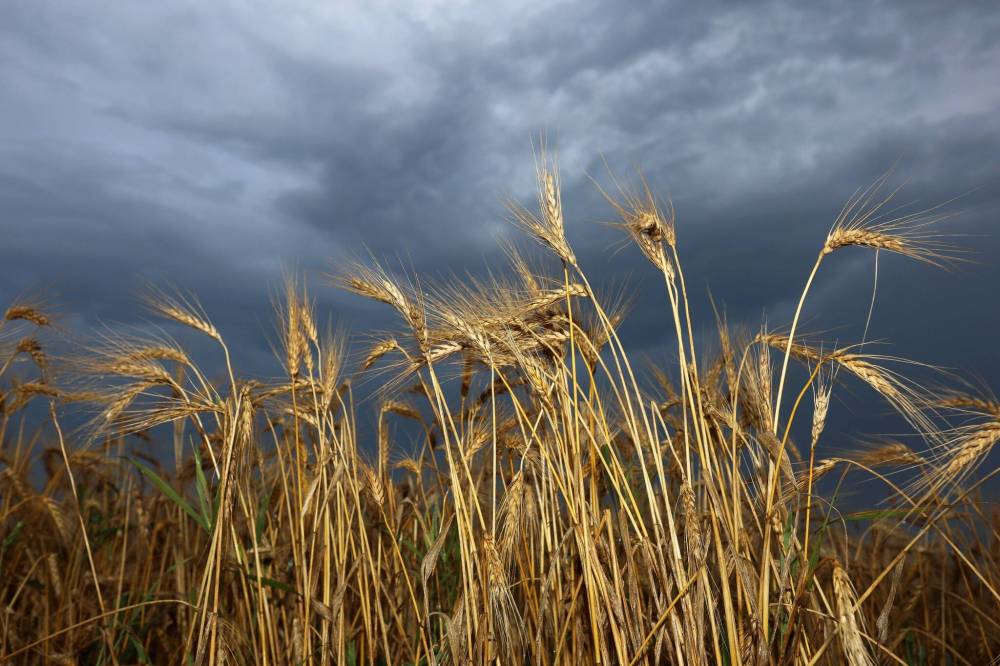
Tim Smith / Brandon Sun files
Storm clouds hover over a crop in the Westman region last month. A series of deluges over the past four weeks has dogged harvest time.
“What’s made this season challenging is the intensity of these rainfalls,” said Manitoba Agriculture ag meteorology specialist Alison Sass as she reviewed the summer’s weather patterns on an extension webinar.
Here’s just one example: “Our Portage station received 97 millimetres over those two days (Sept. 6-7). However, 84 mm fell in just one hour,” she said.
Between the rains came another day of extreme winds July 29, when several locations recorded wind speeds of between 100 to 133 km/h.
This is all consistent with reports offering the latest updates on changing climate. A report from the UN Environmental Programme and the federal government’s Canada’s Changing Climate Report both indicate the world is on track to exceed the previous thresholds for global warming — and Canada is warming at twice the global rate on average.
For the Prairies, this points to more frequent and longer droughts. But the federal report also says when the rain comes, it is more likely to come in torrents.
Whether or not farmers buy into the whole idea of climate change, there is no escaping the fact they are on the front lines of whatever the weather throws at us.
A hellish tale is unfolding as they wait for conditions dry enough to get back to collecting what are now soggy, downgraded crops. Less than one-third of the province’s harvest had been completed as of this week.
The process from here on will be a slog.
Crops that have been toppled and twisted by downpours and the accompanying winds are harder to pick up with harvesting equipment. The seed pods and heads are more apt to shatter, dropping the seeds to the ground where they are irretrievable.
More farmers have been equipping combines with attachments so they can cut and harvest their standing crop in one pass. But conditions this year have forced many to pull out their swathers to cut the crop into windrows before combining it.
That takes more time and manpower. The seeds lying in rows are prone to sprouting and spoilage in warm, humid conditions.
Provincial agricultural specialist Lionel Kaskiw said there has been a surprising amount of sprouting already. “I think we’re going to be seeing some losses in all the crops now, whether it’s canola, whether it’s wheat, barley, even flax.”
The shorter days and cooler temperatures of autumn slow drying in the field, so farmers are more likely to harvest crops before they are completely ripe and pay the additional expense of finishing them post-harvest with heated dryers or aeration bins.

Producers without this equipment must rely on custom operators or neighbours willing to rent out some of their drying capacity. The province has developed resource materials to help producers decide how much it costs to install their own equipment versus how much they should pay to use someone else’s.
The right answer depends on how often farmers expect to need artificial drying. Installation can cost anywhere between $100,000 and $500,000, depending on the scale and fuel source. Plus, there is the cost of additional handling and operation, depending on moisture levels and external temperatures.
It’s a significant capital and operational expense during a period of heightened risk on the farm. But that must be balanced against the cost of a crop being downgraded or worse, turned away from the grain elevator — not to mention having an option that reduces frustration and worry during a difficult harvest.
How can you put a price on that?
Laura Rance-Unger is editor emeritus for Glacier FarmMedia. She can be reached at lrance@farmmedia.com
Laura Rance is editorial director at Farm Business Communications.
Our newsroom depends on a growing audience of readers to power our journalism. If you are not a paid reader, please consider becoming a subscriber.
Our newsroom depends on its audience of readers to power our journalism. Thank you for your support.
Laura Rance is editorial director at Farm Business Communications.
Our newsroom depends on a growing audience of readers to power our journalism. If you are not a paid reader, please consider becoming a subscriber.
Our newsroom depends on its audience of readers to power our journalism. Thank you for your support.
Advertisement Advertise With Us
Advertisement Advertise With Us