Oldest DNA reveals life in Greenland 2 million years ago

Advertisement

Advertise with us

NEW YORK (AP) — Scientists discovered the oldest known DNA and used it to reveal what life was like 2 million years ago in the northern tip of Greenland. Today, it’s a barren Arctic desert, but back then it was a lush landscape of trees and vegetation with an array of animals, even the now extinct mastodon.

Read this article for free:


By clicking the button above, an account will be created and you will begin to receive some of our recommended newsletters. You may opt out of any newsletter by visiting your Email and Communication Preferences page or by clicking "unsubscribe" at the bottom of any email.

or

Already have an account? Log in here »

To continue reading, please subscribe:

Digital Subscription

One year of digital access for only $1.44 a week*

  • Enjoy unlimited reading on winnipegfreepress.com
  • Read the E-Edition, our digital replica newspaper
  • Access News Break, our award-winning app
  • Play interactive puzzles

*Billed as $5.77 plus GST every four weeks. After 52 weeks, price increases to the regular rate of $19.95 plus GST every four weeks. Offer available to new and qualified returning subscribers only. Cancel any time.

To continue reading, please subscribe:

Add Free Press access to your Brandon Sun subscription for only an additional

$1 for the first 4 weeks*

  • Enjoy unlimited reading on winnipegfreepress.com
  • Read the E-Edition, our digital replica newspaper
  • Access News Break, our award-winning app
  • Play interactive puzzles
Start now

*Your next Brandon Sun subscription payment will increase by $1.00 and you will be charged $17.95 plus GST for four weeks. After four weeks, your payment will increase to $24.95 plus GST every four weeks.

Hey there, time traveller!
This article was published 07/12/2022 (1422 days ago), so information in it may no longer be current.

NEW YORK (AP) — Scientists discovered the oldest known DNA and used it to reveal what life was like 2 million years ago in the northern tip of Greenland. Today, it’s a barren Arctic desert, but back then it was a lush landscape of trees and vegetation with an array of animals, even the now extinct mastodon.

“The study opens the door into a past that has basically been lost,” said lead author Kurt Kjær, a geologist and glacier expert at the University of Copenhagen.

With animal fossils hard to come by, the researchers extracted environmental DNA, also known as eDNA, from soil samples. This is the genetic material that organisms shed into their surroundings — for example, through hair, waste, spit or decomposing carcasses.
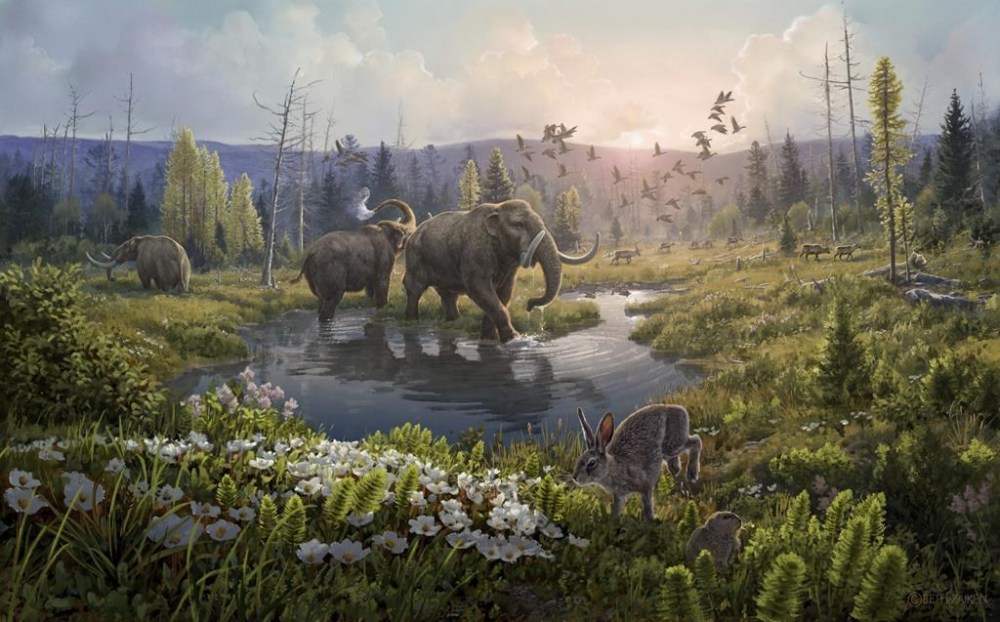
This illustration provided by researchers depicts Kap Kobenhavn, Greenland, two million years ago, when the temperature was significantly warmer than northernmost Greenland today. Scientists have analyzed 2-million-year-old DNA extracted from dirt samples in the area, revealing an ancient ecosystem unlike anything seen on Earth today, including traces of mastodons and horseshoe crabs roaming the Arctic. (Beth Zaiken via AP)

Studying really old DNA can be a challenge because the genetic material breaks down over time, leaving scientists with only tiny fragments.

But with the latest technology, researchers were able to get genetic information out of the small, damaged bits of DNA, explained senior author Eske Willerslev, a geneticist at the University of Cambridge. In their study, published Wednesday in the journal Nature, they compared the DNA to that of different species, looking for matches.

The samples came from a sediment deposit called the Kap København formation in Peary Land. Today, the area is a polar desert, Kjær said.

But millions of years ago, this region was undergoing a period of intense climate change that sent temperatures up, Willerslev said. Sediment likely built up for tens of thousands of years at the site before the climate cooled and cemented the finds into permafrost.

The cold environment would help preserve the delicate bits of DNA — until scientists came along and drilled the samples out, beginning in 2006.

During the region’s warm period, when average temperatures were 20 to 34 degrees Fahrenheit (11 to 19 degrees Celsius) higher than today, the area was filled with an unusual array of plant and animal life, the researchers reported. The DNA fragments suggest a mix of Arctic plants, like birch trees and willow shrubs, with ones that usually prefer warmer climates, like firs and cedars.

The DNA also showed traces of animals including geese, hares, reindeer and lemmings. Previously, a dung beetle and some hare remains had been the only signs of animal life at the site, Willerslev said.

One big surprise was finding DNA from the mastodon, an extinct species that looks like a mix between an elephant and a mammoth, Kjær said.
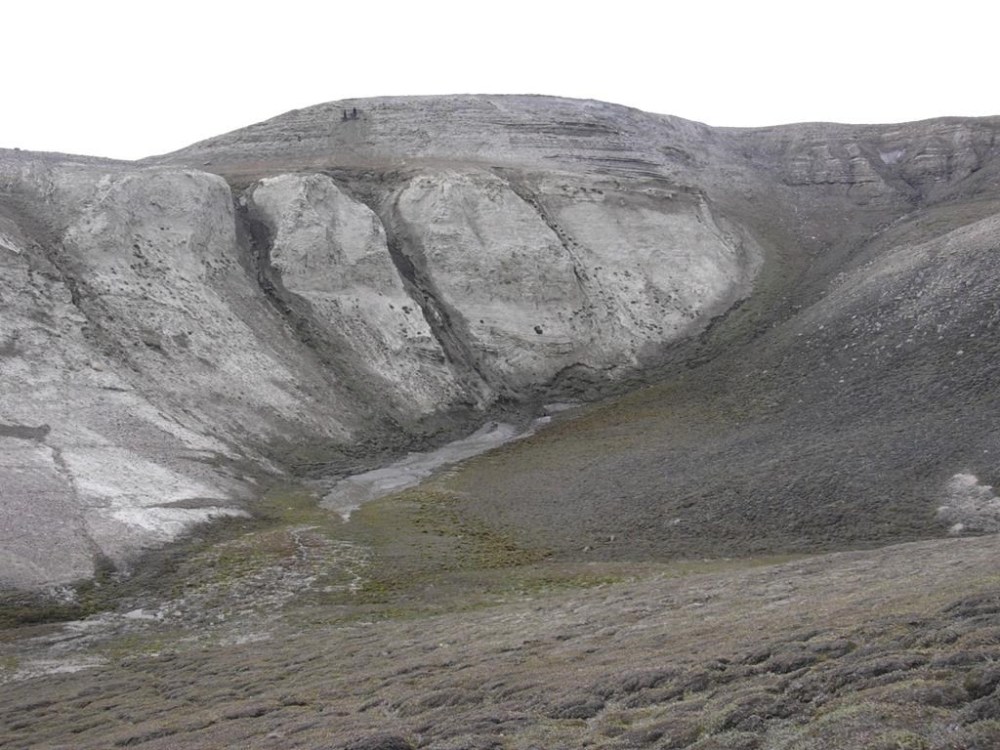
This 2006 photo provided by researchers shows geological formations at Kap Kobenhavn, Greenland. At the bottom of the section, the deep marine deposits are overlain by the coastal deposits of fine sandy material. The two people at the top are sampling for environmental DNA. Scientists have analyzed 2-million-year-old DNA extracted from dirt samples in the area, revealing an ancient ecosystem unlike anything seen on Earth today, including traces of mastodons and horseshoe crabs roaming the Arctic. (Svend Funder via AP)

Many mastodon fossils have previously been found from temperate forests in North America. That’s an ocean away from Greenland, and much farther south, Willerslev said.

“I wouldn’t have, in a million years, expected to find mastodons in northern Greenland,” said Love Dalen, a researcher in evolutionary genomics at Stockholm University who was not involved in the study.

Because the sediment built up in the mouth of a fjord, researchers were also able to get clues about marine life from this time period. The DNA suggests horseshoe crabs and green algae lived in the area — meaning the nearby waters were likely much warmer back then, Kjær said.

By pulling dozens of species out of just a few sediment samples, the study highlights some of eDNA’s advantages, said Benjamin Vernot, an ancient DNA researcher at Germany’s Max Planck Institute for Evolutionary Anthropology who was not involved in the study.

“You really get a broader picture of the ecosystem at a particular time,” Vernot said. “You don’t have to go and find this piece of wood to study this plant, and this bone to study this mammoth.”

Based on the data available, it’s hard to say for sure whether these species truly lived side by side, or if the DNA was mixed together from different parts of the landscape, said Laura Epp, an eDNA expert at Germany’s University of Konstanz who was not involved in the study.

But Epp said this kind of DNA research is valuable to show “hidden diversity” in ancient landscapes.

Willerslev believes that because these plants and animals survived during a time of dramatic climate change, their DNA could offer a “genetic roadmap” to help us adapt to current warming.
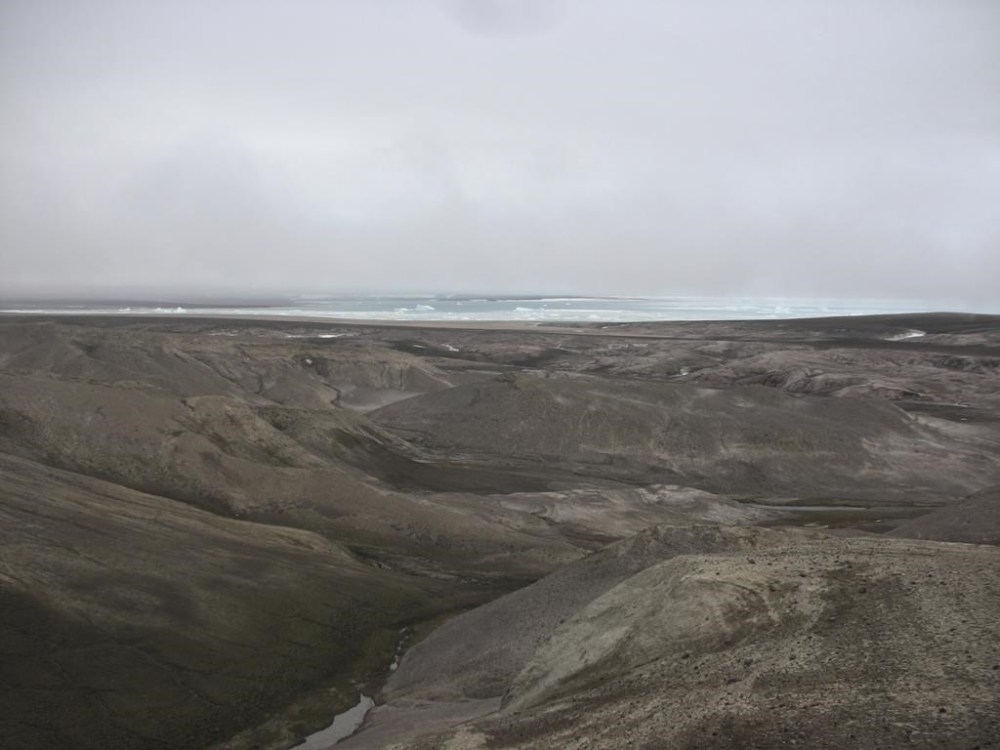
This 2006 photo provided by researchers shows the landscape at Kap Kobenhavn, Greenland. The many hills have been formed by rivers running towards the coast. Scientists have analyzed 2-million-year-old DNA extracted from dirt samples in the area, revealing an ancient ecosystem unlike anything seen on Earth today, including traces of mastodons and horseshoe crabs roaming the Arctic. (Kurt H. Kjaer via AP)

Stockholm University’s Dalen expects ancient DNA research to keep pushing deeper into the past. He worked on the study that previously held the “oldest DNA” record, from a mammoth tooth around a million years old.

“I wouldn’t be surprised if you can go at least one or perhaps a few million years further back, assuming you can find the right samples,” Dalen said.

———

The Associated Press Health and Science Department receives support from the Howard Hughes Medical Institute’s Science and Educational Media Group. The AP is solely responsible for all content.

Report Error Submit a Tip

More Stories

2026 Winnipeg election results: Mayor and council

1 minute read Preview

2026 Winnipeg election results: Mayor and council

1 minute read Thursday, Oct. 22, 2026

Complete results for the 2022 election races for Winnipeg mayor and city councillors.

Read
Thursday, Oct. 22, 2026

Indigenous-, newcomer-focused job fair puts opportunity in spotlight

Gabrielle Piché 3 minute read Tuesday, Oct. 27, 2026

Canadian Armed Forces pamphlets grazed the side of Serena Valiquette’s ribbon skirt, as the Grade 9 student clutched the handouts tight.

“When I get to age, I’ll probably apply,” said Serena, 14, joining pockets of students hopping from booth to booth — City of Winnipeg here, Manitoba Public Insurance there — at a job fair in Winnipeg on Tuesday.

The job seekers, present and future, were largely Indigenous and newcomers. It was the demographic organizer Clayton Sandy aimed to attract.

“We have the ability to open doors for young people,” Sandy said. “This is one of the ways we use.”

Oldest DNA reveals life in Greenland 2 million years ago

Maddie Burakoff, The Associated Press 6 minute read Preview

Oldest DNA reveals life in Greenland 2 million years ago

Maddie Burakoff, The Associated Press 6 minute read Friday, Dec. 9, 2022

NEW YORK (AP) — Scientists discovered the oldest known DNA and used it to reveal what life was like 2 million years ago in the northern tip of Greenland. Today, it’s a barren Arctic desert, but back then it was a lush landscape of trees and vegetation with an array of animals, even the now extinct mastodon.

“The study opens the door into a past that has basically been lost,” said lead author Kurt Kjær, a geologist and glacier expert at the University of Copenhagen.

With animal fossils hard to come by, the researchers extracted environmental DNA, also known as eDNA, from soil samples. This is the genetic material that organisms shed into their surroundings — for example, through hair, waste, spit or decomposing carcasses.

Studying really old DNA can be a challenge because the genetic material breaks down over time, leaving scientists with only tiny fragments.

Read
Friday, Dec. 9, 2022

City rec facilities crumbling

Ryan Thorpe 7 minute read Preview

City rec facilities crumbling

Ryan Thorpe 7 minute read Monday, Oct. 22, 2018

Throughout Winnipeg, decades-old community assets — pools, arenas and recreation and leisure centres — are deteriorating so quickly that service disruptions are inevitable.

Meanwhile, the city’s community services department, which is responsible for managing those assets, operates with an annual deficit of roughly $80 million, meaning there are scant resources to do little more than bail water on a sinking ship.

Soon, Winnipeggers will have a choice: fewer community services or higher costs.

“It poses a huge challenge because we have very limited dollars that we have to invest in our existing facilities. We also have growing demands for new amenities in new areas. We have to be very strategic,” said Ken McKim, manager of asset management for the department.

Read
Monday, Oct. 22, 2018

Waiting for Cormier verdict the ‘calm before the storm’

Katie May 6 minute read Preview

Waiting for Cormier verdict the ‘calm before the storm’

Katie May 6 minute read Thursday, Feb. 22, 2018

As the jury room door closed behind the seven women and four men who are now deliberating on the evidence against Tina Fontaine’s accused killer, Thelma Favel rose from the chair she’s occupied for most of Raymond Cormier’s second-degree murder trial.

Almost every day over the past three weeks, Favel, the woman who raised 15-year-old Tina, has sat right up front, directly across from the jury box, listening, sobbing and soaking in disturbing details of the teen’s last days that have come to light over the course of Cormier’s second-degree murder trial.

On Wednesday afternoon, after Court of Queen’s Bench Chief Justice Glenn Joyal instructed the jury and sent them off to be sequestered until they decide whether 56-year-old Raymond Cormier is guilty of killing Tina, Favel got up and hugged Crown prosecutor Breta Passler. It was one of many moments, this one shielded from jurors, that have long since proven the emotional impact of the case and the lasting power of Tina’s legacy.

Tina’s death sparked a public outcry that renewed calls for a national inquiry into disproportionately high rates of missing and murdered Indigenous women and girls across Canada, and the criminal trial for the man accused of killing her hasn’t happened in a vacuum.

Read
Thursday, Feb. 22, 2018

Multi-year budget to force councillors, bureaucrats to focus on the big picture

Aldo Santin 12 minute read Preview

Multi-year budget to force councillors, bureaucrats to focus on the big picture

Aldo Santin 12 minute read Tuesday, Feb. 26, 2019

City hall is putting the final touches on the 2019 preliminary budget -- but the real tough job will start after that.

The city is committed to developing a four-year budget beginning with 2020, and having it in place by the end of this year.

It's a process that is filled with uncertainties, trying to balance four successive annual budgets at the same time, using assumptions on revenues and expenses that can change without notice: a provincial government that has frozen funding to city hall at 2016 levels and is reluctant to disclose annual funding commitments or share in unexpected revenues; erratic fuel prices; a possible change in government in Ottawa, which could bring new spending priorities. And in the middle of that four-year span, another civic election where new members of council may have other priorities than those laid out by the current crop of office holders.

Municipal governments across Manitoba are required to approve their annual operating and capital budgets by the end of March each year. But the criticism of decision-making at city hall has been that all the decisions are made on a year-to-year basis, keeping voters happy with an eye on the next election.

Read
Tuesday, Feb. 26, 2019