A look at how some historic Canadian hurricanes compare with Fiona

Advertisement

Advertise with us

As people in Atlantic Canada prepared Friday for the imminent arrival of Fiona, some weather experts were studying past hurricanes and storms to gain insight on what could be coming.

Read this article for free:


or

Already have an account? Log in here »

To continue reading, please subscribe:

Subscribe and receive a limited-edition Free Press branded hat or tote.

Digital Subscription

One year of digital access for only $205*

  • Enjoy unlimited reading on winnipegfreepress.com
  • Read the E-Edition, our digital replica newspaper
  • Access News Break, our award-winning app
  • Play interactive puzzles

*First annual payment billed as $205.00 + GST for one year. This annual subscription will automatically renew at $233.00 + GST every 52 weeks (10% off the regular annual price of $259.35). Offer available to new and qualified returning subscribers only. Cancel any time.

To continue reading, please subscribe:

Add Free Press access to your Brandon Sun subscription for only an additional

$1 for the first 4 weeks*

  • Enjoy unlimited reading on winnipegfreepress.com
  • Read the E-Edition, our digital replica newspaper
  • Access News Break, our award-winning app
  • Play interactive puzzles
Start now

*Your next Brandon Sun subscription payment will increase by $1.00 and you will be charged $17.95 plus GST for four weeks. After four weeks, your payment will increase to $24.95 plus GST every four weeks.

Hey there, time traveller!
This article was published 24/09/2022 (1475 days ago), so information in it may no longer be current.

As people in Atlantic Canada prepared Friday for the imminent arrival of Fiona, some weather experts were studying past hurricanes and storms to gain insight on what could be coming.

Chris Fogarty, lead meteorologist and program manager at the Canadian Hurricane Centre, said meteorologists often like to look back at historical events when preparing forecasts.

“We want to see if we can compare (an incoming hurricane) with past events to give people an idea of what we’re going to see,” said Fogarty.
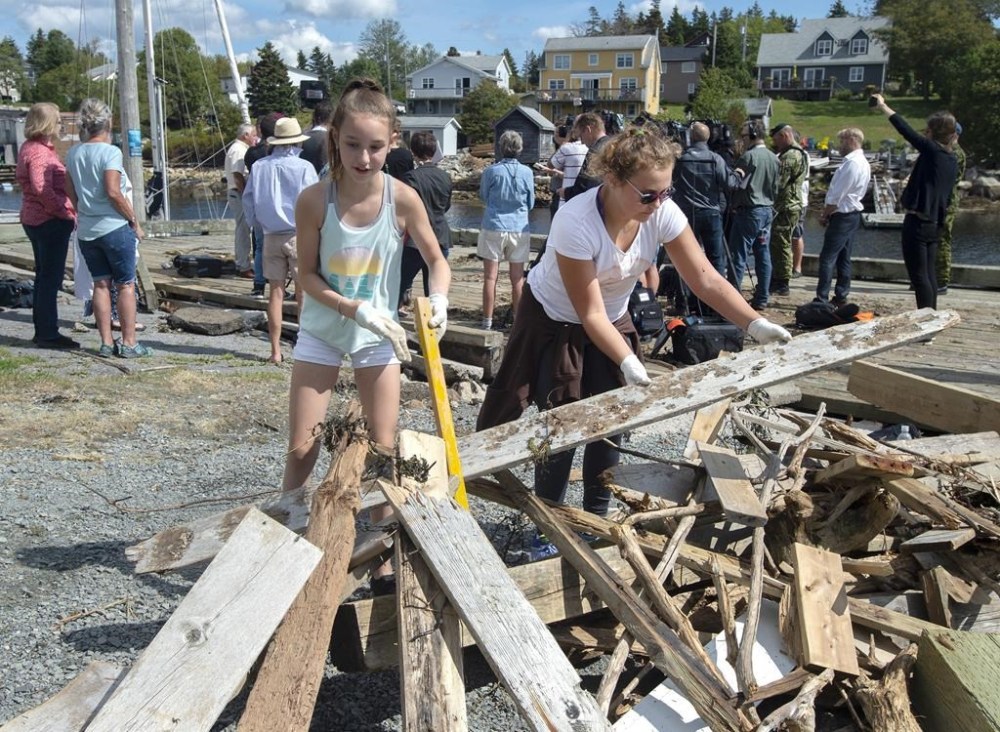
Madelyn Watts, left, and Angelina Taylor clean up debris on the government wharf as Ralph Goodale, minister of Public Safety and Emergency Preparedness and Harjit Sajjan, minister of National Defence, hold a news conference in the background in Herring Cove, N.S. on Tuesday, Sept. 10, 2019. Hurricane Dorian brought wind, rain and heavy seas that knocked out power across the region. THE CANADIAN PRESS/Andrew Vaughan

Fogarty offered thoughts on some of the notable hurricanes and post-tropical storms that have made landfall in Canada and what impact they had.

2019 — Dorian

Hurricane Dorian, a storm that made landfall in Atlantic Canada on Sept. 7, 2019, was “similar in a sense” to Fiona, said Fogarty, in that it was a hurricane that transformed into a nor’easter. The impacts of Dorian were made worse by soaking rains and powerful winds from tropical storm Erin a week earlier, according to Environment Canada records.

Dorian was not as intense as hurricane Juan in 2003, but the winds, rain and waves it brought destroyed more physical infrastructure in Nova Scotia than any storm had in the past. It was the single most damaging storm in Nova Scotia Power’s history, according to Environment Canada records, with 80 per cent of customers affected. Dorian was still much weaker than what Fiona is expected to be, said Fogarty.

2010 — Igor

Environment Canada archives list this storm as the worst of tropical origin to hit Newfoundland in 75 years. It brought excessive rainfall and winds reaching up to 172 km/h that toppled trees, caused power outages and structural damage to buildings, and brought widespread flooding.

Hurricane Fiona is likely to be similar to Igor, said Fogarty, which was a “very powerful storm.”

“(It had) a lot of rain, strong winds, ” he said. “But (meteorologists are) not seeing the numbers, some of the computer model numbers with Fiona, that we saw with Igor in 2010. That’s to say that (Fiona) does look like it’s going to be worse than even (Igor).”

2003 — Juan

This “storm of the century” hit Halifax directly on Sept. 29, 2003, according to Environment Canada. A paramedic in Halifax was killed when a tree was blown onto his ambulance. An estimated 50 to 100 million trees came down in Nova Scotia in a two-hour period. Environment Canada says hurricane Juan was “the most damaging storm in modern history for Halifax,” when measured by the widespread tree blowdowns, power outages and damaged homes.

“The wind speeds in Juan, they were right around what we’re predicting with Fiona,” said Fogarty. “But with Fiona, a larger area will be impacted .… Juan was probably a tenth the size of what Fiona is.”

1954 — Edna

Hurricane Edna formed southeast of Barbados on the afternoon of Sept. 2, 1954, and made landfall in New Brunswick as a Category 1 on Sept. 11, according to Environment Canada. It weakened to tropical storm strength over southern Quebec and Labrador before heading out to sea. With wind speeds of up to 160 km/h, it killed one person in Nova Scotia and injured numerous others.

“I would say that we probably have to go back to at least 1954 to envision some of the impacts that we’ll likely see (with Fiona),” said Fogarty. “Hurricane Edna was in 1954 and it produced wide swaths of forest blowdown in Nova Scotia and Prince Edward Island.”

1873 — The Great Nova Scotia Hurricane

Also referred to as the Great Nova Scotia Cyclone, this storm swept across Cape Breton Island on Aug. 25, 1873, and killed as many as 500 people, mostly sailors, according to Historica Canada. Environment Canada says some historical records indicate 100 more died in Newfoundland, and as many as 1,200 boats and 900 homes were also lost.

“It had properties and a track that might be similar to Fiona,” said Fogarty. “There was incredible surge in the Gulf of St. Lawrence, P.E.I. was (also) devastated, which is likely what we’re going to see with Fiona. To be honest, this 1873 storm, the Great Nova Scotia Cyclone, is the one that stands out in my head as (having) perhaps a similar track and impact.”

1775 — The Independence Hurricane

More than 4,000 mariners were lost, mostly off the coast, in the Independence Hurricane of 1775, according to Environment Canada. The storm hit the then-British colony of Newfoundland. Department archives say it’s been speculated the storm was a turning point in the American Revolution because most of the lives lost were British sailors.

It was “a terrible storm,” said Fogarty, that “may have” had all the same features as Fiona, though there is little data reaching that far back, and information mainly comes from ship reports and early records.

“It was thousands of fatalities because there were no warnings back then,” he said. “But some of the reports from that storm (showed) immense storm surge in eastern Newfoundland.”

This report by The Canadian Press was first published Sept. 24, 2022.

Report Error Submit a Tip

More Stories

Letters, Oct. 8

6 minute read 2:01 AM CDT

A call for digital revolution

Re: MPI on new path after Project Nova debacle (Oct. 6)

Computer scientist Melvin Conway once stated, “Any organization that designs a system (defined broadly) will produce a design whose structure is a copy of the organization’s communication structure.”

This is seen clearly in the Manitoba government’s online service. The Manitoba government has a “Data MB” portal to view government data sets, but data about vehicle collisions is only accessible from Manitoba Public Insurance’s Manitoba Collision Dashboard. If you need to find information on a Manitoba surgeon, that information is on Shared Health’s website, but if you need surgical wait times, that’s on the main government website.

Kids deserve better

Jordan Laidlaw 4 minute read 2:00 AM CDT

As much as I cling to hope, I recognize the ominous circumstances and questionable future that our young people stand to inherit.

Youth are navigating a world plagued with the existential dangers of climate change, artificial intelligence, political polarization and rising military armament, among other disconcerting trends. While schools cannot entirely ameliorate these issues, I am inspired by the words of Amina Mohammed, the United Nations deputy secretary-general, who declared teachers to be the “guardians of our future.”

Our future integrally depends on the learning, healthy development and empowerment of young people. With the upcoming Manitoba school board elections, I invite readers, voters and prospective candidates to consider how to support the practices of these guardians so we may ensure a brighter tomorrow.

First, I believe we are in — or entering — a community mental-health crisis. There is a resounding body of peer-reviewed research outlining the declining trends in the mental health of youth, parents and teachers. In May 2026, Doctors Manitoba stated its concern that the technology consumption habits of youth rivalled the health detriments of drinking and smoking. Many parents are stressed, economically struggling and need assistance. How might schools mitigate these precarious developments?

This week’s silly geopolitical spat

Gwynne Dyer 4 minute read Yesterday at 2:01 AM CDT

“I would not like to call this an incident. Let’s say it’s a diplomatic misunderstanding,” said Ukrainian Foreign Affairs Minister Andrii Sybiha. But the South Korean president definitely sees it as a serious incident, and he has already gone public with it.

“If (Ukraine’s) refusal to acknowledge the facts and issue a public apology continues, we will take additional measures,” President Lee Jae-myung wrote on X. He probably means cutting the non-military aid South Korea gives to Ukraine. (There is no military aid, since the constitution bans Seoul from providing arms to a country actively involved in a war).

What monstrous misdeed did the Ukrainian government commit to deserve such harsh words from a country that is generally sympathetic to Ukraine’s struggle against its giant neighbour? Have the South Koreans discovered Ukrainian spies in the Blue House?

No, it’s what we professionals call a “spat.”

‘Necessary active role’: corporate declaration of action adds initial signees

Gabrielle Piché 3 minute read Yesterday at 7:10 PM CDT

A model canoe took its maiden voyage Wednesday — into the arms of the National Centre for Truth and Reconciliation’s executive director.

Stephanie Scott and her team received the miniature wooden canoe during a ceremony at Assiniboine Park in Winnipeg.

They also left with a freshly signed corporate declaration of action, where national companies pledged their commitment to reconciliation.

“Your commitment, your courage is so important,” Scott told a room of roughly 15 people in the Pavilion. “It is a very long journey that we’re all on.”

Michael Douglas comes to terms with fears, fame, father

Hillel Italie 6 minute read Preview

Michael Douglas comes to terms with fears, fame, father

Hillel Italie 6 minute read Yesterday at 2:01 AM CDT

NEW YORK — Michael Douglas, the award-winning actor and producer, recently turned 82. He is a cancer survivor, a recovered addict, a married man, the father and son of actors.

He is also an author, who begins his memoir with a message of thanks to his family — past and present and future — for the “sense of immortality.”

“Many times my father was asked, ‘Kirk, are you jealous of your son?’” he said during a recent interview at a Manhattan hotel, referring to his late father, fellow actor and sometime combatant Kirk Douglas.

“And he said, ‘Jealous?’ This is a sense of immortality, a continuity of generations.’”

Read
Yesterday at 2:01 AM CDT

A look at how some historic Canadian hurricanes compare with Fiona

Jessica Smith, The Canadian Press 5 minute read Preview

A look at how some historic Canadian hurricanes compare with Fiona

Jessica Smith, The Canadian Press 5 minute read Saturday, Sep. 24, 2022

As people in Atlantic Canada prepared Friday for the imminent arrival of Fiona, some weather experts were studying past hurricanes and storms to gain insight on what could be coming.

Chris Fogarty, lead meteorologist and program manager at the Canadian Hurricane Centre, said meteorologists often like to look back at historical events when preparing forecasts.

"We want to see if we can compare (an incoming hurricane) with past events to give people an idea of what we're going to see," said Fogarty.

Fogarty offered thoughts on some of the notable hurricanes and post-tropical storms that have made landfall in Canada and what impact they had.

Read
Saturday, Sep. 24, 2022