Elon Musk’s successful bid for Twitter explained, analyzed

Advertisement

Advertise with us

TORONTO - Twitter's board accepted Elon Musk's US$44-billion bid to take over the social media platform on Monday.

Read this article for free:


or

Already have an account? Log in here »

To continue reading, please subscribe:

Subscribe and receive a limited-edition Free Press branded hat or tote.

Digital Subscription

One year of digital access for only $205*

  • Enjoy unlimited reading on winnipegfreepress.com
  • Read the E-Edition, our digital replica newspaper
  • Access News Break, our award-winning app
  • Play interactive puzzles

*First annual payment billed as $205.00 + GST for one year. This annual subscription will automatically renew at $233.00 + GST every 52 weeks (10% off the regular annual price of $259.35). Offer available to new and qualified returning subscribers only. Cancel any time.

To continue reading, please subscribe:

Add Free Press access to your Brandon Sun subscription for only an additional

$1 for the first 4 weeks*

  • Enjoy unlimited reading on winnipegfreepress.com
  • Read the E-Edition, our digital replica newspaper
  • Access News Break, our award-winning app
  • Play interactive puzzles
Start now

*Your next Brandon Sun subscription payment will increase by $1.00 and you will be charged $17.95 plus GST for four weeks. After four weeks, your payment will increase to $24.95 plus GST every four weeks.

Hey there, time traveller!
This article was published 26/04/2022 (1578 days ago), so information in it may no longer be current.

TORONTO – Twitter’s board accepted Elon Musk’s US$44-billion bid to take over the social media platform on Monday.

The blockbuster offer made by the controversial Tesla and SpaceX leader, who has Canadian citizenship, will see Musk pay US$54.20 per share, a 38 per cent premium to the closing price of Twitter’s stock on April 1.

Musk has vowed to transform the company by taking it private, reducing content moderation and launching a long-requested edit button on Twitter.
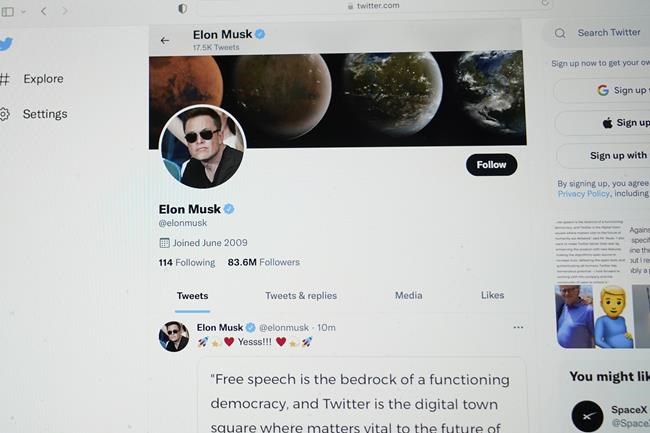
The Twitter page of Elon Musk is seen on the screen of a computer in Sausalito, Calif., on Monday, April 25, 2022. On Monday, Musk reached an agreement to buy Twitter for about $44 billion. THE CANADIAN PRESS/AP-Eric Risberg

How did the deal materialize?

In January, Musk began buying significant shares in Twitter, racking up a five per cent stake in the company in March and just shy of 10 per cent in April.

The more than 73.4 million shares he owned made him the company’s largest shareholder, though he failed to notify the Securities and Exchange Commission that his stake in the company surpassed five per cent within the required time, violating U.S. laws. Some Twitter investors have sued him for failing to disclose the size of his stake promptly.

Musk was due to join Twitter’s board on April 9, though the arrangement prevented him from owning more than 14.9 per cent of Twitter’s outstanding stock.

By April 10, Twitter CEO Parag Agrawal had tweeted Musk had decided not to join the board and “this is for the best.”

But Twitter had not seen the last of Musk. On April 13, he filed his bid to buy the company.

How does Canada figure into the bid?

Royal Bank of Canada and Canadian Imperial Bank of Commerce are two of the 12 banks offering Musk financing for the bid, shows a commitment letter filed by Musk’s X Holdings III LLC. RBC offered US$750 million and CIBC has pledged US$400 million.

How did the board arrive at its decision to accept the offer?

Approving bids like the one Musk made largely comes down to money, said Dave Valliere, a professor at Ryerson University’s Ted Rogers School of Management.

“The job of Twitter’s board of directors is to do whatever is in the best interest of shareholders, and so when somebody comes along and offers a big premium over the existing value of the shares, it’s pretty hard to turn that down,” he said.

What will Musk do with the company?

Musk has mused about making several changes to Twitter.

At an April 14 TED Talk, he said the company should be reluctant to delete tweets and mentioned that it should be “an inclusive arena for free speech.”

Musk has also suggested the company should offer users who pay for the company’s premium subscription product Twitter Blue a verified mark, allow longer tweets and depend more on subscriptions than advertising for revenue.

Perhaps his most popular recommendation has been an edit button, which he polled users on earlier this month. Twitter has long been working on the feature but has never rolled it out.

While these ideas have generated Musk plenty of attention, Valliere said, “it’s not automatically clear to me that he’s got any great business strategy that does well for Twitter, the company.’

How will Musk’s ownership affect Twitter users?

Just after Musk’s bid was accepted, Musk tweeted that he plans to “make Twitter better than ever” by making the algorithms open source to increase trust, defeating the spam bots and authenticating all humans.

Valliere believes the deal is really about Musk being “a rich guy that wants to control the megaphone.”

“He wants a platform that he has some control over and so that people aren’t going to hold him accountable in certain ways that maybe exists now,” the professor said.

“I don’t see that there’s a huge benefit to the other users of Twitter. I don’t see the huge benefits for the existing shareholders of Twitter, other than you’ve already paid them a lot of money.”

Musk has a reputation for being a volatile leader known for Twitter rants and rash business decisions. What will this mean for Twitter staff?

Some who see Musk as successful will stick with the company or try to join, said Valliere.

But others may leave because they doubt he has shareholders’ best interests at heart and Valliere expects “turmoil at the top.”

“Certainly some of the upper management can be expected to depart because if this goes through, this is a vote of non-confidence in the existing team.”

How will Musk handle running a company that is being circled by regulators and international governments looking to restrict harmful materials from being posted online?

Valliere believes Musk won’t help Twitter weather such conditions better because he is known for picking fights with his critics.

“He’s going to try and stick a stake in the ground and so it’s going to be an interesting thing because the legislative agenda is pointing towards greater accountability, but he’s got lots of money, so which one would you want to bet on?”

This report by The Canadian Press was first published April 26, 2022.

Report Error Submit a Tip

More Stories

Today’s horoscope

Georgia Nicols 4 minute read Preview

Today’s horoscope

Georgia Nicols 4 minute read Yesterday at 2:00 AM CDT

MOON ALERT: After 3:45 a.m. today there are no restrictions to shopping or important decisions. The moon is in Sagittarius.

ARIES (March 21-April 19)

You might be interested in unusual, powerful ideas. They might be mystical and idealistic. They might even be related to improving yourself somehow. Nevertheless, be aware this is also a mildly accident-prone day for you. Pay attention to everything you say and do.

TAURUS (April 20-May 20)

Read
Yesterday at 2:00 AM CDT

Letters, Aug. 20

7 minute read Yesterday at 2:00 AM CDT

Old-fashioned news

I scrolled through the comment section of the online news story, my eyes darting through differing opinions until I landed on one that caught my attention. I felt my shoulders tense and my breath quicken as I read the fiery thoughts of a stranger.

Surely, there must be a better way to read the news?

I thought back to the ’90s. Every morning, my mother would open the front door to retrieve the Winnipeg Free Press. I would jump at the Arts section until I found the comics and giggle while I ate my cereal. My parents absorbed the news while getting ready for their day, and eventually the newspaper found its way to the top of the paper pile in the garage. The next morning, the cycle would repeat itself.

Educated people vote

John R. Wiens 5 minute read 2:00 AM CDT

I add my voice to Erna Buffie’s Think Tank piece “Democracy is a civic election issue” (Aug. 13) by asserting that democracy is a public education issue. Put another way, this fall’s municipal and school board elections are a test of public education — educating democratic citizens who appreciate our democratic inheritance enough to take responsibility for renewing it.

Voter turnouts for elections in Canada are abysmal. Where there should be 100 per cent participation, it often approaches 50 per cent federally and provincially, 25 per cent in local elections. The explanations given seem insufficient and unsatisfying, as are the reasons given by those who decide not to bother.

Some say they feel disempowered and alienated from the political process, feeling they have no say in governmental decisions which rule their lives.

Others appear resigned to the fact that, if they were to speak, they would simply be passed over or ignored, choosing not to vote because their votes, like their voices, make no difference and count for nothing. Still others say they’re too busy or just don’t care.

Ready to crack over late-night ‘snacks’

Maureen Scurfield 4 minute read 2:00 AM CDT

DEAR MISS LONELYHEARTS: My new love has a seriously annoying habit that could break us up now that we’re actually living together.

I’m not getting much sleep, and it has nothing to do with having too much sex!Every night at about 2 a.m., my man gets up and goes to the fridge, makes a giant sandwich and pours a huge glass of apple juice, then sits there scarfing it down, with music on for a bit of entertainment. This often wakes me up, and when I complain he just invites me to join him “for a bite.”

Really? The last thing I need is to eat a fourth meal of the day in the middle of the night. He says it’s an old habit from his football days, when he was so hungry all the time and he still enjoys it. He says he isn’t about to change that for me, so, tough luck.

It’s a big problem as I can’t just fall back to sleep after he rattles around the kitchen and then comes back and jumps back into bed with me.

Kids need some sense of split parents’ situation

Maureen Scurfield 5 minute read Yesterday at 2:00 AM CDT

DEAR MISS LONELYHEARTS: On our last day at a beach rental cabin the kids and I were packing up later than the rules asked for, when a familiar car pulled in next door. It was my ex-husband with his new woman and her kids.

My children yelled out, “Look Mom, it’s Daddy! He came to the lake to see us!” and ran over to him for hugs. His girlfriend had the cabin keys dangling, nodded at me, and went inside quickly.

I said to my former husband, “Fancy meeting you here! Come on kids, we’re going home now.” My ex said, “Oh, settle down. Give me a few minutes with my kids, will you?”

So, I finished packing and locked the cabin door, and waited for the kids for 30 minutes in our car. Then I started to cry. It just came gushing out and I couldn’t control it. Finally, my ex brought the children back out. He could see I’d been crying and said in disgust, “Get over it, princess. I have!”

Private governance or public good

David Nutbean 5 minute read 2:00 AM CDT

The Manitoba government recently held public forums to discuss regulations for Bill 51, the Public Sector Artificial Intelligence and Cybersecurity Governance Act. I was able to participate in the meeting in Brandon and there was also a session in Winnipeg.

I was a bit fired up, ready to rail about data centres and phone terms and conditions and generally give it to big tech. The discussion, however, was focused on what the public sector responses should be regarding cybersecurity, data and privacy protections, and AI usage in government.

With all the recent attention on social media bans, the harms of AI, misinformation and the like, I was somewhat disappointed that these would not be tackled directly in this meeting. Those issues may be discussed at future forums.

At this event, as focus groups developed responses, the discussion between private companies and public governance kept getting mixed in, pointing out the reliance of government services on private companies in running their digital operations. As government operations become more dependent on digital infrastructure and towards AI agency and control, rethinking how technology is implemented may be crucial to our democracy.