5 things to know about the new UN report on climate change

Advertisement

Advertise with us

GENEVA (AP) — The U.N.-appointed Intergovernmental Panel on Climate Change published a new report Monday summarizing the latest authoritative scientific information about global warming. Here are five important takeaways.

Read this article for free:

or

Already have an account? Log in here »

To continue reading, please subscribe:

Subscribe and receive a limited-edition Free Press branded hat or tote.

Digital Subscription

One year of digital access for only $205*

  • Enjoy unlimited reading on winnipegfreepress.com
  • Read the E-Edition, our digital replica newspaper
  • Access News Break, our award-winning app
  • Play interactive puzzles

*First annual payment billed as $205.00 + GST for one year. This annual subscription will automatically renew at $233.00 + GST every 52 weeks (10% off the regular annual price of $259.35). Offer available to new and qualified returning subscribers only. Cancel any time.

To continue reading, please subscribe:

Add Free Press access to your Brandon Sun subscription for only an additional

$1 for the first 4 weeks*

  • Enjoy unlimited reading on winnipegfreepress.com
  • Read the E-Edition, our digital replica newspaper
  • Access News Break, our award-winning app
  • Play interactive puzzles
Start now

*Your next Brandon Sun subscription payment will increase by $1.00 and you will be charged $17.95 plus GST for four weeks. After four weeks, your payment will increase to $24.95 plus GST every four weeks.

Hey there, time traveller!
This article was published 09/08/2021 (1819 days ago), so information in it may no longer be current.

GENEVA (AP) — The U.N.-appointed Intergovernmental Panel on Climate Change published a new report Monday summarizing the latest authoritative scientific information about global warming. Here are five important takeaways.

BLAMING HUMANS

The report says almost all of the warming that has occurred since pre-industrial times was caused by the release of heat-trapping gases such as carbon dioxide and methane. Much of that is the result of humans burning fossil fuels — coal, oil, wood and natural gas.
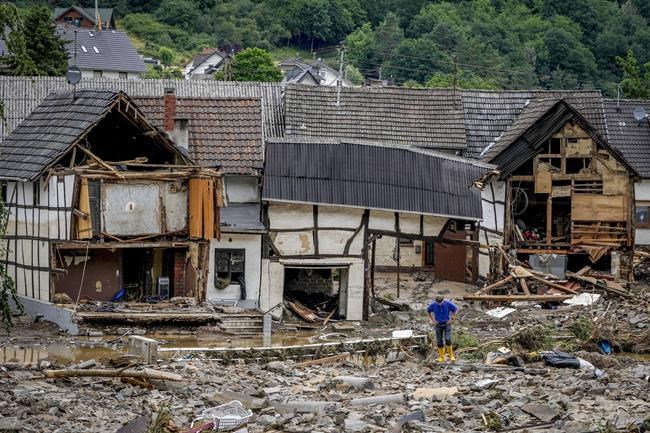
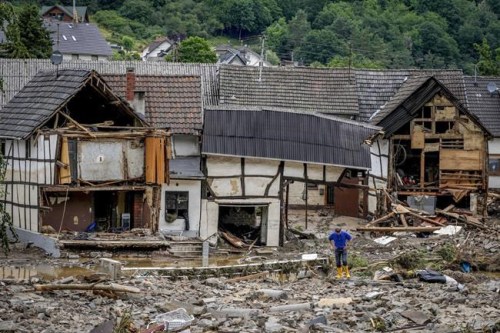
FILE - This Thursday, July 15, 2021 file photo shows destroyed houses in Schuld, Germany. Due to heavy rains, the Ahr River dramatically flooded over its banks the previous evening. (AP Photo/Michael Probst)

The authors say global temperatures have already risen by 1.1 degrees Celsius (2 degrees Fahrenheit) since the 19th century, reaching their highest in over 100,000 years, and only a fraction of that increase can have come from natural forces.

___

PARIS GOALS

Almost all countries have signed up to the 2015 Paris climate accord, which aims to limit global warming to an increase of 2 degrees Celsius (3.6 Fahrenheit) above the pre-industrial average by the year 2100. The agreements says that ideally the increase would be no more than 1.5 degrees Celsius (2.7 degrees Fahrenheit).

But the report’s 200-plus authors looked at five scenarios and concluded that all will see the world cross the 1.5-degree threshold in the 2030s — sooner than in previous predictions. Three of those scenarios will also see temperatures rise 2 degrees Celsius.

___

DIRE CONSEQUENCES

The 3,000-plus-page report concludes that ice melt and sea level rise are already accelerating. Wild weather events — from storms to heat waves — are also expected to worsen and become more frequent.

Further warming is “locked in” due to the greenhouse gases humans have already released into the atmosphere. That means even if emissions are drastically cut, some changes will be “irreversible” for centuries, the report said.

___
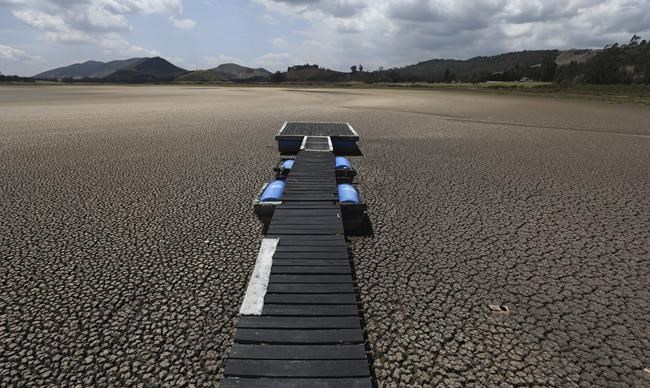
FILE - In this Wednesday, Feb. 17, 2021 file photo, a floating dock sits on the lakebed of the Suesca lagoon, in Suesca, Colombia. The lagoon, a popular tourist destination near Bogota that has no tributaries and depends on rain runoff, has radically decreased its water surface due to years of severe droughts in the area and the deforestation and erosion of its surroundings. (AP Photo/Fernando Vergara, File)

SOME HOPE

While many of the report’s predictions paint a grim picture of humans’ impact on the planet and the consequences that will have going forward, the IPCC also found that so-called tipping points, like catastrophic ice sheet collapses and the abrupt slowdown of ocean currents, are “low likelihood,” though they cannot be ruled out.

___

BIG CATCH

Although temperatures are expected to overshoot the 1.5-degree-Celsius target in the next decade, the report suggests that warming could be brought back down to this level through what are known as “negative emissions.” That means sucking more carbon dioxide out of the atmosphere than is added, effectively cooling the planet again. The panel said that could be done starting about halfway through this century but doesn’t explain how, and many scientists are skeptical it’s possible.

___

Read more of AP’s climate coverage at http://www.apnews.com/Climate

Report Error Submit a Tip

More Stories

Too close to call in Assiniboia

Marsha McLeod 3 minute read Preview

Too close to call in Assiniboia

Marsha McLeod 3 minute read Tuesday, Oct. 3, 2023

The Winnipeg constituency of Assiniboia was too close to call Tuesday, with the NDP candidate leading over the incumbent Tory minister of seniors and long-term care.

At 11:15 p.m., Elections Manitoba, reporting just seven of 18 polls, had the NDP’s Nellie Kennedy with a 562-vote lead over Progressive Conservative incumbent Scott Johnston in the swing riding on the western edge of the city.

Losing the seat would be a blow for the Tories, but it would be a moral, rather than a functional, one. A win for the PC incumbent would do little to dent the NDP’s majority victory. Liberal Charles Ward was running a distant third.

A NDP win would be a reversal. In the 2016 and 2019 elections, the party lost Assiniboia to the PCs by roughly 16- and nine-point margins, respectively. Johnston won with 44 per cent of the vote in 2019.

Read
Tuesday, Oct. 3, 2023

The man who ran for president from his cell

Allan Levine 5 minute read Friday, Apr. 26, 2024

Should Donald Trump be found guilty of all 34 felony charges he is currently on trial for in a New York City courtroom, he could be sentenced to 20 years in prison, the maximum sentence the state allows for the type of offences he has allegedly committed.

The odds are that his prison term would be much less, if he is incarcerated at all.

Even if he is locked up, and assuming that he becomes the Republican party presidential nominee, a conviction would not disqualify him. True, millions of voters might (finally) turn against him, yet there is no U.S. constitutional law that individuals with a criminal record cannot run for a federal office.

Moreover, it has happened before. More than a century ago, Eugene Debs, the head of the Socialist Party of America (SPA), ran as a third-party candidate in the 1920 presidential election from his cell in the Atlanta Federal Penitentiary. In September 1918, he had been convicted on charges for violating the Espionage and Sedition Acts and was given a 10-year prison sentence.

Climate change threatens events we wait for all year

Jen Zoratti 5 minute read Preview

Climate change threatens events we wait for all year

Jen Zoratti 5 minute read 2:01 AM CDT

This week, owing to extreme heat and a wild storm with tree-snapping winds, the Royal Winnipeg Ballet had to cancel its full run of Ballet in the Park, a much-loved annual tradition at which people from all over Manitoba can enjoy world-class art in the verdant Assiniboine Park.

Two weeks prior, Rainbow Stage, another jewel of a Winnipeg summer, had to cancel the closing matinee of Jesus Christ Superstar owing to heat and humidity.

And at the beginning of July, Winnipeg Folk Festival attendees baked under scorching temperatures — 47 C with the humidex — to enjoy not just the discovery of music, but the community that has formed in Birds Hill Park on the second weekend of July for over 50 years.

This doesn’t feel great. I do not begrudge cancellations — they are absolutely the correct call for the health and safety of performers and patrons — but I can’t be the only one feeling some existential dread about our summers, and the things that make them special, in the face of a changing climate.

Read
2:01 AM CDT

Podcast platform for Indigenous women’s voices

Janine LeGal 6 minute read Preview

Podcast platform for Indigenous women’s voices

Janine LeGal 6 minute read Monday, Jan. 17, 2022

Writer and award-winning producer Kim Wheeler has spent much of her career passionately sharing stories and giving voice to relevant issues of the day.

Now, she’s focused on giving others a voice and an opportunity to share their stories.

Auntie Up! is a new 10-part podcast, described as a celebration of Indigenous women talking about important stuff. Launched in November, the series brings Indigenous voices to the masses at a time when reconciliation has taken a more prominent role in many news stories. The programming offers a space for building connections, learning and understanding.

As one of the three creators of the project, Wheeler’s lived experience makes her an ideal contributor. The producer and journalist is Anishinaabe, Mohawk, a member of Sagkeeng First Nation, and a Sixties Scoop survivor.

Read
Monday, Jan. 17, 2022

0 minute read

0 minute read