Interior secretary: Drought demands investment, conservation

Advertisement

Advertise with us

DENVER (AP) — Confronting the historic drought that has a firm grip on the American West requires a heavy federal infrastructure investment to protect existing water supplies but also will depend on efforts at all levels of government to reduce demand by promoting water efficiency and recycling, Interior Secretary Deb Haaland said Thursday.

Read this article for free:


By clicking the button above, an account will be created and you will begin to receive some of our recommended newsletters. You may opt out of any newsletter by visiting your Email and Communication Preferences page or by clicking "unsubscribe" at the bottom of any email.

or

Already have an account? Log in here »

To continue reading, please subscribe:

Digital Subscription

One year of digital access for only $1.44 a week*

  • Enjoy unlimited reading on winnipegfreepress.com
  • Read the E-Edition, our digital replica newspaper
  • Access News Break, our award-winning app
  • Play interactive puzzles

*Billed as $5.77 plus GST every four weeks. After 52 weeks, price increases to the regular rate of $19.95 plus GST every four weeks. Offer available to new and qualified returning subscribers only. Cancel any time.

To continue reading, please subscribe:

Add Free Press access to your Brandon Sun subscription for only an additional

$1 for the first 4 weeks*

  • Enjoy unlimited reading on winnipegfreepress.com
  • Read the E-Edition, our digital replica newspaper
  • Access News Break, our award-winning app
  • Play interactive puzzles
Start now

*Your next Brandon Sun subscription payment will increase by $1.00 and you will be charged $17.95 plus GST for four weeks. After four weeks, your payment will increase to $24.95 plus GST every four weeks.

Hey there, time traveller!
This article was published 22/07/2021 (1916 days ago), so information in it may no longer be current.

DENVER (AP) — Confronting the historic drought that has a firm grip on the American West requires a heavy federal infrastructure investment to protect existing water supplies but also will depend on efforts at all levels of government to reduce demand by promoting water efficiency and recycling, Interior Secretary Deb Haaland said Thursday.

Haaland told reporters in Denver that the Biden administration’s proposed fiscal year 2022 budget includes a $1.5 billion investment in the Bureau of Reclamation, which manages water and power in the Western states, and more than $54 million for states, tribes and communities to upgrade infrastructure and water planning projects.

“Drought doesn’t just impact one community. It affects all of us — from farmers and ranchers to city dwellers and Indian tribes. We all have a role to use water wisely,” Haaland said at the start of a three-day visit to Colorado to address the U.S. response to increasingly scarce water and massive wildfires burning throughout the region.

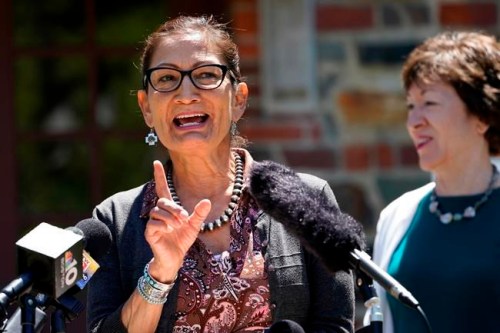
FILE-In this June 18, 2021 file photo, Interior Secretary Deb Haaland speaks to reporters during a visit to Acadia National Park in Winter Harbor, Maine. Haaland is visiting her home state this weekend, Saturday, July 17, to celebrate what marks the largest wilderness land donation in the agency's history. The donation from the Trust for Public Land increases the size of the Sabinoso Wilderness in northeastern New Mexico by nearly 50%. (AP Photo/Robert F. Bukaty, File)

The American West is gripped by the worst drought in modern history, including most of western Colorado. The northern part of the state is experiencing deadly flash flooding and mudslides after rain fell in areas scarred by massive wildfires last year. Fires are burning across the West, most severely in Oregon and California, while the drought stresses major waterways like the Colorado River and reservoirs that sustain millions of people.

The drought and recent heat waves in the region that are tied to climate change have made wildfires harder to fight. Climate change has made the West much warmer and drier in the past 30 years and will continue to make weather more extreme and wildfires larger and more destructive.

Haaland spoke after meeting with Democratic Rep. Diana DeGette, Gov. Jared Polis and Jim Lochhead, CEO of Denver Water, Colorado’s largest water agency, for a discussion on the drought and possible federal solutions.

Among other initiatives, she said the Bureau of Reclamation is working to identify and dispense “immediate, technical and financial assistance for impacted irrigators and Indian tribes.”

Tanya Trujillo, the department’s assistant secretary for water and science, cited a recent decision to release water from several Upper Colorado River basin reservoirs to supply Lake Mead and Lake Powell — the two manmade reservoirs that store Colorado River water.

The reservoirs are shrinking faster than expected, spreading panic throughout a region that relies on the river to sustain 40 million people. Federal officials expect to make the first-ever water shortage declaration in the Colorado River basin next month, prompting cuts in Arizona, Nevada and Mexico.

“We have seen hydrologic projections that are worse than anticipated,” Trujillo said.

Haaland’s three-day stay in Colorado includes her first trip Friday to the Bureau of Land Management’s new headquarters in Grand Junction, established by the Trump administration in 2019. The agency’s move from Washington, D.C., produced an outcry from critics who said it gutted the office. Haaland opposed the move as a member of Congress.

The agency overseen by the Interior Department manages nearly 250 million acres of public lands, most of which are in the West. Polis and Colorado’s congressional delegation have urged Haaland to keep the office in Grand Junction.

Haaland reiterated her support for Tracy Stone-Manning, President Joe Biden’s pick to oversee the land agency, after a Senate panel deadlocked Thursday on Stone-Manning’s nomination amid allegations she stonewalled a 1989 investigation into the sabotage of an Idaho timber sale.

“Tracy Stone-Manning has a wealth of experience and knowledge about all issues to do with our public lands. We have full faith that she will put her nose to the grindstone as soon as she’s confirmed by the Senate,” Haaland said.

The 10-10 tie in the Senate Energy and Natural Resources Committee set up a floor vote on the nomination. It would take every Senate Republican plus at least one Democratic lawmaker to block her confirmation in the evenly divided chamber.

Haaland is visiting as severe and intense dry periods sweeping areas of the West over the last several years have resulted in more intense and dangerous wildfires, parched croplands and a lack of vegetation for livestock and wildlife, according to government scientists.

They also found that the problem is accelerating — rainstorms are becoming increasingly unpredictable and more regions are seeing longer time intervals between storms since the turn of the century.

___

Nieberg is a corps member for the Associated Press/Report for America Statehouse News Initiative. Report for America is a nonprofit national service program that places journalists in local newsrooms to report on undercovered issues.

___

See AP’s complete coverage of the drought: https://apnews.com/hub/droughts.

Report Error Submit a Tip

More Stories

Wildfires in Brazil’s Amazonas state worsen air quality in Manaus

Gabriela Sá Pessoa, The Associated Press 3 minute read Preview

Wildfires in Brazil’s Amazonas state worsen air quality in Manaus

Gabriela Sá Pessoa, The Associated Press 3 minute read Friday, Oct. 9, 2026

SAO PAULO (AP) — Smoke from wildfires disrupted daily life in Brazil's largest Amazon region city of Manaus on Friday as the country's dry season approached its peak.

The city, the capital of Amazonas state, suspended in-person work at municipal administrative offices, citing worsening air quality. Public school classes were canceled, and residents were urged to wear face masks.

The city said in a statement that the concentration of pollutants averaged 196 micrograms per cubic meter, which is considered an unhealthy level way above the normal range of about 3 to 9.

“For several days, Manaus has been affected by heavy smoke from fires in municipalities elsewhere in Amazonas state and in other states,” the city said. “The serious situation extends beyond the capital and threatens the health and quality of life of thousands of families.”

Read
Friday, Oct. 9, 2026

Feds hold back on stable health funding

Editorial 4 minute read Preview

Feds hold back on stable health funding

Editorial 4 minute read 2:00 AM CDT

The federal government wants provinces to improve health care, expand treatment services and find better ways to deliver care. But it’s refusing to provide provincial governments with the one thing they need most to plan for the future: stable, predictable funding.

That’s not a serious way to manage public health care.

Provincial and territorial health ministers gathered in Winnipeg last week hoping to secure long-term federal funding commitments to help manage mounting pressures on their health-care systems. They left with little more than a promise to keep talking.

Ottawa agreed to extend a $1.2-billion annual funding agreement for mental-health and substance-use treatment, home care and community care by one year. That’s welcome, but it hardly provides the certainty provinces need to maintain existing programs, never mind expand services to meet growing demand.

Read
2:00 AM CDT

Festival celebrates all facets of African artistic culture

Thandi Vera 4 minute read Preview

Festival celebrates all facets of African artistic culture

Thandi Vera 4 minute read Friday, Aug. 30, 2024

Nosa Guobadia saw something missing in Winnipeg’s vibrant arts scene — an absence that struck him deeply.

“As an artist myself, I saw a huge gap and felt there should be a space for African artists in Winnipeg,” says the Nigerian-born Guobadia, who performs as Cozymannos.

The realization dawned on him at last year’s Soca Reggae Festival when he noticed that the audience was predominantly African, despite the event’s Caribbean focus.

“It hit me then. It made me think that we need a festival that truly celebrates African artists — not just as performers, but as the heartbeat of the event,” he says.

Read
Friday, Aug. 30, 2024

Interior secretary: Drought demands investment, conservation

Patty Nieberg, The Associated Press 5 minute read Preview

Interior secretary: Drought demands investment, conservation

Patty Nieberg, The Associated Press 5 minute read Thursday, Jul. 22, 2021

Here are the 10 best ones

Read
Thursday, Jul. 22, 2021

Would Canada actually spy on Cuba?

Peter McKenna 5 minute read Preview

Would Canada actually spy on Cuba?

Peter McKenna 5 minute read 2:00 AM CDT

The Globe and Mail recently ran a series of stories on how “Havana syndrome” negatively impacted a number of diplomats working at the Canadian embassy in Cuba. As of this writing, there has been unusual radio silence on the topic from Mark Carney’s governing Liberals.

The reportage also linked the so-called “sonic attacks” or what the Americans call “anomalous health incidents” (and the attendant concussion-like symptoms) to a Russian high-frequency microwave weapon. More importantly, the Globe maintained that Moscow’s retaliation against Canadian officials in Havana was because of their close co-operation with U.S. intelligence agencies in spying on the Cuban government.

Some of the articles claimed that high-tech satellite gear, which was brought into Cuba covertly by U.S. officials, was installed on the roofs of the residences of Canadian diplomats in Havana. Presumably, Canadian officials — or what are sometimes referred to as officers or agents working under the Global Security Reporting Program (GSRP) within the Department of Global Affairs — were using this satellite technology to collect intelligence on human sources in Cuba.

The secret information was eventually passed on to Canada’s partners in the so-called “Five Eyes” alliance (the U.S., Australia, Britain and New Zealand). It’s worth pointing out that this wouldn’t have been the first time Canadian officials in Cuba were funnelling sensitive intelligence to their U.S. counterparts.

Read
2:00 AM CDT

Today’s horoscope

Georgia Nicols 4 minute read Preview

Today’s horoscope

Georgia Nicols 4 minute read 2:00 AM CDT

MOON ALERT: There are no restrictions to shopping or important decisions today. The moon is in Aquarius.

ARIES (March 21-April 19)

This can be a lovely, friendly and romantic day if you can avoid intense discussions about shared property, inheritances and anything jointly held. Focus on what works. Avoid people who are intent on getting their way – not yours.

TAURUS (April 20-May 20)

Read
2:00 AM CDT