The ‘bittersweet’ legacy of Canada’s wartime Jewish and Italian internment camps
Advertisement
Read this article for free:
or
Already have an account? Log in here »
To continue reading, please subscribe:
Digital Subscription
One year of digital access for only $1.44 a week*
- Enjoy unlimited reading on winnipegfreepress.com
- Read the E-Edition, our digital replica newspaper
- Access News Break, our award-winning app
- Play interactive puzzles
*Billed as $5.77 plus GST every four weeks. After 52 weeks, price increases to the regular rate of $19.95 plus GST every four weeks. Offer available to new and qualified returning subscribers only. Cancel any time.
To continue reading, please subscribe:
Add Free Press access to your Brandon Sun subscription for only an additional
$1 for the first 4 weeks*
- Enjoy unlimited reading on winnipegfreepress.com
- Read the E-Edition, our digital replica newspaper
- Access News Break, our award-winning app
- Play interactive puzzles
*Your next Brandon Sun subscription payment will increase by $1.00 and you will be charged $17.95 plus GST for four weeks. After four weeks, your payment will increase to $24.95 plus GST every four weeks.
Read unlimited articles for free today:
or
Already have an account? Log in here »
Hey there, time traveller!
This article was published 09/11/2020 (2180 days ago), so information in it may no longer be current.
MONTREAL – In 1940, a Jewish student in the United Kingdom named Edgar Lion was sent to Canada against his will on a ship that carried both German and Austrian Jews and Nazi prisoners of war.
And when he first arrived at an internment camp in Trois-Rivieres, Que., the Austrian-born Lion quickly realized the local citizens gathered near the camp entrance didn’t know the difference between the two groups.
“People were cursing us and throwing stones at us. We had to cross a gauntlet of citizens who knew some of us were prisoners of war, but (didn’t know) some of us were just ordinary prisoners,” he said in a recent interview.

“We were in the wrong place. We weren’t supposed to be interned.”
Lion, now 100, is one of thousands of Italian, Austrian and German citizens who were rounded up by the British government and sent to Canada to be interned as “enemy aliens” in what remains a relatively unknown chapter in Canada’s Second World War history.
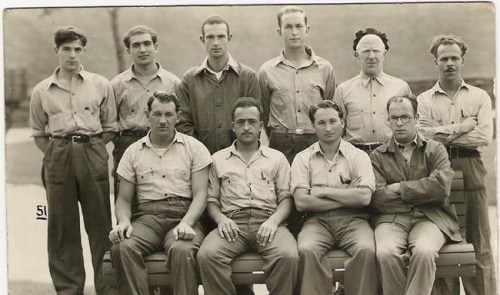
The men, who included Jewish refugees, civilians working in the U.K. and students, were scattered in camps across Ontario, Quebec and New Brunswick, where they were surrounded by armed guards and barbed wire.
Andrea Shaulis, the curator at the Montreal Holocaust Museum, said Canada was unprepared to receive the internees — Italian, German and Austrian nationals living in Great Britain who were sent overseas because the British government feared could pose a security threat in the event of invasion.
Canadian authorities had thought they would be receiving prisoners categorized as “dangerous enemy aliens,” and had not realized they would be mixed with ordinary citizens or even refugees fleeing Nazi persecution, she said
The facilities where they were sent were primitive at first, including a garage in Sherbrooke, Que., with auto bays filled with water. One camp in Quebec received a load of blankets but no mattresses; another got the opposite.
In some cases Nazi prisoners of war were interned alongside the Jewish refugees at first, causing tension and even fights.
Eventually, however, conditions improved in many of the camps, and the prisoners settled into a routine.
Raffaello Gonnella, the son of an Italian-born man who was interned in a camp on Montreal’s Ile Ste-Helene, says his father described life in the camp as boring but safe.
“The war was raging in Europe and Britain, so their families were more in danger than they were,” he said in a phone interview from Glasgow.
Unlike in Great Britain, there was no rationing in Canada, and “being Italian men, they ate rather well,” thanks to the chefs and other restaurant staff among their number who had been working in restaurants prior to being interned, Gonnella recalled.
Lion recalls that in the camps, the internees with university educations created schools and study groups for their younger counterparts.
“We started a camp school for the youngest people who were interned with us, and they didn’t have a chance to go to high school, so we made up for it” Lion said.
That effort would later pay off: after their release, many of the internees would go on to study in universities across Canada and Europe, becoming prominent architects, professors, and even Nobel Prize winners.
To this day, the history of Canada’s Italian and German internment camps remains little-known among the general population, with few plaques to mark the sites where they once stood.
The building housing the internment camp on Montreal’s Ile Ste-Helene now offers tours to visitors who are often surprised to hear an internment camp existed right next to a major Canadian city.
Paula Draper, a historian who has written books on Canada’s Holocaust experience, said this lack of knowledge may be partly because the situation is generally seen as less egregious than the internment of Canadian-born Japanese citizens.
Because conditions were comparatively good, she said many former internees may have hesitated to tell their stories.
“However unpleasant the experience had been to be interned in Canada . . . how do you complain about this when, in fact, the internment saved your life?” she said in a phone interview.
Draper maintains the internment was an “injustice” that should never have happened. On the other hand, it also kept the men safe and, eventually, allowed some to immigrate to North America, where many found great success.
“I always looked at is as a bittersweet kind of Holocaust story,” she said.
Gonnella says the biggest hardship the men experienced in the camp was the uncertainty of not knowing what was happening back home. “They were more worried about their families than themselves,” he said.
But while his father told him stories of pranks and good food, as a young teen Gonnella would learn how deeply the experience had affected his father.
One day, while rooting through his father’s closet for something to wear to school, a young Gonnella came across a denim shirt with a large red, white and blue circle on the back that resembled a target. When he asked if he could wear it, his father “flew into a rage I never saw.”
Unknowingly, Gonnella had taken out his father’s camp uniform, emblazoned with atarget symbol to make internees visible to the armed guards in the event of an escape attempt.

“I still fill with tears when I think about it,” Gonnella said. “He absolutely went crazy, screaming, shouting, bawling in Italian.”
After spending time in camps in Trois-Rivieres, Que, Fredericton and Sherbrooke, Lion was released in 1941. He moved to Montreal to live with friends of his family and went on to complete his university education, raise a family and build a successful career in the building industry.
Now living in a long-term care home in Montreal, he describes himself as a “survivor” whose life was transformed by his time in the camps.
“It certainly changed my life, because, for one thing, I became a Canadian citizen,” he said.
This report by The Canadian Press was first published Nov 9, 2020
Related Articles
Despite COVID-19, we still remember
Advertisement Advertise With Us
Advertisement Advertise With Us