‘Looking at the world around us:’ Canadian scientist wins Nobel Prize in physics

Advertisement

Advertise with us

James Peebles, a Manitoba-born scientist who won the Nobel Prize for physics on Tuesday, said his relatively quiet life isn't so quiet anymore.

Read this article for free:


or

Already have an account? Log in here »

To continue reading, please subscribe:

Subscribe and receive a limited-edition Free Press branded hat or tote.

Digital Subscription

One year of digital access for only $205*

  • Enjoy unlimited reading on winnipegfreepress.com
  • Read the E-Edition, our digital replica newspaper
  • Access News Break, our award-winning app
  • Play interactive puzzles

*First annual payment billed as $205.00 + GST for one year. This annual subscription will automatically renew at $233.00 + GST every 52 weeks (10% off the regular annual price of $259.35). Offer available to new and qualified returning subscribers only. Cancel any time.

To continue reading, please subscribe:

Add Free Press access to your Brandon Sun subscription for only an additional

$1 for the first 4 weeks*

  • Enjoy unlimited reading on winnipegfreepress.com
  • Read the E-Edition, our digital replica newspaper
  • Access News Break, our award-winning app
  • Play interactive puzzles
Start now

*Your next Brandon Sun subscription payment will increase by $1.00 and you will be charged $17.95 plus GST for four weeks. After four weeks, your payment will increase to $24.95 plus GST every four weeks.

Hey there, time traveller!
This article was published 08/10/2019 (2537 days ago), so information in it may no longer be current.

James Peebles, a Manitoba-born scientist who won the Nobel Prize for physics on Tuesday, said his relatively quiet life isn’t so quiet anymore.

Peebles, who was born in the francophone community of St. Boniface before it became part of Winnipeg, completed his undergraduate studies at the University of Manitoba before moving to Princeton University in New Jersey for graduate school.

A dual Canadian-U.S. citizen, he has taught at the Ivy League school for the last five decades.
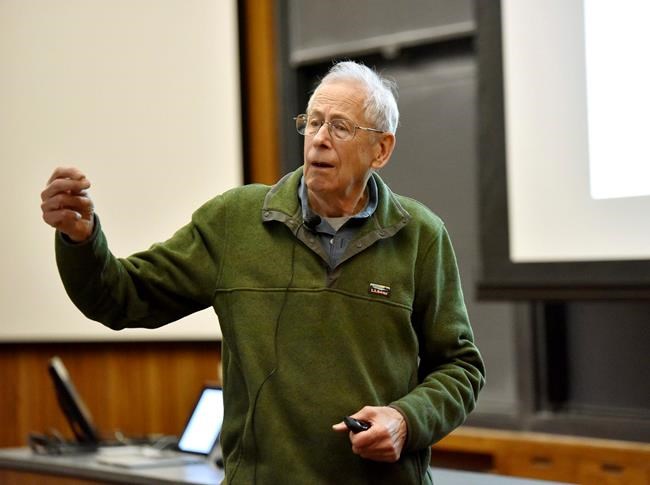
In this 2016 photo provided by Princeton University, James Peebles speaks at the 43rd annual Donald R. Hamilton Lecture, at the university in Princeton, N.J. Peebles was among three scientists who won the 2019 Nobel Prize in Physics on Tuesday, Oct. 8, 2019, for their work in understanding how the universe has evolved, and the Earth's place in it. The prize was given to Peebles
In this 2016 photo provided by Princeton University, James Peebles speaks at the 43rd annual Donald R. Hamilton Lecture, at the university in Princeton, N.J. Peebles was among three scientists who won the 2019 Nobel Prize in Physics on Tuesday, Oct. 8, 2019, for their work in understanding how the universe has evolved, and the Earth's place in it. The prize was given to Peebles "for theoretical discoveries in physical cosmology" and the other half jointly to Michel Mayor and Didier Queloz "for the discovery of an exoplanet orbiting a solar-type star." (Mark Czajkowski/Princeton University via AP)

Peebles, 84, has been retired for 20 years, but he says he has continued to research and teach at a “relaxed rate” because he enjoys it.

“Life will go on,” he said in a phone interview between media events. “I suppose the aura of the Nobel is such that my life will change, but I don’t think I’m going to let it change much.

“You understand, I’m used to a quiet life.”

The Nobel committee said it gave Peebles the honour because his work is the basis of our contemporary ideas about the universe from the big bang to the present day.

“The field has exploded,” Peebles said. “It’s just a remarkable extension of well-tested natural science … so it should be recognized. And I’ve been working on it longer than anyone.”

He also told news conferences Tuesday that while awards are “very much appreciated,” that’s not why young people should study science.

“You should enter it for the love of the science,” he said. “You should enter science because you are fascinated by it. That’s what I did.”

Peebles said part of his childhood in Manitoba was spent building or taking apart thing such as the clocks in his family’s home.

“One of my earliest memories is throwing a tantrum because I wasn’t allowed to put together the coffee percolator,” he said.

“I simply liked looking at the world around us.”

Neil Turok, who worked with Peebles at Princeton and now serves as director of the Centre for the Universe at the Perimeter Institute in Waterloo, Ont., described his former colleague as an unsung hero, famous in the world of cosmology, but seldom recognized outside of it.

“Jim is one of the most modest people in the field. His contributions are frequently overlooked. The experts know you can’t oversee him,” Turok said.

Peebles has honorary doctorates from a string of Canadian universities and is a fellow of the Royal Society of Canada and the Order of Manitoba.

He is also the author or co-author of five books, including “Physical Cosmology” and “Finding the Big Bang.” He said he has a sixth book coming out next year, which maps the history of cosmology from Albert Einstein to today.

Peebles shares the Nobel Prize with Swiss scientists Michel Mayor and Didier Queloz, who won for the discovery of an exoplanet orbiting a solar-type star. Mayor and Queloz announced their discovery 24 years ago.

The three men will share a nine-million kronor (C$1.2 million) cash award, a gold medal and a diploma. The laureates are to receive them at a ceremony in Stockholm on Dec. 10.

Peebles said he plans to give some of his winnings to charity and his family. “I owe a lot to the University of Manitoba and a chunk will go to it.”

David Barnard, president of the University of Manitoba, said Peebles’s achievements have inspired new generations of scientists.

Prime Minister Justin Trudeau tweeted his congratulations and Manitoba Premier Brian Palliser issued a statement.

“As Manitobans, we know looking to the vast night sky is often a powerful experience,” Pallister wrote. “Dr. Peebles has reminded us that it can also be the beginning of a journey towards knowledge, achievement and academic excellence to be shared with the world.”

Peebles is the second Canadian in a row to win the physics prize. The University of Waterloo’s Donna Strickland was honoured last in 2018.

Arthur McDonald, a retired professor at Queen’s University, won physics prize in 2015.

This report by The Canadian Press was first published Oct. 8, 2019.

— With files from The Associated Press and Kelly Geraldine Malone in Winnipeg

Note to readers: This is a corrected story. An early version said Peebles took part in news conferences Friday.

Report Error Submit a Tip

More Stories

Free as can be

AV Kitching 5 minute read Preview

Free as can be

AV Kitching 5 minute read Tuesday, Sep. 15, 2026

Katelyn Sawatzky founded Childfree Winnipeg Women in 2021 to bring together women who don’t have kids — be it by choice or circumstance — and do not plan on raising children.

The group is designed to help them share experiences and build meaningful friendships.

The community welcomes cisgender, straight, transgender, bisexual and lesbian women. Parents, including empty nesters and men, are turned away.

“Our group is a safe space where women can hang out with other women without being asked when you’re going to have kids or why you don’t have kids … where you don’t feel like you have to validate or defend your choices in any way, because everyone gets it,” Sawatzky says.

Read
Tuesday, Sep. 15, 2026

Remove barriers, coalition says

Dan Lett 6 minute read Preview

Remove barriers, coalition says

Dan Lett 6 minute read Monday, Jul. 30, 2018

Game on.

Just two weeks after city council approved a referendum on whether to open Winnipeg’s landmark intersection, an official ‘Yes’ campaign in support of tearing down the barriers has formed.

A coalition of downtown business and land owners, planners, architects and advertising and marketing firms — with the support of organizations such as the Exchange District and Downtown BIZ organizations — has taken up the challenge to defend Mayor Brian Bowman’s vision of a barrier-free Portage and Main.

Organizers said the campaign in favour of re-opening the intersection will be funded by an online crowd-sourcing campaign and will open a storefront headquarters in the shadow of the historic intersection. Lawn signs, promotional videos and mass mail will all be part of the drive to remove pedestrian barriers once and for all.

Read
Monday, Jul. 30, 2018

Hurdy-gurdy show coming to St. Norbert Arts Centre

Ben Waldman 4 minute read Preview

Hurdy-gurdy show coming to St. Norbert Arts Centre

Ben Waldman 4 minute read 2:00 AM CDT

Quintin Bart’s favourite instrument has a name that’s easy to remember and it makes a sound that’s difficult to forget.

Say it with us — hurdy-gurdy.

Functioning like a wheeled, crank-activated violin, Bart’s trapezoidal instrument produces a continuous range of sound by manipulation of two drone strings, two melody strings and one trompette string. As the wheel spins in a single direction, the music created can last as long as the crank turns.

“I like to think of it as an analogue synthesizer,” says Bart, a jazz-minded Winnipeg folk musician who has used the baroque tool in performances with artists including Matt Foster and Raine Hamilton.

Read
2:00 AM CDT

Finding the balance on short-term rentals

Editorial 4 minute read Preview

Finding the balance on short-term rentals

Editorial 4 minute read 2:00 AM CDT

It’s fair to say the advent of Airbnb in 2008 changed the short-term rental market — it and its competitors gave hotels a run for their money, gave homeowners new ways to make an income and helped customers pay less for accommodations.

The change didn’t come without problems. No one is likely to enjoy having rowdy instant condo neighbours who are in town for a day or two to catch a concert and party the night away — nor do quiet neighbourhoods enjoy the constant churn of customers abutting their yards.

But short-term rental owners are taxpayers, too — in fact, when they’re fully compliant with municipal regulations, you can argue that they often pay more than their neighbours. They’re part of the accommodations economy and many owners have seen the rules change during the tenure of their operations, making it harder and harder to turn a profit.

Every time a municipality announces plans to change the rules, owners probably shudder.

Read
2:00 AM CDT

Sweeney’s sexist U.S. gambling-site ad isn’t the real problem

Dan Lett 5 minute read Preview

Sweeney’s sexist U.S. gambling-site ad isn’t the real problem

Dan Lett 5 minute read Wednesday, Sep. 16, 2026

Until very recently, there was no reason to connect actress and model Sydney Sweeney with online sports betting. But the degrees separating these two culture trends evaporated in short order this week.

Sweeney, a pop culture icon who is a source of endless speculation in political circles, made a big splash with a provocative advertising campaign for Novig, a new-generation sports gambling site in the United States. In a promotional video, Sweeney appears largely nude, with strategically placed sports equipment and her long, blonde hair providing just enough cover to keep from being classified as pornography.

“Think you know sports?” Sweeney says seductively in the opening of the video, with two footballs hiding her breasts. “Prove it.”

Novig is a “peer-to-peer” gambling app that allows people south of the border to bet against each other on the outcomes of professional sports, as opposed to betting against “the house,” as is the case with traditional sports books. And it just so happens that Sweeney, either from a direct investment or as payment for her participation in the ad campaign, is now an equity partner in Novig.

Read
Wednesday, Sep. 16, 2026

Selkirk Avenue resident misses sound of silence

Zoe Pierce 4 minute read Preview

Selkirk Avenue resident misses sound of silence

Zoe Pierce 4 minute read Wednesday, Aug. 5, 2026

Selkirk Avenue resident Gail Allard sits on her front steps, looking at a row of tree stumps.

Until last fall, Allard would have opened her front door to a lush canopy of mature trees. Now, she has an unobstructed view of a freight terminal — the Canadian Pacific Kansas City Ltd. intermodal yard.

Although the residential street is quiet on this August afternoon, the steady beeping of machinery moving shipping containers carries throughout the neighbourhood.

It’s the first summer since Manitoba Hydro cut down 262 mature trees — most of them Siberian elms — along Selkirk Avenue between Keewatin and Railway streets.

Read
Wednesday, Aug. 5, 2026