The sound of infinity
Hurdy-gurdy show coming to St. Norbert Arts Centre

Advertisement
Read this article for free:
or
Already have an account? Log in here »
To continue reading, please subscribe:

Digital Subscription
One year of digital access for only $205*
- Enjoy unlimited reading on winnipegfreepress.com
- Read the E-Edition, our digital replica newspaper
- Access News Break, our award-winning app
- Play interactive puzzles
*First annual payment billed as $205.00 + GST for one year. This annual subscription will automatically renew at $233.00 + GST every 52 weeks (10% off the regular annual price of $259.35). Offer available to new and qualified returning subscribers only. Cancel any time.
To continue reading, please subscribe:
Add Free Press access to your Brandon Sun subscription for only an additional
$1 for the first 4 weeks*
- Enjoy unlimited reading on winnipegfreepress.com
- Read the E-Edition, our digital replica newspaper
- Access News Break, our award-winning app
- Play interactive puzzles
*Your next Brandon Sun subscription payment will increase by $1.00 and you will be charged $17.95 plus GST for four weeks. After four weeks, your payment will increase to $24.95 plus GST every four weeks.
Read unlimited articles for free today:
or
Already have an account? Log in here »
Quintin Bart’s favourite instrument has a name that’s easy to remember and it makes a sound that’s difficult to forget.
Say it with us — hurdy-gurdy.
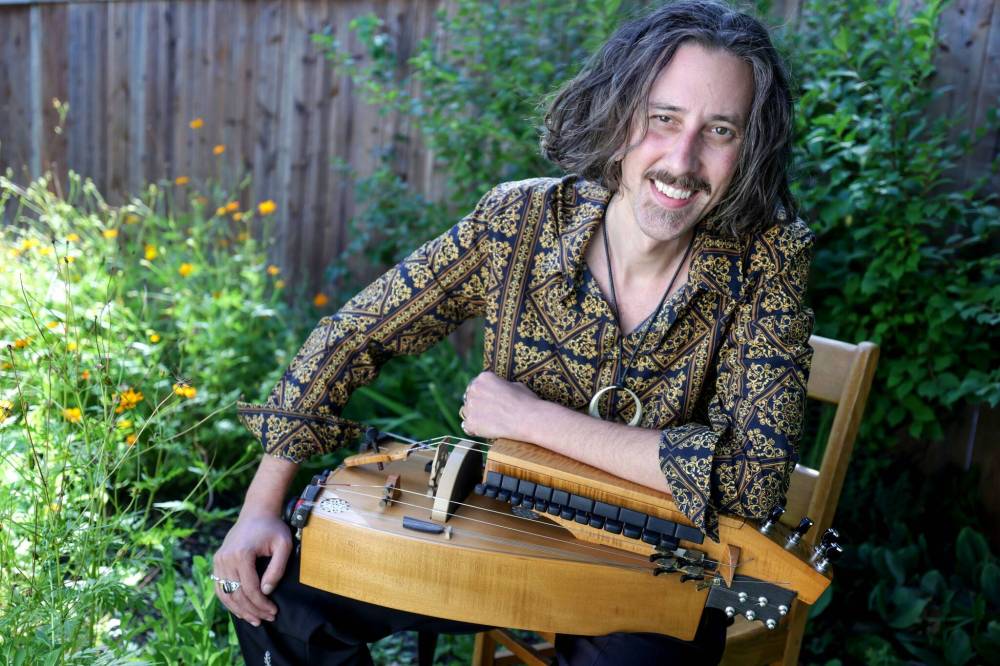
Functioning like a wheeled, crank-activated violin, Bart’s trapezoidal instrument produces a continuous range of sound by manipulation of two drone strings, two melody strings and one trompette string. As the wheel spins in a single direction, the music created can last as long as the crank turns.
Ruth Bonneville / Free Press
Quintin Bart is performing the Oroboro Vignettes, an original collection of neo-Baroque works for the hurdy-gurdy, at St. Norbert Arts Centre Sunday.
“I like to think of it as an analogue synthesizer,” says Bart, a jazz-minded Winnipeg folk musician who has used the baroque tool in performances with artists including Matt Foster and Raine Hamilton.
“It has this very meditative and contemplative nature, especially with that drone. It can be transformative, like time stands still or feels to be moving differently when I’m playing or listening to it. That’s made me think a lot about what we do as performers. I really do feel that music is a kind of sharing of a state of vibration with the performer, both emotionally and intellectually. And listeners may attune to that and meld to it in the performance setting: we draw on the energy of the listener and it creates a circle there as well.”
To Bart, the hurdy-gurdy — which predates the pipe organ as an accompaniment for liturgical service — sounds close to infinity.
In order to get familiarized with the uncommon, millennium-old instrument, Bart had to head east, moving to Budapest in 2010 after graduating from the University of Manitoba with a degree in jazz double bass performance to learn and play with Romano Glaszo, a traditional Romani family band.
“While I was there in Budapest, I encountered the hurdy-gurdy in a music shop. Throughout my life, I’d been interested in that instrument, but because it’s so rare and unusual, especially here in Canada, I never had a chance to hold one and rarely did I get to see one in person. So I brought it home. That was my carry-on luggage,” he says.
The next seven years, Bart studied the instrument’s mechanics and tended to its maintenance, an ongoing concern in the extremes of a Manitoba climate. In 2017, seeking to advance his education, he received Manitoba Arts Council support to study privately in Austria, Switzerland and England with hurdy-gurdy masters Matthias Loibner, Tobie Miller and Nigel Eaton.
“Even though those are the top players in the world, they welcomed me into their studios and gave me a lifetime of musical direction to continue practising afterward,” says Bart, 39.

Those experiences led Bart to develop his own composition cycle on the hurdy-gurdy, a sequence of neo-baroque explorations he calls the Oroboro Vignettes.
“It’s my take on the ancient symbol of a snake eating or chasing its own tail, and to me, it really echoes the infinite sound of the hurdy-gurdy,” he says.
Blending traditions of classical music, Slavic folksong and exploring the history of the instrument itself, the Oroboro Vignettes will be performed Sunday at 7 p.m. at the St. Norbert Arts Centre. Bart will be joined by Natanielle Felicitas (cello), Daniel Koulack (double bass), Monica Jones (tenor sax), and percussionists Daniel Roy and Scott Senior. Clair Tang will play the violin and the erhu, a two-stringed Chinese vertical fiddle.
Tickets are $20 at quintinbart.com.
ben.waldman@winnipegfreepress.com
Ben Waldman covers a little bit of everything for the Free Press.
Our newsroom depends on a growing audience of readers to power our journalism. If you are not a paid reader, please consider becoming a subscriber.
Our newsroom depends on its audience of readers to power our journalism. Thank you for your support.
New shows and releases
JayWood returns to Winnipeg
Though he’s enjoying his time in Montreal, Winnipeg’s Jeremy Haywood-Smith doesn’t like to stay away from home for too long. On Saturday, the artist returns to West Broadway for a headlining set at the Handsome Daughter. With openers Synthetic Friend and Meadows, expect to get a big bang for your buck. ($19 at reallovewpg.com)
Pick fruit with Field Guide & Georgia Harmer
Brandon-raised, Winnipeg-based rocker Field Guide joins forces with Toronto’s Georgia Harmer for a surprise EP released Thursday. On Peaches and Limes, the two Canadian indie stars combine natural sweetness on folky cuts such as Party of One and Time Has Made a Change with drum-machine driven duets Back to the Way and Waste Your Time, reflecting across the record on the onset of adulthood and reaping what they’ve sown. “Don’t you realize we’ve been growing a garden the whole time,” they sing on the title track. “Tomato vines, peaches and limes. We’ve been growing the grapes and soon will drink the wine.”
Grab a ticket to Dan Mangan
It was welcome news last week when the West End Cultural Centre padded its 40th anniversary season with the announcement that Canadian indie-folk favourite Dan Mangan would be visiting the iconic Ellice Avenue venue as part of his National Light tour. Mangan will be joined by Matlock’s Micah Erenberg, the Juno-nominated songwriter behind the Secret Beach. (Oct. 5, tickets $50 at wecc.ca)
Ben Waldman covers a little bit of everything for the Free Press.
Our newsroom depends on a growing audience of readers to power our journalism. If you are not a paid reader, please consider becoming a subscriber.
Our newsroom depends on its audience of readers to power our journalism. Thank you for your support.
Advertisement Advertise With Us
Advertisement Advertise With Us