Opioid deaths highlight need to decriminalize hard-drug possession, police chiefs say

Advertisement

Advertise with us

TORONTO - The scourge of overdose deaths underscores the need for Canada to decriminalize simple possession of hard drugs, the head of the national chiefs of police association said on Thursday.

Read this article for free:


By clicking the button above, an account will be created and you will begin to receive some of our recommended newsletters. You may opt out of any newsletter by visiting your Email and Communication Preferences page or by clicking "unsubscribe" at the bottom of any email.

or

Already have an account? Log in here »

To continue reading, please subscribe:

Digital Subscription

One year of digital access for only $1.44 a week*

  • Enjoy unlimited reading on winnipegfreepress.com
  • Read the E-Edition, our digital replica newspaper
  • Access News Break, our award-winning app
  • Play interactive puzzles

*Billed as $5.77 plus GST every four weeks. After 52 weeks, price increases to the regular rate of $19.95 plus GST every four weeks. Offer available to new and qualified returning subscribers only. Cancel any time.

To continue reading, please subscribe:

Add Free Press access to your Brandon Sun subscription for only an additional

$1 for the first 4 weeks*

  • Enjoy unlimited reading on winnipegfreepress.com
  • Read the E-Edition, our digital replica newspaper
  • Access News Break, our award-winning app
  • Play interactive puzzles
Start now

*Your next Brandon Sun subscription payment will increase by $1.00 and you will be charged $17.95 plus GST for four weeks. After four weeks, your payment will increase to $24.95 plus GST every four weeks.

Hey there, time traveller!
This article was published 28/01/2021 (2105 days ago), so information in it may no longer be current.

TORONTO – The scourge of overdose deaths underscores the need for Canada to decriminalize simple possession of hard drugs, the head of the national chiefs of police association said on Thursday.

In urging action, Bryan Larkin noted that overdose deaths are outpacing those from the COVID-19 pandemic and homicides in British Columbia and likely Ontario.

“Over the last six years, 18,000 Canadians have lost their lives to drug addiction,” Larkin said. “If 18,000 people lost their lives in traffic collisions, our country and our communities would not accept that. There would be outcry.”
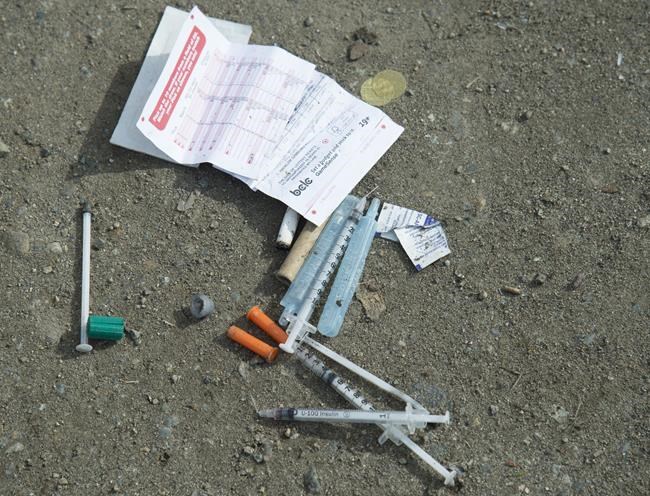
Needles are seen on the ground in Oppenheimer park in Vancouver's downtown eastside on March 17, 2020. The scourge of overdose deaths underscores the need for Canada to decriminalize simple possession of hard drugs, the head of the national chiefs of police association said on Thursday. In urging action, Bryan Larkin noted that overdose deaths are outpacing those from the pandemic and homicides in British Columbia and likely Ontario. THE CANADIAN PRESS/Jonathan Hayward

Larkin, president of the Canadian Association of Chiefs of Police, made his comments at a virtual forum called “Policing 2021.” The issue of decriminalization — as was the case with cannabis — is “polarizing” both within society and within police ranks, he said.

Like many others, Larkin said he was raised to believe “drugs are bad and people who use drugs are criminals.” But criminalization, he said, has disproportionately affected the marginalized and people of colour, and there’s now an awareness that addictions are a mental health issue.

“Nobody wakes up wanting actually to have an addiction,” said Larkin, chief of Waterloo Regional Police Service. “The opioid overdose crisis in Canada doesn’t discriminate.”

Antje McNeely, who is Larkin’s Ontario counterpart, said that changing the mindset of police officers when it comes to dealing with drug abusers was also important.

“We’ve been hard-wired,” said McNeely, police chief in Kingston, Ont. “It is a mind change for the front line and the rest of us as well.”

The national chiefs association raised eyebrows last year when it first began advocating for decriminalization of possession. Discussions on the topic were spurred by the legalization of cannabis and the mounting opioid death toll now exacerbated by the pandemic.

In response, the federal government has been looking at Canada’s drug policy, with a view to reducing opioid-related deaths during the pandemic. Prosecutors were instructed last year to prosecute only the most serious drug-possession offences.

Larkin, who said he has been encouraged by Ottawa’s response, noted the nexus between addictions and mental health, saying more than 10 people kill themselves each day in Canada. That is not something police can fix, he said.

Peter Sloly, chief of the Ottawa Police Service, agreed police need to become a “diminishing” element when it comes to dealing with people in mental health crises.

While police will always have some role in such responses, there needs to be a different model that takes in social services, education and the health-care sector, he said.

“We’ve been not just the last resort, but often the first resort on these types of incidents,” Sloly told the forum. “We’ve become a bit of a Swiss Army knife.”

Sloly cited a program in Eugene, Ore., where up to 90 per cent of mental health calls are handled without hard police intervention. Such changes take years to implement successfully and he warned against moving too quickly.

“There’s a group of people out there who believe that police should have nothing to do with mental health services,” Sloley said. “I just don’t think it is practical.”

The chiefs also acknowledged systemic racism in policing but said the issue was no longer being swept under the rug. At the same time, Sloly said simply addressing the issue within police services won’t fix the wider problem.

“We’re still going to have the conditions that produce crime and victimization, marginalization and discrimination,” he said.

This report by The Canadian Press was first published Jan. 28, 2021

Report Error Submit a Tip

More Stories

Letters, Nov. 3

7 minute read 2:01 AM EST

The times, they aren’t a-changin’

I would like to ask Premier Wab Kinew a very simple question: Why in the world would you want to leave the clocks on permanent daylight time rather than continue changing them twice a year, as Manitobans have been accustomed to doing for decades?

Manitoba is in the geographical middle of Canada. Our time zone should reflect our location and our relationship with the rest of Western Canada.

I simply cannot understand the reasoning behind keeping Manitoba on permanent daylight time. Changing our clocks twice a year has been part of our lives since 1963. Why fix something that has worked for generations?

New artistic director ready to get to work at Sick + Twisted

Ben Waldman 5 minute read Preview

New artistic director ready to get to work at Sick + Twisted

Ben Waldman 5 minute read 2:01 AM EST

After a months-long national search for its next artistic director, Winnipeg’s Sick + Twisted Theatre has found who it’s been looking for in Mandy E. MacLean.

A Maritimer who studied theatre and performance at the University of New Brunswick and at Toronto’s Humber College, MacLean has served in recent years as the artistic and access producer for Toronto’s Crossroads Theatre — a low-barrier, youth-focused company — and as accessibility producer for Ontario’s renowned SummerWorks Festival.

MacLean, who arrived in Winnipeg last month, has long appreciated Sick + Twisted’s core philosophy, developed by former artistic director Debbie Patterson and a strong community of advisers and fellow artists. The company’s overarching goals include changing the way we think about disability in society and to create safe, supportive environments for artists to bring their “full selves” to the work.

MacLean, who was chosen by Sick + Twisted’s selection committee from a field of over 30 applicants, says the new position was intriguing, especially since she worked as an assistant director on the company’s 2025 production of Neither Here nor There, a personal, group-devised exploration of ability and difference that blended mythology, fantasy and reality.

Read
2:01 AM EST

Gilles, Poirier hope winding road leads to podium

Lori Ewing, The Canadian Press 7 minute read Preview

Gilles, Poirier hope winding road leads to podium

Lori Ewing, The Canadian Press 7 minute read Friday, Jan. 21, 2022

What deals should GM Kyle Dubas be looking for? Is the team tough enough?

Read
Friday, Jan. 21, 2022

0 minute read

With the start of 2022 comes a new framework for Manitoba’s real estate industry

Ben Waldman 6 minute read Preview

With the start of 2022 comes a new framework for Manitoba’s real estate industry

Ben Waldman 6 minute read Monday, Jan. 10, 2022

New year, new rules for Manitoba real estate.

On Jan. 1, the Real Estate Services Act came into effect in the province, bringing with it an updated regulatory framework for the local industry to follow, along with some key changes for parties on either side of a real estate transaction.

One of the most notable changes to consumers is likely the introduction of a service agreement requirement: any buyers, sellers, or renters of residential or commercial properties are now required to sign such an agreement with a realtor prior to any services being rendered. But there are other moves that will impact real estate business moving forward.

The regulatory Manitoba Securities Commission’s real estate division consulted with industry groups such as the Manitoba Real Estate Association in drafting the legislation, which replaces the Real Estate Brokers Act, and which the commission’s website says “reflects the changing face” of the provincial real estate landscape.

Read
Monday, Jan. 10, 2022

We don’t vote like our lives depend on it

Judy Waytiuk 5 minute read Preview

We don’t vote like our lives depend on it

Judy Waytiuk 5 minute read 2:00 AM EST

There’s an old saw — we get the government we deserve. It assumes active participation in our elections, full and fair media coverage from which voters can learn and a set of viable, capable candidates from which we can choose.

Arguably, those conditions did not apply this time around in Winnipeg. Our voter turnout was just 38 per cent and Mayor Scott Gillingham’s victory came from just 15 per cent of Winnipeg’s eligible voters. Two supposedly serious competitors embroiled themselves — by choice — in juvenile mudslinging and offered scattered, chaotic policy platforms.

A fourth contender surged from behind in the closing weeks of the campaign — and Noah Redden had spent most of the campaign being thought of as one of the pack of gadflies that emerge to run every time there’s a mayoralty campaign here. Yet he virtually tied Kevin Klein for second place. Had Redden been treated during the campaign as a viable candidate (he was the only one to publish online a detailed, thought-through policy platform), who knows what would have happened?

Absorb those facts.

Read
2:00 AM EST