Feds looking at permanent remote work, office needs after COVID-19

Advertisement

Advertise with us

OTTAWA - The federal government is taking a close look at the amount of office space it will need in the coming years as it considers how some of Canada's hundreds of thousands of federal public servants could end up working from home permanently.

Read this article for free:


or

Already have an account? Log in here »

To continue reading, please subscribe:

Subscribe and receive a limited-edition Free Press branded hat or tote.

Digital Subscription

One year of digital access for only $205*

  • Enjoy unlimited reading on winnipegfreepress.com
  • Read the E-Edition, our digital replica newspaper
  • Access News Break, our award-winning app
  • Play interactive puzzles

*First annual payment billed as $205.00 + GST for one year. This annual subscription will automatically renew at $233.00 + GST every 52 weeks (10% off the regular annual price of $259.35). Offer available to new and qualified returning subscribers only. Cancel any time.

To continue reading, please subscribe:

Add Free Press access to your Brandon Sun subscription for only an additional

$1 for the first 4 weeks*

  • Enjoy unlimited reading on winnipegfreepress.com
  • Read the E-Edition, our digital replica newspaper
  • Access News Break, our award-winning app
  • Play interactive puzzles
Start now

*Your next Brandon Sun subscription payment will increase by $1.00 and you will be charged $17.95 plus GST for four weeks. After four weeks, your payment will increase to $24.95 plus GST every four weeks.

Hey there, time traveller!
This article was published 22/06/2020 (2242 days ago), so information in it may no longer be current.

OTTAWA – The federal government is taking a close look at the amount of office space it will need in the coming years as it considers how some of Canada’s hundreds of thousands of federal public servants could end up working from home permanently.

The review was revealed Monday by Treasury Board President Jean-Yves Duclos, who oversees the bureaucracy as a workforce, as the government released a guide for the eventual return of public servants to their normal workplaces.

The vast majority of federal public servants have been working from home since mid-March as COVID-19 saw offices and other workspaces across the country shuttered to slow transmission of the illness.
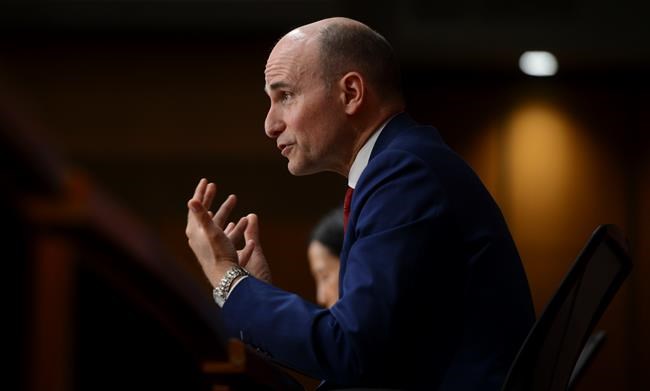
President of the Treasury Board Jean-Yves Duclos takes part in a press conference on Parliament Hill amid the COVID-19 pandemic in Ottawa on Monday, June 15, 2020. Canada's roughly 250,000 federal public servants are being primed for an eventual return to their workplaces, though many are expected to continue working remotely for the foreseeable future.THE CANADIAN PRESS/Sean Kilpatrick

While there have been some hiccups and criticisms, Duclos said significant lessons have been learned — and efficiencies realized — over the past three months even as the government dramatically ramped up the ability for bureaucrats to work remotely.

That included doubling the number of secure internet connections available to public servants and tripling the number of minutes available for teleconferences so workers and supervisors can stay in touch and co-ordinate their activities.

As a result, “we’ve started really reflecting on the number of offices and the number of office spaces we want over the next few years,” Duclos said during the daily COVID-19 ministerial news conference in Ottawa.

The comments coincided with the release of a 30-page document aimed at providing guidance to federal public servants at all levels for getting back into their offices even though the pandemic continues to pose a threat.

The guidebook includes directions to senior management to take into consideration their departments’ own requirements as well as the circumstances of individual employees and their families. It also makes clear that the return to “normal” will take time.

“Employees whose work can be done remotely should continue to take advantage of recent investments in IT infrastructure and digital skills, as the work and equipment permit,” the guidebook tells federal workers.

“Employees who are considered vulnerable as defined by public health agencies should be supported to continue to work remotely when possible; this includes people with chronic illnesses or are immuno-suppressed (or living with others who qualify).”

Federal departments and agencies are also directed to track and report on cases of COVID-19 among their staff, which includes tracking incidents in which employees refuse to work on safety grounds.

“Noting that health authorities have stated that physical distancing measures should remain, these plans will make provisions for the fact that many public servants will continue to work remotely for some time to come,” Duclos said.

He promised federal public servants would receive “reasonable notice and assurances” about safety measures before being asked to return to their offices.

The Public Service Alliance of Canada, the biggest federal-government union, was largely happy with the government’s plan. But it did express concerns about the level of discretion managers have in forcing employees back to work.

“We hope to see some uniformity throughout all the departments and even inside the same department depending on their region,” said PSAC national executive vice-president Magali Picard.

“It’s really not clear if they’re going to be trained, if they’re going to have one person in HR or Treasury Board who’s going to give advice to the management team. But this is not completely covered inside that plan.”

Picard also flagged concerns about any move toward permanent remote work for federal public servants that goes too fast, saying that while there are potential benefits, experience has also shown that such a working environment is not for everyone.

“We know because we had some workers working from home before the pandemic,” she said, noting that some employees feel isolated while provisions must also be made for ergonomic workplaces and mental-health support.

“It’s not true that after four months that we know exactly what is going to be the impact on workers working from home all the time.”

The federal public service has been praised for the speed with which it has rolled out a variety of support programs such as the Canada Emergency Response Benefit during the pandemic.

It has also been criticized for the closure of Service Canada offices across the country since March, particularly as minimum-wage employees in grocery stores and other workplaces continued to work.

There have also been concerns about the impact that working from home has had on the federal access-to-information system along with tasks requiring access to sensitive government material such as military procurement.

This report by The Canadian Press was first published June 22, 2020.

Report Error Submit a Tip

More Stories

Today’s horoscope

Georgia Nicols 4 minute read Preview

Today’s horoscope

Georgia Nicols 4 minute read 2:00 AM CDT

MOON ALERT: Caution! Avoid shopping or major decisions after noon today. The solar eclipse (new moon) in Leo peaks at 12:37 p.m.

ARIES (March 21-April 19)

This is the perfect time to hatch some new ideas and plans, perhaps related to vacations, your kids or an artistic project that appeals. Even though it’s a sudden decision, it might lead to more stability in the future.

TAURUS (April 20-May 20)

Read
2:00 AM CDT

Grim outlook for airport authority

Temur Durrani 5 minute read Preview

Grim outlook for airport authority

Temur Durrani 5 minute read Thursday, Apr. 29, 2021

The Winnipeg Airports Authority revealed a particularly grim outlook of their consolidated financial statements at their annual public meeting Thursday morning.

A year marred by COVID-19, executive members from the airports authority said urgent support is needed from the federal government to save them from their dire future beyond the pandemic, outlining the many ways in which Ottawa has failed regional airports like Winnipeg's so far.

Nicole Stefaniuk, vice-president of finance and administration, said 2020 was the worst year in the airport's history — mostly because passengers typically make up about 90 per cent of airport revenue and because almost 80 per cent of costs are fixed items the authority has to continue paying (such as utilities, personnel employment and taxes).

Passenger traffic fell from an average of 12,300 travellers per day to less than 250 people on a good day for Winnipeg's airport — a symptom of mandated lockdowns, border closures and travel restrictions across Canada.

Read
Thursday, Apr. 29, 2021

Tabulating long-term impact of long COVID

Dan Lett 6 minute read Preview

Tabulating long-term impact of long COVID

Dan Lett 6 minute read Monday, Feb. 7, 2022

Throughout a career dedicated to health research, Dr. Alan Katz had never seen anything like it.

In fall 2021, it was announced the Manitoba Centre for Health Policy (which Katz leads) had been awarded a grant to study “long COVID-19,” the name given to the prolonged suffering experienced by people who contracted, and survived, the novel coronavirus.

Soon after the news broke, Katz said something extraordinary happened: he started getting direct calls from people who believed they were suffering from long COVID, and who wanted to participate in the study.

“I’ve done research for a long time and I’d never seen anything like it before,” he said.

Read
Monday, Feb. 7, 2022

Gas, travel limits in parts of B.C. after storm

Camille Bains, The Canadian Press 5 minute read Preview

Gas, travel limits in parts of B.C. after storm

Camille Bains, The Canadian Press 5 minute read Friday, Nov. 19, 2021

VANCOUVER - The British Columbia government is rationing gasoline and restricting travel in southern parts of the province after an unprecedented storm severed highways and cut supply lines.

Public Safety Minister Mike Farnworth said Friday a limit of 30 litres of fuel per visit to a gas station is an important step to maintaining the supply as the province works to bring in more gas by truck and barge from Alberta, Washington state, Oregon and California.

He said the order would apply for 10 to 11 days, and he trusts that people won't be greedy and will keep critical services in mind as they focus on residents whose communities have been devastated by flooding.

The orders apply to residents of Vancouver Island, the Gulf Islands, southwestern parts of the province and the Sunshine Coast.

Read
Friday, Nov. 19, 2021

South Korea protests penalties assessed in short track

The Associated Press 3 minute read Preview

South Korea protests penalties assessed in short track

The Associated Press 3 minute read Tuesday, Feb. 8, 2022

Quebec City MP Joël Lightbound said Tuesday that governments shouldn’t dismiss the concerns of people who want health measures to be lifted.

Read
Tuesday, Feb. 8, 2022

Surgery backlog, St. Boniface ER big-ticket items in health budget

Danielle Da Silva 5 minute read Preview

Surgery backlog, St. Boniface ER big-ticket items in health budget

Danielle Da Silva 5 minute read Tuesday, Apr. 12, 2022

The provincial government will spend more than $200 million this year to tackle the massive backlog of surgeries and expand emergency room capacity, while slashing its COVID-19 response budget.

Finance Minister Cameron Friesen said his government will spend a combined $7.2 billion to deliver health care, mental health and addictions services, a new seniors strategy and deliver promised improvements to long term care in 2022-23, representing a 2.5 per cent spending increase over last year.

The provincial budget, unveiled Tuesday, includes $9 million to fund 28 new critical care beds provincewide; $100 million for the redevelopment of the St. Boniface Hospital emergency department; and $110 million to expedite an estimated 167,000 surgical and diagnostic cases that were delayed due to the pandemic.

“Our government is very serious about driving down these times that were elongated as a consequence of a global pandemic,” Friesen said. “That’s why we’re putting a very significant effort into combating that.”

Read
Tuesday, Apr. 12, 2022