Feds looking at permanent remote work, office needs after COVID-19

Advertisement

Advertise with us

OTTAWA - The federal government is taking a close look at the amount of office space it will need in the coming years as it considers how some of Canada's hundreds of thousands of federal public servants could end up working from home permanently.

Read this article for free:


or

Already have an account? Log in here »

To continue reading, please subscribe:

Subscribe and receive a limited-edition Free Press branded hat or tote.

Digital Subscription

One year of digital access for only $205*

  • Enjoy unlimited reading on winnipegfreepress.com
  • Read the E-Edition, our digital replica newspaper
  • Access News Break, our award-winning app
  • Play interactive puzzles

*First annual payment billed as $205.00 + GST for one year. This annual subscription will automatically renew at $233.00 + GST every 52 weeks (10% off the regular annual price of $259.35). Offer available to new and qualified returning subscribers only. Cancel any time.

To continue reading, please subscribe:

Add Free Press access to your Brandon Sun subscription for only an additional

$1 for the first 4 weeks*

  • Enjoy unlimited reading on winnipegfreepress.com
  • Read the E-Edition, our digital replica newspaper
  • Access News Break, our award-winning app
  • Play interactive puzzles
Start now

*Your next Brandon Sun subscription payment will increase by $1.00 and you will be charged $17.95 plus GST for four weeks. After four weeks, your payment will increase to $24.95 plus GST every four weeks.

Hey there, time traveller!
This article was published 22/06/2020 (2273 days ago), so information in it may no longer be current.

OTTAWA – The federal government is taking a close look at the amount of office space it will need in the coming years as it considers how some of Canada’s hundreds of thousands of federal public servants could end up working from home permanently.

The review was revealed Monday by Treasury Board President Jean-Yves Duclos, who oversees the bureaucracy as a workforce, as the government released a guide for the eventual return of public servants to their normal workplaces.

The vast majority of federal public servants have been working from home since mid-March as COVID-19 saw offices and other workspaces across the country shuttered to slow transmission of the illness.
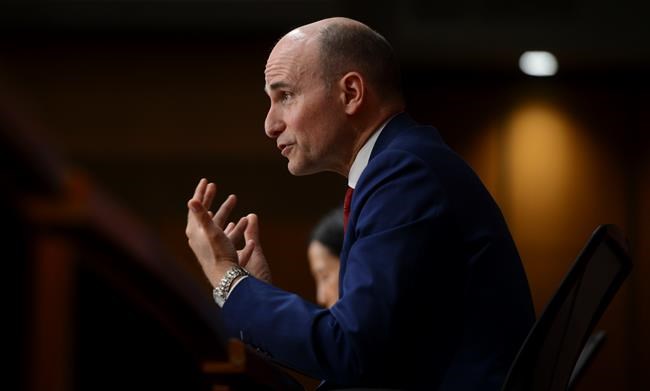
President of the Treasury Board Jean-Yves Duclos takes part in a press conference on Parliament Hill amid the COVID-19 pandemic in Ottawa on Monday, June 15, 2020. Canada's roughly 250,000 federal public servants are being primed for an eventual return to their workplaces, though many are expected to continue working remotely for the foreseeable future.THE CANADIAN PRESS/Sean Kilpatrick

While there have been some hiccups and criticisms, Duclos said significant lessons have been learned — and efficiencies realized — over the past three months even as the government dramatically ramped up the ability for bureaucrats to work remotely.

That included doubling the number of secure internet connections available to public servants and tripling the number of minutes available for teleconferences so workers and supervisors can stay in touch and co-ordinate their activities.

As a result, “we’ve started really reflecting on the number of offices and the number of office spaces we want over the next few years,” Duclos said during the daily COVID-19 ministerial news conference in Ottawa.

The comments coincided with the release of a 30-page document aimed at providing guidance to federal public servants at all levels for getting back into their offices even though the pandemic continues to pose a threat.

The guidebook includes directions to senior management to take into consideration their departments’ own requirements as well as the circumstances of individual employees and their families. It also makes clear that the return to “normal” will take time.

“Employees whose work can be done remotely should continue to take advantage of recent investments in IT infrastructure and digital skills, as the work and equipment permit,” the guidebook tells federal workers.

“Employees who are considered vulnerable as defined by public health agencies should be supported to continue to work remotely when possible; this includes people with chronic illnesses or are immuno-suppressed (or living with others who qualify).”

Federal departments and agencies are also directed to track and report on cases of COVID-19 among their staff, which includes tracking incidents in which employees refuse to work on safety grounds.

“Noting that health authorities have stated that physical distancing measures should remain, these plans will make provisions for the fact that many public servants will continue to work remotely for some time to come,” Duclos said.

He promised federal public servants would receive “reasonable notice and assurances” about safety measures before being asked to return to their offices.

The Public Service Alliance of Canada, the biggest federal-government union, was largely happy with the government’s plan. But it did express concerns about the level of discretion managers have in forcing employees back to work.

“We hope to see some uniformity throughout all the departments and even inside the same department depending on their region,” said PSAC national executive vice-president Magali Picard.

“It’s really not clear if they’re going to be trained, if they’re going to have one person in HR or Treasury Board who’s going to give advice to the management team. But this is not completely covered inside that plan.”

Picard also flagged concerns about any move toward permanent remote work for federal public servants that goes too fast, saying that while there are potential benefits, experience has also shown that such a working environment is not for everyone.

“We know because we had some workers working from home before the pandemic,” she said, noting that some employees feel isolated while provisions must also be made for ergonomic workplaces and mental-health support.

“It’s not true that after four months that we know exactly what is going to be the impact on workers working from home all the time.”

The federal public service has been praised for the speed with which it has rolled out a variety of support programs such as the Canada Emergency Response Benefit during the pandemic.

It has also been criticized for the closure of Service Canada offices across the country since March, particularly as minimum-wage employees in grocery stores and other workplaces continued to work.

There have also been concerns about the impact that working from home has had on the federal access-to-information system along with tasks requiring access to sensitive government material such as military procurement.

This report by The Canadian Press was first published June 22, 2020.

Report Error Submit a Tip

More Stories

DAZN hires former Bombers QB Streveler as CFL, NFL analyst

Taylor Allen 6 minute read Preview

DAZN hires former Bombers QB Streveler as CFL, NFL analyst

Taylor Allen 6 minute read Yesterday at 5:53 PM CDT

As soon as Chris Streveler tore his ACL, he basically knew his gridiron career was over.

Last October, when the Winnipeg Blue Bombers hosted the Montreal Alouettes in the regular-season finale, the quarterback went down with a non-contact injury just minutes into the game.

Streveler had torn three of the four major ligaments in that same left knee during the 2024 Banjo Bowl and worked tirelessly to make it back for the 2025 season.

This time, however, a path to a return wasn’t going to be viable.

Read
Yesterday at 5:53 PM CDT

International Peace Garden 9/11 remembrance ‘especially meaningful’

Alex Lambert 6 minute read Preview

International Peace Garden 9/11 remembrance ‘especially meaningful’

Alex Lambert 6 minute read Yesterday at 5:05 PM CDT

INTERNATIONAL PEACE GARDEN — Hundreds of people on the American side of the International Peace Garden, which straddles the Manitoba-North Dakota border, bowed their heads and observed a moment of silence Friday on the 25th anniversary of the 9/11 terrorist attacks.

Firefighters, politicians, military members and aviation officials were part of the ceremony at the garden, held to remember and honour the nearly 3,000 people who died and the heroic acts of first responders.

“Twenty-five years have passed, but the significance of that day has not diminished,” said Dave Schellenberg, the vice-chair of the Manitoba Association of Fire Chiefs.

On Sept. 11, 2001, terrorists hijacked four planes and flew two of them into the World Trade Center’s Twin Towers in New York City and a third one into the Pentagon in Washington, D.C., while a fourth one that was targeted to hit the White House crashed into a field in Pennsylvania. The attacks were orchestrated by al-Qaida.

Read
Yesterday at 5:05 PM CDT

Banjo Bowl a big deal for new and returning faces

Ken Wiebe 7 minute read Preview

Banjo Bowl a big deal for new and returning faces

Ken Wiebe 7 minute read Yesterday at 6:16 PM CDT

Kenneth Womack never doubted this day would come.

For all of the twists and turns along this journey, Womack believed in himself and the work he’s been putting in on the road to becoming a professional football player.

So, as the Winnipeg Blue Bombers receiver gets set to make his CFL on Saturday afternoon against the Saskatchewan Roughriders in the Banjo Bowl, you can be sure he’s going to take a moment to savour the experience while doing his best to make it feel like any other game he’s played previously.

“Once I run out the tunnel, it’s all going to sink in,” Womack said after Friday’s walkthrough.

Read
Yesterday at 6:16 PM CDT

Ottawa assessing office needs after COVID-19

Lee Berthiaume, The Canadian Press 5 minute read Preview

Ottawa assessing office needs after COVID-19

Lee Berthiaume, The Canadian Press 5 minute read Monday, Jun. 22, 2020

OTTAWA - The federal government is taking a close look at the amount of office space it will need in the coming years as it considers how some of Canada's hundreds of thousands of federal public servants could end up working from home permanently.

The review was revealed Monday by Treasury Board President Jean-Yves Duclos, who oversees the bureaucracy as a workforce, as the government released a guide for the eventual return of public servants to their normal workplaces.

The vast majority of federal public servants have been working from home since mid-March as COVID-19 saw offices and other workspaces across the country shuttered to slow transmission of the illness.

While there have been some hiccups and criticisms, Duclos said significant lessons have been learned — and efficiencies realized — over the past three months even as the government dramatically ramped up the ability for bureaucrats to work remotely.

Read
Monday, Jun. 22, 2020

9 to 5:

Tory McNally 8 minute read Preview

9 to 5:

Tory McNally 8 minute read 2:00 AM CDT

I watched the 1980 comedy 9 to 5 for the first time this week.

I know: I’m an HR consultant. I’ve been doing this work for 13 years, I write about workplaces for a living, and somehow I had never actually watched the movie that gave us one of the most recognizable workplace songs of all time.

I knew the premise, of course. I knew American music icon Dolly Parton was in it. I knew there was a terrible boss and three women who eventually decided they had enough.

I expected a funny, somewhat dated movie about three women getting revenge on an awful boss. What I didn’t expect was to spend the next two hours thinking about how much has changed in the workplace since 1980 — and how much really hasn’t.

Read
2:00 AM CDT

The port of Churchill — but done right

Editorial 4 minute read Preview

The port of Churchill — but done right

Editorial 4 minute read 2:00 AM CDT

The seagoing grain carrier wasn’t christened with a champagne bottle. There was no confetti or streamers. Nevertheless, the Aug. 31 event marking the first shipment of grain to be loaded at the Port of Churchill since 2020 was celebrated like the launch of a brand new vessel.

The presence of the federal minister of northern and arctic affairs, provincial cabinet ministers and leaders and elders from several northern First Nations signalled that the fast-tracked process of refurbishing and buffing up Manitoba’s deep-water seaport gem is gaining momentum.

For OneNorth, the partnership of 29 First Nations and 12 northern communities which owns the Port of Churchill and the Hudson Bay Railway (both operated by the Arctic Gateway Group) the event heralded a new beginning. It’s been eight years since OneNorth purchased the port and railroad, and six years since grain was moved by rail through Manitoba and then by ship to European markets. Two more grain shipments, plus shipments of potash and critical minerals, will continue through the fall.

When Prime Minister Mark Carney solicited the premiers to suggest “nation-building” projects following his election in 2025, Premier Wab Kinew pitched a Manitoba trade corridor that would move wheat, critical minerals, potash and energy (oil or liquid natural gas) through the Port of Churchill.

Read
2:00 AM CDT