EXPLAINER: Why are China’s COVID rules so strict?

Advertisement

Advertise with us

BEIJING (AP) — At the outbreak of the COVID-19 pandemic, China set out its “zero-COVID” measures that were harsh, but not out of line with what many other countries were doing to try and contain the virus. While most other nations saw the health and safety regulations as temporary until vaccines were widely available, however, China has stuck steadfastly to its strategy.

Read this article for free:


or

Already have an account? Log in here »

To continue reading, please subscribe:

Subscribe and receive a limited-edition Free Press branded hat or tote.

Digital Subscription

One year of digital access for only $205*

  • Enjoy unlimited reading on winnipegfreepress.com
  • Read the E-Edition, our digital replica newspaper
  • Access News Break, our award-winning app
  • Play interactive puzzles

*First annual payment billed as $205.00 + GST for one year. This annual subscription will automatically renew at $233.00 + GST every 52 weeks (10% off the regular annual price of $259.35). Offer available to new and qualified returning subscribers only. Cancel any time.

To continue reading, please subscribe:

Add Free Press access to your Brandon Sun subscription for only an additional

$1 for the first 4 weeks*

  • Enjoy unlimited reading on winnipegfreepress.com
  • Read the E-Edition, our digital replica newspaper
  • Access News Break, our award-winning app
  • Play interactive puzzles
Start now

*Your next Brandon Sun subscription payment will increase by $1.00 and you will be charged $17.95 plus GST for four weeks. After four weeks, your payment will increase to $24.95 plus GST every four weeks.

Hey there, time traveller!
This article was published 29/11/2022 (1399 days ago), so information in it may no longer be current.

BEIJING (AP) — At the outbreak of the COVID-19 pandemic, China set out its “zero-COVID” measures that were harsh, but not out of line with what many other countries were doing to try and contain the virus. While most other nations saw the health and safety regulations as temporary until vaccines were widely available, however, China has stuck steadfastly to its strategy.

Weary of the policy that has confined millions of people to their homes in an attempt to isolate every infection, and with an eye on the freedoms now enjoyed elsewhere around the world, protests have broken out around China in recent days.

Though some anti-virus restrictions have been eased in some places, the ruling Communist Party has affirmed its “zero-COVID” strategy. Here are some of the regulations:
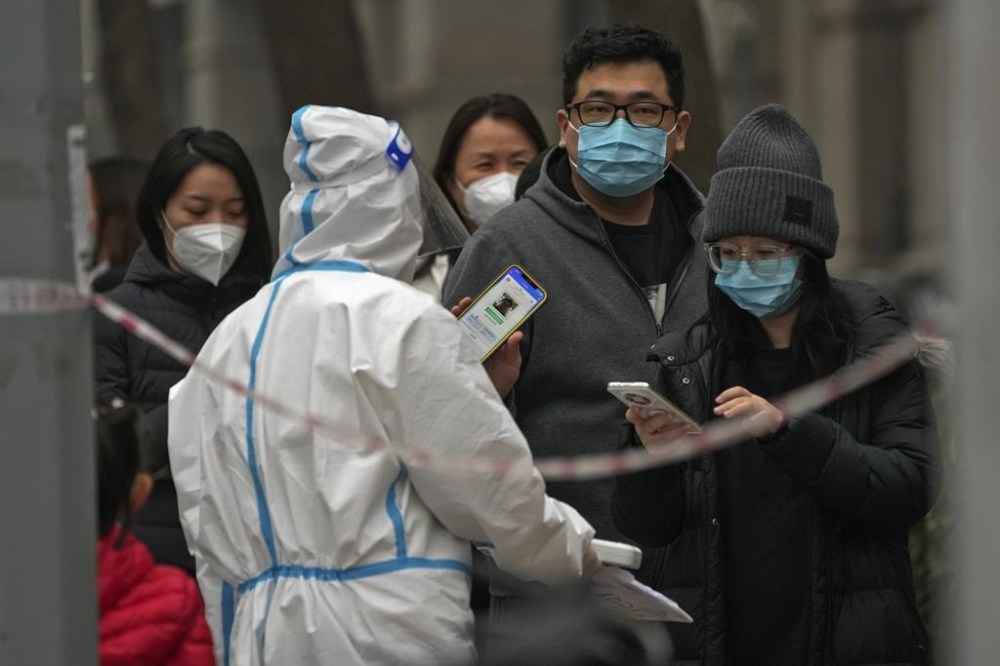
FILE - A man shows his health check QR code as he and others line up to get their routine COVID-19 throat swabs at a coronavirus testing site in Beijing, Thursday, Nov. 24, 2022. (AP Photo/Andy Wong, File)

TESTS AND QUARANTINE FOR INBOUND PASSENGERS

Inbound travelers need to take a PCR test before flying and quarantine in a hotel for five days and at home for three days upon arrival. That may seem strict, but prior to updated regulations earlier this month, travelers needed to take two PCR tests before flying and quarantine for seven days in a hotel and three days at home. Before that, the quarantine period was 14 days.

China also ended its “circuit breaker” policy of shutting down a flight for a week or two if a certain percentage of passengers aboard tested positive for COVID-19, with the length of the ban dependent upon how many had the virus.

ISOLATION ON DOMESTIC ROUTES

Travelers on domestic flights, trains or buses who are close contacts of someone with COVID-19 need to quarantine for five days at designated sites, plus three days at home. Prior to November changes, the quarantine time was longer and the close contacts of the person with close contact to someone with COVID-19 also needed to isolate. People who visited areas in China deemed “high-risk” also need to quarantine for seven days at home.

GREEN CODE

Inside China, individuals need to show their personal “green code” — indicating they are COVID-19-negative — when entering public places like shopping malls and restaurants, or when using public transit. Everyone must register with their identification papers, and the code is then displayed through a smartphone app. Staying “green” means not contracting COVID-19, not being a close contact of someone with the virus, and not visiting areas deemed to be a risk. If there is an outbreak in your area, local authorities may require regular testing to keep the code green. In Beijing at the moment, for example, residents must undergo a rapid coronavirus test at least every 48 hours at a government-approved facility.

WHO GOES INTO LOCKDOWN?

China has reacted quickly and decisively to any detection of COVID-19, and has locked down parts of, or entire cities. At the moment the central urban area of Chongqing, with about 10.3 million people, is on lockdown, as is part of Guangzhou.

The decision on what to lock down depends on the scale of the outbreak. Smaller lockdowns of buildings, building compound areas or city districts are common. Entire apartment building units are locked down if a single resident is found to have COVID-19, and people are not allowed to leave for at least five days. Food and other essential supplies can be ordered for delivery.

FILE - Government Chief Information Officer Victor Lam holds a mobile phone to unveil a new COVID-19 tracking health code mobile app during a news conference in Hong Kong, Thursday, Dec. 2, 2021. (AP Photo/Kin Cheung, File)

Similarly, office buildings are locked down if someone in the building tests positive for COVID-19 until the building can be disinfected, a process that usually takes several days.

OTHER RESTRICTIONS

China has in place many other regulations that would be familiar to most from the early months of the pandemic. Social distancing is encouraged, and people have to wear masks in public venues. In areas where there is believed to be a risk of transmission, there are restrictions on large gatherings, restaurants are closed for indoor dining, and enhanced disinfection measures are required at public venues.

Much like the bubble measures imposed for the 2022 Winter Olympics in Beijing, facilities where people are deemed most at risk, like nursing homes, have “closed-loop management” plans in place, under which workers live in their workplaces with no outside contacts.

___

AP news researchers Caroline Chen and Yu Bing contributed to this report.

Report Error Submit a Tip

More Stories

Today’s horoscope

Georgia Nicols 4 minute read Preview

Today’s horoscope

Georgia Nicols 4 minute read Yesterday at 2:00 AM CDT

MOON ALERT: There are no restrictions to shopping or important decisions. The moon is in Aries.

ARIES (March 21-April 19)

This is a wonderful, energetic day. The moon in your sign is dancing with lucky Jupiter promoting domestic peace and happiness. It’s a great day for business. But your top choice will be to socialize, enjoy fun activities with kids, check out sporting events or slip away on a vacation. .

TAURUS (April 20-May 20)

Read
Yesterday at 2:00 AM CDT

New series terrific addition to RWB repertoire

Holly Harris 5 minute read Preview

New series terrific addition to RWB repertoire

Holly Harris 5 minute read Saturday, Sep. 26, 2026

‘See the music, hear the dance,” is a famous quote from quintessential ballet influencer George Balanchine, whose pithy bons mots have defined much of American classical dance since the legendary Russian-born choreographer first blazed a trail with the New York City Ballet.

Local balletomanes were given a golden opportunity to experience both up-close-and-personal Thursday when the Royal Winnipeg Ballet officially kicked off its 87th season with its newly minted Studio Series, which runs until Sunday.

The brainchild of the company’s artistic director, Christopher Stowell, the series features an abridged “concert version” of Balanchine’s seminal Who Cares?, set to a playlist of catchy George Gershwin tunes that make up the backbone of the Great American Songbook.

The Studio Series is the latest initiative taken by Stowell as he settles into his arguably still new position. Some of those endeavours will invariably stumble; others will hit their mark. This venture belongs in the latter category, bringing a 500-plus-year-old art form, often perceived as rarified, to audience members who may be hesitant, shy or just plain intimidated to visit the cavernous Centennial Concert Hall.

Read
Saturday, Sep. 26, 2026

Fans will pay the price as Blue Bombers freed from financial tether

Paul Wiecek 6 minute read Preview

Fans will pay the price as Blue Bombers freed from financial tether

Paul Wiecek 6 minute read Friday, Sep. 28, 2018

The Manitoba Tories said this week they’ve “saved” the Winnipeg Blue Bombers.

I’d argue quite to the contrary, they’ve doomed the Bombers -- and the rest of us suckers -- to decades more of lousy football on the field and mismanagement off of it.

In a classic example of government coming up with a solution to a problem that doesn’t exist, the province announced this week it has written-off another huge chunk of the loan it gave the Bombers to help build Investors Group Field, and is now in negotiations with the CFL team to lower the annual mortgage payments it has been making.

How low can they go? Strap in -- this is going to be a free fall.

Read
Friday, Sep. 28, 2018

Olympians crossed the sportsmanship line with bites, kicks and brawls

Doug Speirs  11 minute read Preview

Olympians crossed the sportsmanship line with bites, kicks and brawls

Doug Speirs  11 minute read Saturday, Jul. 31, 2021

You might say Moroccan boxer Youness Baalla really sank his teeth into the Olympic spirit during his opening bout at the Summer Games in Tokyo.

That’s because Baalla, 22, tried to literally take a bite out of opponent David Nyika’s ear late in the third and final round of his loss to the New Zealand fighter.

Baalla decided to channel Mike Tyson — who famously took a chunk out of Evander Holyfield’s ear during a championship fight at Madison Square Garden in 1997 — during a clinch in the centre of the ring.

The fight continued and Nyika, who was one of New Zealand’s flag bearers at the Games opening ceremony, registered a 5-0 win to book a spot in the quarter-finals. He was surprised the referee didn’t see the attempted bite, which was only picked up on television.

Read
Saturday, Jul. 31, 2021

EXPLAINER: Why are China’s COVID rules so strict?

The Associated Press 5 minute read Preview

EXPLAINER: Why are China’s COVID rules so strict?

The Associated Press 5 minute read Tuesday, Nov. 29, 2022

BEIJING (AP) — At the outbreak of the COVID-19 pandemic, China set out its “zero-COVID” measures that were harsh, but not out of line with what many other countries were doing to try and contain the virus. While most other nations saw the health and safety regulations as temporary until vaccines were widely available, however, China has stuck steadfastly to its strategy.

Weary of the policy that has confined millions of people to their homes in an attempt to isolate every infection, and with an eye on the freedoms now enjoyed elsewhere around the world, protests have broken out around China in recent days.

Though some anti-virus restrictions have been eased in some places, the ruling Communist Party has affirmed its “zero-COVID” strategy. Here are some of the regulations:

TESTS AND QUARANTINE FOR INBOUND PASSENGERS

Read
Tuesday, Nov. 29, 2022

Winnipeg a character all its own onscreen

Jen Zoratti 4 minute read Preview

Winnipeg a character all its own onscreen

Jen Zoratti 4 minute read Saturday, Sep. 26, 2026

Watch something shot in Winnipeg with a Winnipegger, and you will be treated to a live running commentary. We can’t help playing “spot the location.”

When we recognize that field/statue/mall/intersection/theatre, we have to say it. It’s practically civically mandated.

A friend told me she was at a film screening at which people literally applauded footage of the Mint. (That likely would have been 2005’s The Constant Gardener.)

Being excited about seeing Portage Place Mall at Christmastime in the trailer for Violent Night 2 — and then exclaiming, to your husband, “Oh, look, it’s Portage Place Mall at Christmastime!” — is not, I will admit, particularly cosmopolitan behaviour. In fact, I could be accused of suffering from a mild case of Podunkitis.

Read
Saturday, Sep. 26, 2026