Saskatchewan’s top doctor not recommending mask as respiratory virus rates rise

Advertisement

Advertise with us

REGINA - Saskatchewan’s chief medical health officer is not recommending masks as the province deals with a trifecta of respiratory viruses.

Read this article for free:


By clicking the button above, an account will be created and you will begin to receive some of our recommended newsletters. You may opt out of any newsletter by visiting your Email and Communication Preferences page or by clicking "unsubscribe" at the bottom of any email.

or

Already have an account? Log in here »

To continue reading, please subscribe:

Digital Subscription

One year of digital access for only $1.44 a week*

  • Enjoy unlimited reading on winnipegfreepress.com
  • Read the E-Edition, our digital replica newspaper
  • Access News Break, our award-winning app
  • Play interactive puzzles

*Billed as $5.77 plus GST every four weeks. After 52 weeks, price increases to the regular rate of $19.95 plus GST every four weeks. Offer available to new and qualified returning subscribers only. Cancel any time.

To continue reading, please subscribe:

Add Free Press access to your Brandon Sun subscription for only an additional

$1 for the first 4 weeks*

  • Enjoy unlimited reading on winnipegfreepress.com
  • Read the E-Edition, our digital replica newspaper
  • Access News Break, our award-winning app
  • Play interactive puzzles
Start now

*Your next Brandon Sun subscription payment will increase by $1.00 and you will be charged $17.95 plus GST for four weeks. After four weeks, your payment will increase to $24.95 plus GST every four weeks.

Hey there, time traveller!
This article was published 15/11/2022 (1446 days ago), so information in it may no longer be current.

REGINA – Saskatchewan’s chief medical health officer is not recommending masks as the province deals with a trifecta of respiratory viruses.

Dr. Saqib Shahab said coughs and colds are returning after a two-year hiatus, and that people can expect to get sick two to four times a year.

“Ultimately, it’s your personal choice to wear a mask,” Shahab said Tuesday.

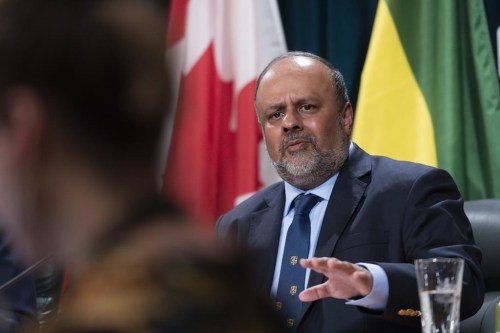
Saqib Shahab, chief medical health officer, speaks at a COVID-19 news update at the Legislative Building in Regina on March 18, 2020. THE CANADIAN PRESS/Michael Bell

Instead of recommending everyone wear masks in public settings, Shahab said people need to do their own risk assessment and stay home when sick.

He said the flu and respiratory syncytial virus are more prominent in the province, with COVID-19 having hit a plateau.

Saskatchewan’s latest respiratory illness surveillance report shows the influenza test positivity rate is nearly 22 per cent, with RSV having a test positivity of about two per cent.

COVID-19 has a test positivity rate of about 10 per cent, while other respiratory illnesses have a test positivity rate of nearly 32 per cent.

The report says COVID-19 hospitalizations in the province have plateaued since August, with about 176 people being admitted every week.

“We knew that as fall comes, and as we move indoors, we will see the usual respiratory viruses that we always used to see and didn’t see the last couple of years come up,” Shahab said. “Now we have respiratory season plus COVID.”

He said the best way people can prevent the health-care system from getting overburdened is by getting vaccinated against the flu and COVID-19.

Unlike Ontario, where some health-care services have been put on hold, Saskatchewan Minister Health Minister Paul Merriman said so far no procedures have been cancelled due to increased pressures on hospitals.

However, the triple threat of viruseshasaffected schools.

Shahab said absenteeism rates in some classrooms show about 50 to 60 per cent of students out sick, while other classrooms have a lower rate.

“I don’t get concerned when I hear of high absenteeism,” Shahab said. “I’d be more concerned ifthere arelots of viruses going around and there’s low absenteeism because that means kids are going to school sick.”

Shahab said there is no plan to bring back a mask mandate in schools to address the rise in children getting sick, adding that most of the illnesses are mild and can be treated with rest and plenty of fluids.

He said a mask mandate in schools may not be helpful because children are involved in after-school activities, social events and sleepovers — where viruses are known to spread the most in close-knit indoor settings.

“Mandate — it requires everyone wearing masks. I don’t think schools or medical health officers will like to go there,” Shahab said.

“I never say never to anything … but (we’re) probably not going towards a mask mandate at this point.”

This report by The Canadian Press was first published Nov. 15, 2022.

Report Error Submit a Tip

More Stories

Transit driver killed in knife attack on U of M campus

8 minute read Preview

Transit driver killed in knife attack on U of M campus

8 minute read Tuesday, Feb. 14, 2017

A Winnipeg Transit driver was killed early this morning after he was stabbed by the only passenger on his bus at the University of Manitoba campus.

Irvine Jubal Fraser, 58, was rushed to hospital in critical condition but later died, police said.

The attack occurred at about 2 a.m. in the area of Dafoe Road West and Gillson Street.

Witnesses pointed officers led by the canine unit in the direction of the Red River, where a 22-year-old suspect trying to cross to the St. Vital side was arrested and taken into custody.

Read
Tuesday, Feb. 14, 2017

Ottawa announces $500 million for North End sewage plant upgrade

Joyanne Pursaga 4 minute read Preview

Ottawa announces $500 million for North End sewage plant upgrade

Joyanne Pursaga 4 minute read 5:03 PM CDT

The federal government will provide $500 million to help complete the major upgrade to Winnipeg’s North End sewage treatment plant.

Winnipeg South MP Terry Duguid confirmed the total funding at a news conference at the plant Friday, calling the work critical to Winnipeg’s future.

“The stakes could not be higher. Without expanded wastewater treatment, Winnipeg would run out of capacity to build new homes and accommodate new industries within six years,” said Duguid.

The commitment offers the final funding needed to cover the $1.57-billion third and final phase of the upgrade. The city and province will also pay $500 million each for the work.

Read
5:03 PM CDT

Err on the side of lung health

Mitch Calvert 6 minute read Saturday, Aug. 16, 2025

This summer, Manitobans aren’t just sweating under the August sun — we’re coughing, wheezing and blinking through a haze so thick you could mistake Portage Avenue for a foggy morning in San Francisco.

Recent air-quality readings put Winnipeg at the worst in Canada, with PM2.5 levels soaring well past the “very unhealthy” threshold. Health experts aren’t mincing words: prolonged exposure to this kind of pollution can increase risks of heart attacks, worsen asthma and even impact brain function and mental health. It’s not just your lungs feeling the burn, it’s your energy, recovery and overall resilience.

And while the headlines are everywhere, the lesson isn’t: you can’t out-train bad air. The basics of health — movement, nutrition, recovery — don’t change, but how you approach them needs to adjust when the environment throws you a curveball.

Here’s how to stay fit despite the forest-fire smoke.

Saskatchewan’s top doctor not recommending mask as respiratory virus rates rise

Mickey Djuric, The Canadian Press 3 minute read Preview

Saskatchewan’s top doctor not recommending mask as respiratory virus rates rise

Mickey Djuric, The Canadian Press 3 minute read Tuesday, Nov. 15, 2022

REGINA - Saskatchewan’s chief medical health officer is not recommending masks as the province deals with a trifecta of respiratory viruses.

Dr. Saqib Shahab said coughs and colds are returning after a two-year hiatus, and that people can expect to get sick two to four times a year.

"Ultimately, it's your personal choice to wear a mask," Shahab said Tuesday.

Instead of recommending everyone wear masks in public settings, Shahab said people need to do their own risk assessment and stay home when sick.

Read
Tuesday, Nov. 15, 2022

Science-art collaboration injects dose of emotion into cold, hard truths

Sarah Lawrynuik 5 minute read Preview

Science-art collaboration injects dose of emotion into cold, hard truths

Sarah Lawrynuik 5 minute read Wednesday, Apr. 28, 2021

Looking at spreadsheets and map plots of trees is far beyond Rhian Brynjolson’s typical day as a visual artist, but she became entranced and inspired by data collected by Canadian scientists for a new art project.

Her hope is to try and bring the numbers, map dots and statistics to life in a new way to help the public better connect to climate science.

Falcon Lake’s Brynjolson is one of 12 Canadian artists who participated in an art-science collaboration exhibit, co-ordinated by the Global Water Futures program out of the University of Saskatchewan. The project saw the artists paired with researchers and scientists across the country who then engaged in conversations to try to inspire a new angle to their art.

“The whole idea behind it is: water is life,” says Louise Arnal, the project lead, and a post-doctoral fellow at the Centre for Hydrology and Coldwater Laboratory.

Read
Wednesday, Apr. 28, 2021

City rec facilities crumbling

Ryan Thorpe 6 minute read Preview

City rec facilities crumbling

Ryan Thorpe 6 minute read Monday, Oct. 22, 2018

Throughout Winnipeg, decades-old community assets — pools, arenas and recreation and leisure centres — are deteriorating so quickly that service disruptions are inevitable.

Meanwhile, the city’s community services department, which is responsible for managing those assets, operates with an annual deficit of roughly $80 million, meaning there are scant resources to do little more than bail water on a sinking ship.

Soon, Winnipeggers will have a choice: fewer community services or higher costs.

“It poses a huge challenge because we have very limited dollars that we have to invest in our existing facilities. We also have growing demands for new amenities in new areas. We have to be very strategic,” said Ken McKim, manager of asset management for the department.

Read
Monday, Oct. 22, 2018