N.L. making COVID-19 rapid tests widely available for first time since pandemic hit

Advertisement

Advertise with us

ST. JOHN'S, N.L. - Newfoundland and Labrador health officials are making COVID-19 rapid tests widely and freely available to the public for the first time since the pandemic began.

Read this article for free:


or

Already have an account? Log in here »

To continue reading, please subscribe:

Subscribe and receive a limited-edition Free Press branded hat or tote.

Digital Subscription

One year of digital access for only $205*

  • Enjoy unlimited reading on winnipegfreepress.com
  • Read the E-Edition, our digital replica newspaper
  • Access News Break, our award-winning app
  • Play interactive puzzles

*First annual payment billed as $205.00 + GST for one year. This annual subscription will automatically renew at $233.00 + GST every 52 weeks (10% off the regular annual price of $259.35). Offer available to new and qualified returning subscribers only. Cancel any time.

To continue reading, please subscribe:

Add Free Press access to your Brandon Sun subscription for only an additional

$1 for the first 4 weeks*

  • Enjoy unlimited reading on winnipegfreepress.com
  • Read the E-Edition, our digital replica newspaper
  • Access News Break, our award-winning app
  • Play interactive puzzles
Start now

*Your next Brandon Sun subscription payment will increase by $1.00 and you will be charged $17.95 plus GST for four weeks. After four weeks, your payment will increase to $24.95 plus GST every four weeks.

Hey there, time traveller!
This article was published 15/11/2022 (1420 days ago), so information in it may no longer be current.

ST. JOHN’S, N.L. – Newfoundland and Labrador health officials are making COVID-19 rapid tests widely and freely available to the public for the first time since the pandemic began.

Chief medical officer of health Dr. Janice Fitzgerald told reporters today that officials will mail two test kits to every family in the province.

Test kits will also be available at provincial libraries and at the constituency offices of members of the legislature.
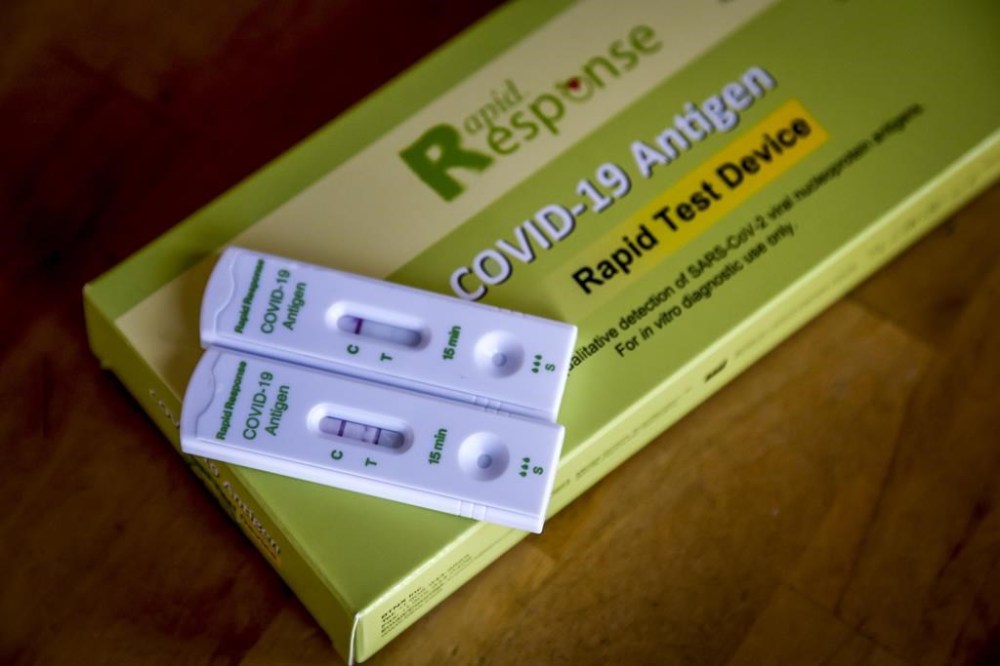
Positive, left, and negative COVID-19 antigen rapid tests are pictured in Calgary, Alta., Tuesday, Jan. 4, 2022. THE CANADIAN PRESS/Jeff McIntosh

Previously, the province had issued test kits to families with school-aged children.

Otherwise, residents had to purchase rapid test kits at pharmacies and drugstores, often for more than $20 each.

Fitzgerald says making rapid tests available to everyone will allow people to make better decisions about their risks of contracting and spreading the virus.

Meanwhile, the province is not seeing the early arrival of influenza season or the high cases of respiratory viruses reported in other provinces such as Ontario and Quebec, she said.

That could change, Fitzgerald said, and she urged residents to get vaccinated against COVID-19 and the flu. Masks are still recommended, and residents should wear them if they think they’re at risk of being exposed to a respiratory infection, she said.

“The recommendation may become stronger as time goes on and as we see changes,” Fitzgerald said, adding that she doesn’t believe the current levels of respiratory illness in the province warrant another mask mandate.

“Before you start infringing on people’s rights, that you have to have the evidence to support doing so and that there’s really no other way to mitigate that risk,” she said.

This report by The Canadian Press was first published Nov. 15, 2022.

Report Error Submit a Tip

More Stories

Hydro Québec faces issue we should avoid

Editorial 4 minute read Preview

Hydro Québec faces issue we should avoid

Editorial 4 minute read 2:01 AM CDT

You might be tempted to call it a canary in an electric power generation coal mine.

But instead, it’s just another heads-up into the already-obvious problem with the proliferation of data centres.

This week, Hydro-Québec went before the Régie de l’énergie, Québec’s public utilities board, to change the rules for new and existing large data centres.

Now, it was not that long ago that Hydro Québec was actively wooing data centres — offering bulk power rates to be used to lure labour-intensive, power-hungry heavy industry (think aluminum smelters) with rates substantially lower than they offer Québec’s own residential customers. It was a way to use surplus power to create jobs and drive economic activity.

Read
2:01 AM CDT

Tokyo Olympic aftermath still being untangled a year later

Stephen Wade, The Associated Press 7 minute read Preview

Tokyo Olympic aftermath still being untangled a year later

Stephen Wade, The Associated Press 7 minute read Thursday, Jul. 21, 2022

TOKYO (AP) — The Tokyo Olympics survived the COVID-19 postponement, soaring expenses and some public opposition. A year later, the costs and benefits remain as difficult to untangle as the Games were to pull off.

In his speech at the closing ceremony, IOC President Thomas Bach said a major accomplishment of the Games was simply reaching the end.

“We did it,” Bach said. “We did it together," he repeated, crediting the athletes, Japanese government officials, and deep-pocketed broadcasters for refashioning the Games despite no fans, disappointed sponsors, and no buzz around the city.

Organizers said the Games would drive tourism, showcase Japan's technological prowess, and create memories similar to the 1964 Tokyo Olympics. The pandemic erased that.

Read
Thursday, Jul. 21, 2022

Keeping the lights on

Hal Turner 4 minute read 2:00 AM CDT

Manitobans are hardy.

We live, work and play in one of the harshest winter climates in the world.

We’re used to the cold and the dark. We’re also used to escaping it by turning on the lights and the heat.

Manitoba Hydro’s responsibility is to make sure that works, no matter what and no matter when.

Figure skating coach Callaghan banned by SafeSport

The Associated Press 2 minute read Preview

Figure skating coach Callaghan banned by SafeSport

The Associated Press 2 minute read Wednesday, Aug. 21, 2019

Richard Callaghan, who coached Tara Lipinski to Olympic gold, has been banned from figure skating by the U.S. Center for SafeSport for sexual misconduct.

Callaghan, who also coached six-time U.S. champion Todd Eldredge, was ruled "permanently ineligible" on Wednesday for actions involving a minor. Callaghan was accused by a former student, Adam Schmidt, in a lawsuit. Schmidt alleged that Callaghan sexually abused him from 1999-2001. Schmidt was 14 in 1999.

Also in 1999, Callaghan was investigated for sexual misconduct involving another coach, Craig Maurizi, but U.S. Figure Skating dismissed those charges. Maurizi said the incidents began in 1976 when he was 13, and continued for years.

Now 73, Callaghan was suspended in March 2018 by SafeSport and by the federation. He sued SafeSport, but the lawsuit was dismissed.

Read
Wednesday, Aug. 21, 2019

Ottawa commits $8.1 million for downtown Y redevelopment

Kelly-Anne Riess 2 minute read Preview

Ottawa commits $8.1 million for downtown Y redevelopment

Kelly-Anne Riess 2 minute read Monday, Sep. 28, 2026

The federal government is backing a major redevelopment of Winnipeg’s Downtown Y that will expand community programs and update the century-old Vaughan Street building.

On Monday, Ottawa committed $8.1 million toward the Y’s plans to expand newcomer and mental-health programs.

The project will also upgrade elevators, change rooms, aquatics and fitness areas and energy systems. Construction is expected to begin in October, according to the Y’s website.

The YMCA-YWCA is contributing $3.5 million to the project.

Read
Monday, Sep. 28, 2026

Thank Manitoba’s teachers by investing in students

Lillian Klausen 5 minute read 2:00 AM CDT

Manitoba’s students are settling into a new school year. Whether you graduated in 1986 or 2006, today’s classrooms look very different from the ones you remember.

Students reflect the changing makeup of our communities — differences in social, emotional, physical and cognitive abilities and socioeconomic stresses are all increasingly present and adding to the complexity of our classrooms.

Meeting these differing individual needs is no easy feat. It requires manageable class sizes, school counsellors, social workers, specialized resource teachers and investment in the systems that can help students thrive. But when those supports aren’t available, students’ needs don’t disappear. Increasingly, it falls to classroom teachers to try to fill the gaps.

When I started working as a teacher more than 30 years ago, we had budgets for resources when we needed them. Today, the needs of students have diversified and increased, but the funding for our public schools is failing to meet them.