Ontario docs advise masks, vaccine catch-up ahead of anticipated tough viral season

Advertisement

Advertise with us

TORONTO - Ontarians are being advised to keep up with vaccinations and wear masks indoors as doctors warn of a worsening respiratory illness season that's hitting children – and the pediatric health system – particularly hard.

Read this article for free:


By clicking the button above, an account will be created and you will begin to receive some of our recommended newsletters. You may opt out of any newsletter by visiting your Email and Communication Preferences page or by clicking "unsubscribe" at the bottom of any email.

or

Already have an account? Log in here »

To continue reading, please subscribe:

Digital Subscription

One year of digital access for only $1.44 a week*

  • Enjoy unlimited reading on winnipegfreepress.com
  • Read the E-Edition, our digital replica newspaper
  • Access News Break, our award-winning app
  • Play interactive puzzles

*Billed as $5.77 plus GST every four weeks. After 52 weeks, price increases to the regular rate of $19.95 plus GST every four weeks. Offer available to new and qualified returning subscribers only. Cancel any time.

To continue reading, please subscribe:

Add Free Press access to your Brandon Sun subscription for only an additional

$1 for the first 4 weeks*

  • Enjoy unlimited reading on winnipegfreepress.com
  • Read the E-Edition, our digital replica newspaper
  • Access News Break, our award-winning app
  • Play interactive puzzles
Start now

*Your next Brandon Sun subscription payment will increase by $1.00 and you will be charged $17.95 plus GST for four weeks. After four weeks, your payment will increase to $24.95 plus GST every four weeks.

Hey there, time traveller!
This article was published 09/11/2022 (1453 days ago), so information in it may no longer be current.

TORONTO – Ontarians are being advised to keep up with vaccinations and wear masks indoors as doctors warn of a worsening respiratory illness season that’s hitting children – and the pediatric health system – particularly hard.

Physicians at a news conference hosted by the Ontario Medical Association said Wednesday that influenza arrived early in the province and more than half of Canadian cases of the illness so far have been in children and teenagers.

The early arrival of the flu, a resurgence in respiratory syncytial virus, or RSV, and the continued spread of COVID-19 has made for a “triple threat” respiratory season that’s sending many children to the hospital and the situation is expected to get worse in the coming months, doctors said.
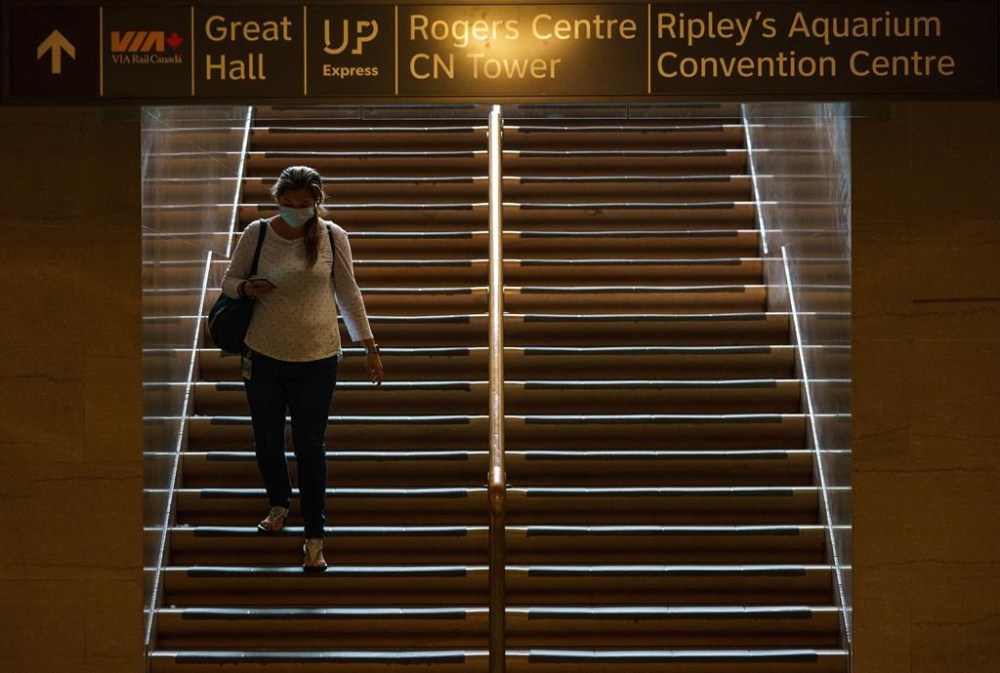
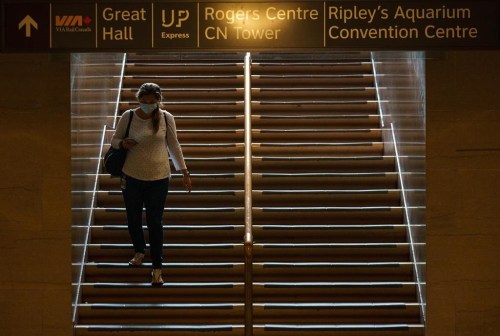
A commuter wears a mask while walking down the stairs at Union Station in Toronto on Friday, Sept. 16, 2022. Ontario doctors are advising that people wear masks indoors and keep up with vaccinations amid a worsening respiratory illness season that's hitting children particularly hard. THE CANADIAN PRESS/Alex Lupul

“It’s a little bit of a perfect storm,” said Dr. Rod Lim, emergency medical director of the ER at the Children’s Hospital in London, Ont.

The pediatric health-care system is under significant strain due to staffing challenges, medication supply chain issues and early circulation of viruses that typically peak in January, February and March, Lim said.

“Most of us in the pediatric sector are bracing ourselves for an incredibly challenging winter,” he said.

Lim’s hospital is currently seeing “record volumes,” including young infants arriving with difficulty breathing, and he said he expects the high hospitalization numbers from viral illnesses “will get worse before it gets better.”

His comments came as an Ottawa children’s hospital said Wednesday that it was opening a second intensive care unit to treat an “unprecedented” number of critically ill babies and young children amid the early viral season.

Dr. Rose Zacharias, president of the Ontario Medical Association, said her organization is urging the public to get vaccinated against influenza and keep up-to-date with COVID-19 shots.

Masks are not currently required in most spaces in Ontario. Zacharias said the association is following public health advice around masks, but recommended people wear masks in crowded indoor spaces and around those who are more at risk. She also said “we need to be prepared to pivot” with viral illness trends.

“Our entire conversation today is around the increasing risk of respiratory illnesses and we know that masks can protect there,” she said.

Some medical experts have begun to call for renewed mask mandates in light of viral illness trends and pressures on hospitals, and Toronto’s board of health this week asked its top doctor to explore mandatory masking as an option to mitigate disease spread.

Ontario’s chief medical officer told The Canadian Press last week that he would make a decision soon about masking recommendations based on viral illness trends that are straining the health system.

Dr. Kieran Moore said he would make a recommendation on masking in certain indoor settings if the backlog of delayed surgeries is affected by COVID-19, and would recommend reinstating mask mandates if there are further effects.

Premier Doug Ford said Wednesday that he would follow Moore’s advice when it comes to masks, but said people should wear a mask if they can and know they are at risk.

He said he planned to get a flu shot and a fourth COVID-19 vaccine soon, and advised that others do the same.

“I’m going to head out there and get my fourth one. I’m going to get a flu shot because I can’t chance it, old guys like me,” he said. “We’re going to get a shot just to be safe.”

Dr. Vinita Dubey, associate medical officer of health for Toronto, said masks can help reduce the spread of various viral illnesses that are circulating in the province, including COVID-19, and noted that children were able wear them in school without issue for much of the pandemic.

She said there are ways to boost uptake of masks without officially mandating them, if the chief medical officer of health strongly recommends them.

“With that strong recommendation, mask usage does increase even without having to go to a mandate,” she said.

The Ontario Liberal health critic also discussed health system pressures on Wednesday, sharing data showing wait times for emergency room visits and ambulance offloads grew longer in September compared with a year earlier.

Adil Shamji, who is also a physician, called on the government to share more real-time data on the situation in hospitals, and said masking is one solution the province could implement “very quickly and easily” to reduce pressures.

“(Masking) would be very effective in curbing the spread of these respiratory viruses and decreasing the burden on our health-care system,” he said.

This report by The Canadian Press was first published Nov. 9, 2022.

Report Error Submit a Tip

More Stories

Province’s first female dentist took skill, insight wherever needed

David Sanderson    25 minute read Preview

Province’s first female dentist took skill, insight wherever needed

David Sanderson    25 minute read Saturday, Apr. 3, 2021

Some stories take longer to get around to than others.

In the fall of 2011 I hooked up with Fiona Odlum at an Academy Road Starbucks for a lighthearted feature about people who report on traffic for a living. Odlum, currently a contributor at CBC Saskatchewan, was working for 680 CJOB at the time, clueing rush-hour commuters in on stalls, lane closures and fender-benders they’d be wise to avoid.

Odlum turned the tables at one point by asking a few questions of her own including, “So, what’s your main beat?”

I don’t really have one, I told her, but if pressed, I would probably go with human-interest pieces.

Read
Saturday, Apr. 3, 2021

Has the political wind changed?

Gwynne Dyer 5 minute read Yesterday at 2:01 AM CDT

It has been quite a week. First we had “Lula” – Luiz Inácio da Silva (as nobody but his mother ever called him) – defying everybody’s expectations. After winding up two million votes behind his challenger, Flávio Bolsonaro, in the first round of the Brazilian presidential election, he made a “miraculous” comeback in the second.

It was like a man going into a revolving door behind you and coming out in front. At the end of the first round, Lula was two million votes behind; at the end of the second round on Oct. 25 he was four million votes ahead. So how did he win a fourth term without cheating?

That’s what Bolsonaro claims he did, having fled to the United States; Trump, Flávio’s mentor, hints at the same. But Lula’s victory was not miraculous. He only learned to read when he was 10, and at 80 he still refused to have a mobile phone. His team finally made him get one and use it.

He wouldn’t do social media videos, so they created a WhatsApp channel called Lula’s Army, and made him appear on it at least daily. The channel went from zero to 10.8 million viewers in two weeks, and Lula won.

Imperialist crusades: 21st-century style

John R. Wiens 5 minute read Preview

Imperialist crusades: 21st-century style

John R. Wiens 5 minute read Wednesday, Jul. 8, 2026

In the 11th century and lasting into the 13th, the papacy launched a series of at least eight military campaigns we now refer to as the Crusades, or Holy Wars. They were an imperialistic call to arms for Christians to retake Jerusalem, which was at the time under Muslim rule.

Spiritual rewards for participation were implied, and other incentives offered, to dull the extra taxation demanded to fund the campaigns. Over time, the “crusades” morphed to become massacres of not only Muslims but also Jews and Christian dissidents — in other words, any enemies of the papacy. If today’s news sounds like déjà vu all over again, it probably should.

The stories keep repeating themselves in many forms. We now know that two 20th century world wars, global in scope, were caused by imperialistic ambitions, changes in the balance of international powers and corresponding arms races. The first was attributed to the assassination of the heir to the Austro-Hungarian throne by a Bosnian Serb, a kind of “regime change” initiative. The second resulted from rising tensions between Allied and Axis powers, triggered by the rise of European fascism and Japanese militarism. The human toll of both was unimaginable.

In the First World War, 15 to 22 million people, including soldiers and civilians, were killed and another 23 million were wounded. These numbers do not account for those otherwise affected — victims of chemical warfare whose compromised health shortened their lives; of the subsequent Spanish flu epidemic amplified by the displacement of peoples; others who died from other diseases caused by war conditions; and those who were malnourished or starved. Nor do they account for the ongoing trauma and resentments passed on intergenerationally to this day.

Read
Wednesday, Jul. 8, 2026

Ontario docs advise masks, vaccine catch-up ahead of anticipated tough viral season

Holly McKenzie-Sutter, The Canadian Press 5 minute read Preview

Ontario docs advise masks, vaccine catch-up ahead of anticipated tough viral season

Holly McKenzie-Sutter, The Canadian Press 5 minute read Wednesday, Nov. 9, 2022

TORONTO - Ontarians are being advised to keep up with vaccinations and wear masks indoors as doctors warn of a worsening respiratory illness season that's hitting children – and the pediatric health system – particularly hard.

Physicians at a news conference hosted by the Ontario Medical Association said Wednesday that influenza arrived early in the province and more than half of Canadian cases of the illness so far have been in children and teenagers.

The early arrival of the flu, a resurgence in respiratory syncytial virus, or RSV, and the continued spread of COVID-19 has made for a "triple threat" respiratory season that's sending many children to the hospital and the situation is expected to get worse in the coming months, doctors said.

"It’s a little bit of a perfect storm," said Dr. Rod Lim, emergency medical director of the ER at the Children's Hospital in London, Ont.

Read
Wednesday, Nov. 9, 2022

RRC Polytech program cuts take bite out of hospitality, tourism sector

Maggie Macintosh 4 minute read Preview

RRC Polytech program cuts take bite out of hospitality, tourism sector

Maggie Macintosh 4 minute read Saturday, May. 2, 2026

Manitoba’s tourism industry is bracing for the disappearance of hospitality training programs — once-popular courses among international students.

Citing budgetary challenges related to a shift in federal immigration policy, Red River College Polytechnic is scrapping 11 programs and scaling back three others in 2026-27. Its hospitality business management diploma is one of seven permanent casualties.

The announcement, while unsurprising, is but the latest blow to a sector trying to “build back the workforce” in the wake of the COVID-19 pandemic, said Michael Juce, president of the Manitoba Hotel Association.

“Are people going to go outside of Manitoba for training? And if they leave, are they going to come back?” Juce said, adding that rural hotels in particular are already grappling with staffing shortages.

Read
Saturday, May. 2, 2026

Fact Check

1 minute read Thursday, Nov. 30, 2023

Fact Check

Having problems with the form?Contact Us Directly |