COVID hospitalizations rise in Quebec, minister criticized for overly optimistic tone

Advertisement

Advertise with us

MONTREAL - The number of COVID-19 hospitalizations is increasing across Quebec, but the rise is not as rapid as in previous waves and is not being felt in intensive care units, Health Minister Christian Dubé said Wednesday.

Read this article for free:


By clicking the button above, an account will be created and you will begin to receive some of our recommended newsletters. You may opt out of any newsletter by visiting your Email and Communication Preferences page or by clicking "unsubscribe" at the bottom of any email.

or

Already have an account? Log in here »

To continue reading, please subscribe:

Digital Subscription

One year of digital access for only $1.44 a week*

  • Enjoy unlimited reading on winnipegfreepress.com
  • Read the E-Edition, our digital replica newspaper
  • Access News Break, our award-winning app
  • Play interactive puzzles

*Billed as $5.77 plus GST every four weeks. After 52 weeks, price increases to the regular rate of $19.95 plus GST every four weeks. Offer available to new and qualified returning subscribers only. Cancel any time.

To continue reading, please subscribe:

Add Free Press access to your Brandon Sun subscription for only an additional

$1 for the first 4 weeks*

  • Enjoy unlimited reading on winnipegfreepress.com
  • Read the E-Edition, our digital replica newspaper
  • Access News Break, our award-winning app
  • Play interactive puzzles
Start now

*Your next Brandon Sun subscription payment will increase by $1.00 and you will be charged $17.95 plus GST for four weeks. After four weeks, your payment will increase to $24.95 plus GST every four weeks.

Hey there, time traveller!
This article was published 12/10/2022 (1479 days ago), so information in it may no longer be current.

MONTREAL – The number of COVID-19 hospitalizations is increasing across Quebec, but the rise is not as rapid as in previous waves and is not being felt in intensive care units, Health Minister Christian Dubé said Wednesday.

Health officials reported a rise of 207 COVID-19 patients, for a total of 2,030 — the first time hospitalizations rose above 2,000 since mid-August. They said 595 patients are in hospital because of the disease.

Hospitalizations are on the rise, Dubé told reporters in Montreal, because there has been a steady increase in infections over the past four weeks, particularly among people 70 and over and among health-care workers.

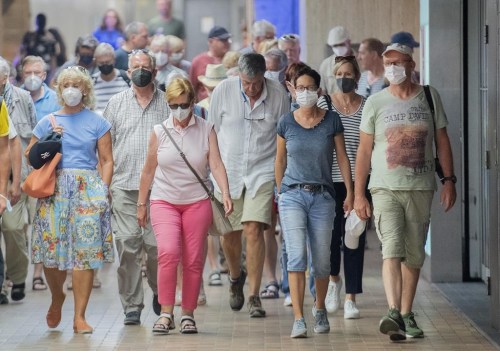
People wear face masks as they walk through a subway station in Montreal, Sunday, July 17, 2022, as the COVID-19 pandemic continues in the province. The number of hospitalizations linked to COVID-19 in Quebec has risen above 2,000 for the first time since mid-August. THE CANADIAN PRESS/Graham Hughes

“It’s not the kind of exponential increase we’ve seen before and this increase is not being felt in intensive care at the moment, which is also good news, so it’s different from the seventh wave that we had in the summer,” Dubé said.

But Roxane Borgès Da Silva, a professor at Université de Montréal’s school of public health, said Dubé’s message is too positive. The situation is worsening in Europe, she said, adding that in France, nearly 95,000 new COVID-19 cases were detected Tuesday and hospitalizations have risen significantly.

“The context is not so reassuring,” she said in an interview Wednesday, adding that the impact of new variants remains unknown and that the arrival of flu season at a time when COVID-19 hospitalizations are rising could put heavy pressure on Quebec’s health-care system.

“Their positivism worries me, because it sends too positive a message compared to the uncertainty that we face this fall,” she said about Dubé and public health director Dr. Luc Boileau.

Dubé said the best way to protect the health-care system is for people to get a COVID-19 vaccine booster, adding that anyone whose last shot was more than five months ago, or whose last infection was more than three months ago, should get another dose.

Da Silva said she thinks encouraging people to get vaccinated is the right message, but she added that more should be done to promote it. “It’s necessary to send a reassuring but strict, serious message that it is absolutely necessary to be vaccinated,” she said.

Dr. Matthew Oughton, an infectious disease specialist at Montreal’s Jewish General Hospital, said this year’s flu season is expected to come early and be more harsh than usual because of a particularly severe influenza strain in circulation and because people have been less exposed than normal to that virus over the past two years.

Australia just experienced its worse flu season in five years, he said. “The flu season hit them early, it hit hard, it seemed to cause a high, high burden of disease, particularly in children and teenagers.”

Quebec has made the flu vaccine available a month ahead of schedule, a decision Oughton said he applauds. But he too said more needs to be done to encourage COVID-19 vaccination.

The government, he said, shouldn’t rule out bringing back mandatory masking in places where there are large public gatherings, if there is a “sudden surge of severe viral infections.”

While Dubé said people should think about wearing masks more frequently, he added that the government has no plans to implement any restrictive public health measures. “There is no need at this time for new measures, we just need to wear the mask when it’s needed, and I think that’s very important, but also the key message today is go get your booster shot as soon as possible,” Dubé said.

Officials said 52 people were in intensive care with COVID-19 Wednesday, including 19 people hospitalized because of the disease. The Health Department also reported 14 more deaths attributed to the novel coronavirus, including three that occurred within the previous 24 hours.

This report by The Canadian Press was first published Oct. 12, 2022.

Report Error Submit a Tip

More Stories

Is Canada headed for time chaos this weekend?

Michelle Bastian 5 minute read 2:00 AM CDT

When Manitoba Premier Wab Kinew declared Sept. 17 that the province would remain on permanent daylight time, he suggested it was a historical moment people would share with their “great-great-grandkids.” But, while Sunday, Nov. 1 has been heralded as the date many Canadians will stop changing their clocks, there are rumblings behind the scenes suggesting this will actually cause more trouble than ever before.

There are, of course, the warnings from chrono-biologists and sleep scientists about the damage permanent daylight time will do. The lighter evenings will mean many more dark mornings. But there is another set of problems in the offing in the critical infrastructure that underpins our digital lives.

While it used to be common to spend the Sunday morning after a time change going around our homes updating the clocks, we now wake up to devices that have already adjusted to the new time. These automatic updates occur regularly for daylight time, as well as when we travel to new time zones.

Our clocks are able to change by themselves owing to the hard work of a group of volunteers who were recently named in a list of the people who hold up the internet. This group, led by Paul Eggert, a computer scientist at UCLA, maintains a little-known tool called the Time Zone Database. Since the 1980s, it has kept track of regional, national and international debates about clock time and provided an up-to-date table of what time it should be on our walls.

Waiting for Cormier verdict the ‘calm before the storm’

Katie May 6 minute read Preview

Waiting for Cormier verdict the ‘calm before the storm’

Katie May 6 minute read Thursday, Feb. 22, 2018

As the jury room door closed behind the seven women and four men who are now deliberating on the evidence against Tina Fontaine’s accused killer, Thelma Favel rose from the chair she’s occupied for most of Raymond Cormier’s second-degree murder trial.

Almost every day over the past three weeks, Favel, the woman who raised 15-year-old Tina, has sat right up front, directly across from the jury box, listening, sobbing and soaking in disturbing details of the teen’s last days that have come to light over the course of Cormier’s second-degree murder trial.

On Wednesday afternoon, after Court of Queen’s Bench Chief Justice Glenn Joyal instructed the jury and sent them off to be sequestered until they decide whether 56-year-old Raymond Cormier is guilty of killing Tina, Favel got up and hugged Crown prosecutor Breta Passler. It was one of many moments, this one shielded from jurors, that have long since proven the emotional impact of the case and the lasting power of Tina’s legacy.

Tina’s death sparked a public outcry that renewed calls for a national inquiry into disproportionately high rates of missing and murdered Indigenous women and girls across Canada, and the criminal trial for the man accused of killing her hasn’t happened in a vacuum.

Read
Thursday, Feb. 22, 2018

Just say no (to deficits during good economic times)

Tom Brodbeck 5 minute read Preview

Just say no (to deficits during good economic times)

Tom Brodbeck 5 minute read Wednesday, Oct. 2, 2019

When a political party pledges to run small, “manageable” deficits if elected, it almost always means it will go deeper into the red if it wins government.

It’s human nature.

After all, as a government, if you get the blessing of the public to spend beyond your means, what’s a few billion more a year in overspending?

The problem is, it doesn’t usually end there. When those same politicians seek re-election, they often want permission to post even larger deficits. In some cases, they’ve abandoned the idea of balancing the books altogether, arguing perpetual deficit financing is acceptable, as long as the debt doesn’t exceed a certain percentage of the economy.

Read
Wednesday, Oct. 2, 2019

A fond farewell to the Hercules

Editorial 4 minute read Preview

A fond farewell to the Hercules

Editorial 4 minute read 2:00 AM CDT

Fans at the NHL’s outdoor Heritage Classic game last weekend were no doubt thrilled by the sight and sound of two CF-18 Hornet fighter jets conducting a flyover at Princess Auto Stadium shortly before the puck was dropped for the much-anticipated Winnipeg Jets/Montreal Canadiens matchup.

Flyovers such as these always create a spectacular scene, as the speed and power of the jets are on full display for the brief moments they’re in view above the stadium bowl. But fans who maintained their skyward gaze for a few seconds after the Hornets’ blink-and-you’ll-miss-it appearance were treated to a much more poignant aeronautical exhibition, as a CC-130H Hercules aircraft passed over the stadium in the fighter jets’ wake.

Compared to the supersonic CF-18s, the massive, propeller-driven transport plane probably seemed to be doing more of a “crawl-over”; what most folks at the outdoor game probably didn’t realize, however, was that this was almost certainly the last time they’ll see one of these ubiquitous Canadian Forces aircraft in the sky.

The CC-130H is being retired after more than half a century as the RCAF’s combat, rescue and transport workhorse. The “Herc” will be replaced by more modern aircraft, including the smaller and more nimble CC-295 Kingfisher, which will be used for search-and-rescue missions out of 17 Wing Winnipeg, beginning next month.

Read
2:00 AM CDT

COVID hospitalizations rise in Quebec, minister criticized for overly optimistic tone

Jacob Serebrin, The Canadian Press 4 minute read Preview

COVID hospitalizations rise in Quebec, minister criticized for overly optimistic tone

Jacob Serebrin, The Canadian Press 4 minute read Wednesday, Oct. 12, 2022

MONTREAL - The number of COVID-19 hospitalizations is increasing across Quebec, but the rise is not as rapid as in previous waves and is not being felt in intensive care units, Health Minister Christian Dubé said Wednesday.

Health officials reported a rise of 207 COVID-19 patients, for a total of 2,030 — the first time hospitalizations rose above 2,000 since mid-August. They said 595 patients are in hospital because of the disease.

Hospitalizations are on the rise, Dubé told reporters in Montreal, because there has been a steady increase in infections over the past four weeks, particularly among people 70 and over and among health-care workers.

"It's not the kind of exponential increase we've seen before and this increase is not being felt in intensive care at the moment, which is also good news, so it's different from the seventh wave that we had in the summer," Dubé said.

Read
Wednesday, Oct. 12, 2022

Building healthier Canadians

Jason M. Sutherland 4 minute read 2:00 AM CDT

Ottawa is betting that billions of taxpayer dollars spent on steel, asphalt and concrete will secure Canada’s economic future and prosperity. Through the $51 billion Build Communities Strong fund, the federal government is paying for roads, bridges, water systems and transit to boost productivity and attract capital from Europe and Asia.

As the shovels hit the ground from Halifax to Vancouver, Canadians should be asking themselves: What good does it do to build a stronger country if we are not building healthier Canadians?

The fund’s $5 billion allocation for health infrastructure is welcome news, as many of our hospitals and long-term care homes across the country are showing severe signs of aging, and modern care centres are much needed. But pouring concrete for new facilities is not the same as building a healthy population.

A ribbon-cutting at a modern hospital does not guarantee you see a family doctor when you need one, keep a rural emergency department open overnight, or shorten the wait for a knee replacement keeping someone off the job or robbing a retiree of independence.