Protesters descend on U.S. Supreme Court to decry decision to overturn Roe v. Wade
Advertisement
Read this article for free:
or
Already have an account? Log in here »
To continue reading, please subscribe:
Digital Subscription
One year of digital access for only $1.44 a week*
- Enjoy unlimited reading on winnipegfreepress.com
- Read the E-Edition, our digital replica newspaper
- Access News Break, our award-winning app
- Play interactive puzzles
*Billed as $5.77 plus GST every four weeks. After 52 weeks, price increases to the regular rate of $19.95 plus GST every four weeks. Offer available to new and qualified returning subscribers only. Cancel any time.
To continue reading, please subscribe:
Add Free Press access to your Brandon Sun subscription for only an additional
$1 for the first 4 weeks*
- Enjoy unlimited reading on winnipegfreepress.com
- Read the E-Edition, our digital replica newspaper
- Access News Break, our award-winning app
- Play interactive puzzles
*Your next Brandon Sun subscription payment will increase by $1.00 and you will be charged $17.95 plus GST for four weeks. After four weeks, your payment will increase to $24.95 plus GST every four weeks.
Read unlimited articles for free today:
or
Already have an account? Log in here »
Hey there, time traveller!
This article was published 24/06/2022 (1588 days ago), so information in it may no longer be current.
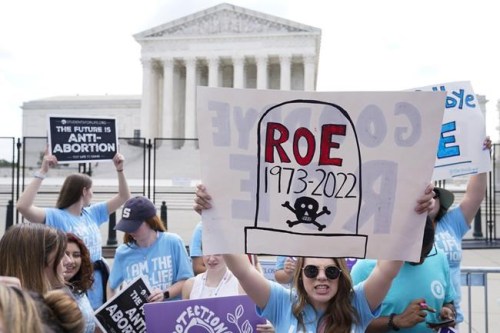
WASHINGTON – Hundreds of Americans — many enraged, others elated — gathered on Capitol Hill to vent their feelings Friday after the U.S. Supreme Court overturned Roe v. Wade, the landmark 1973 decision that made it possible for women to obtain legal abortions in the United States.
Out in front of the high court’s towering marble facade, ringfenced for weeks by an imposing two-metre barricade, the two sides remained largely peaceful, save for the occasional shouting match, under the watchful eyes of dozens of Capitol Police officers.
Some sat to the side, weeping openly or staring at the ground. Others shouted slogans and brandished hand-lettered, profanity-laced placards, many vowing to “aid and abet” a medical procedure that’s all but guaranteed to become illegal in fully half the country.

“I can’t believe that I’m alive in this country where we’ve made some progress, and this is a huge step back,” said Libby Malditz, whose two-word placard bore a simple — and unprintable — message to the five Supreme Court justices who supported the decision.
Malditz, who closed her two D.C.-area retail shops so that employees could attend the protests, said she’s wary about what comes next in a country already wracked with division and social tension.
“Violence isn’t going to help, but we also saw through the civil rights movement that sometimes violence needs to happen for change to happen,” she said.
“I hope it doesn’t come to that, I won’t be part of that, but you know, it’s that bad in our country right now. People need to rise up. If you don’t have freedom, you have nothing.”
Three of the five justices who voted in favour of the decision — Brett Kavanaugh, Neil Gorsuch and Amy Coney Barrett — were appointed by former president Donald Trump, who promptly issued a statement taking full credit for the decision.
He called it “the biggest WIN for LIFE in a generation,” one that came “because I delivered everything as promised.”
The court voted 6-3 to uphold the Mississippi abortion ban at the core of the original case, but Chief Justice John Roberts wrote in a concurring opinion against overturning Roe — “repudiating a constitutional right” the court has already recognized and reaffirmed.
Roberts also did not sign the scorching dissent penned by the court’s diminished liberal wing: justices Elena Kagan, Sonia Sotomayor and Stephen Breyer.
“With sorrow — for this court, but more for the many millions of American women who have today lost a fundamental constitutional protection — we dissent,” they wrote.
Within hours of the decision, foreshadowed back in May when an early draft of the ruling found its way past the veil of secrecy that normally shrouds the court’s deliberations, state governments were already moving to enact abortion bans, some of which had been on the books for years.
Thirteen states, including Texas, Oklahoma, Kentucky, the Dakotas and Idaho, have trigger laws that will take effect within the next 30 days, if not immediately.
Five others — Alabama, Iowa, Ohio, Georgia and South Carolina — are sure to challenge court decisions that blocked or struck down their abortion bans. Indiana and West Virginia are also widely expected to impose strict new laws.
In the trigger state of Missouri, Attorney General Eric Schmitt said officials would promptly enforce a 2019 ban on abortions except in cases of medical emergency. In Alabama, Gov. Kay Ivey vowed to ask a judge to lift an injunction on her state’s near-total ban.
Jamie Manson, president of the group Catholics for Choice, said she’s hoping Friday’s decision serves as a jarring wake-up call for anyone in the U.S. who hasn’t been paying close attention to what’s been happening.
“It takes us to a place that I hope is the tipping point for people in the United States who I think did not believe this day would come,” said Manson, who described the “Christian nationalist agenda” that she said is taking over the country.
“We were lulled into complacency. I think we were raised to believe that rights would always be expanded, not restricted.”
Polls have consistently indicated that fewer than one-third of Americans support striking down Roe v. Wade, which has served as both a bedrock precedent for the courts and a lodestar for reproductive rights champions for the last 49 years.
That has Democrats, who face a reckoning in the midterm elections in November, priming the pumps for abortion to be a major motivator in getting their supporters out to the polls this fall.
“This is not over,” President Joe Biden vowed Friday as he urged Congress to step up and codify in federal law the principles that Roe v. Wade had preserved.
He said the Supreme Court is clearly embarking on an “extreme and dangerous path” that could soon jeopardize other high court precedents that are not expressly preserved in the U.S. Constitution, such as the right to same-sex marriage and birth control.
“The court has done what it has never done before: expressly take away a constitutional right that is so fundamental to so many Americans that had already been recognized,” Biden said.
The decision will have “real and immediate consequences” for the health of women, he added, and leave them exposed to criminal sanction simply for doing what’s necessary to protect their well-being.
“It’s — it just stuns me.”
Vice-President Kamala Harris, speaking in Illinois, noted that women in the U.S. now have less access to reproductive health care than their mothers and grandmothers had for the better part of half a century.

“Right now, as of this minute, we can only talk about what Roe v. Wade protected — past tense,” Harris said. “Millions of women in America will go to bed tonight without access to the health care and reproductive care that they had this morning.”
That is sure to have many of them looking to abortion-friendly states like California, which is already bracing for an influx of patients, said Rep. Sara Jacobs, a Democrat who represents the state’s 53rd district, which includes parts of San Diego.
In the meantime, it’s vital for Congress to do away with the legislative filibuster so it can codify protections for abortion into law, Jacobs said in an interview in the midst of Friday’s protest.
“While we do that, we need to work with the states so that they have the support they need,” she said. “States like California, which I represent, are going to have an influx of people from other states who are coming to be able to access the reproductive health care that they deserve.”
This report by The Canadian Press was first published June 24, 2022.
Related Articles
Supreme Court overturns Roe v. Wade; states can ban abortion


Advertisement Advertise With Us
Advertisement Advertise With Us