Most Canadians support the right to choose to have an abortion: poll

Advertisement

Advertise with us

OTTAWA - As the United States faces turmoil over the possible overturning of the right to have an abortion, a new poll offers a picture of how Canadians feel about the issue.

Read this article for free:


By clicking the button above, an account will be created and you will begin to receive some of our recommended newsletters. You may opt out of any newsletter by visiting your Email and Communication Preferences page or by clicking "unsubscribe" at the bottom of any email.

or

Already have an account? Log in here »

To continue reading, please subscribe:

Digital Subscription

One year of digital access for only $1.44 a week*

  • Enjoy unlimited reading on winnipegfreepress.com
  • Read the E-Edition, our digital replica newspaper
  • Access News Break, our award-winning app
  • Play interactive puzzles

*Billed as $5.77 plus GST every four weeks. After 52 weeks, price increases to the regular rate of $19.95 plus GST every four weeks. Offer available to new and qualified returning subscribers only. Cancel any time.

To continue reading, please subscribe:

Add Free Press access to your Brandon Sun subscription for only an additional

$1 for the first 4 weeks*

  • Enjoy unlimited reading on winnipegfreepress.com
  • Read the E-Edition, our digital replica newspaper
  • Access News Break, our award-winning app
  • Play interactive puzzles
Start now

*Your next Brandon Sun subscription payment will increase by $1.00 and you will be charged $17.95 plus GST for four weeks. After four weeks, your payment will increase to $24.95 plus GST every four weeks.

Hey there, time traveller!
This article was published 11/05/2022 (1634 days ago), so information in it may no longer be current.

OTTAWA – As the United States faces turmoil over the possible overturning of the right to have an abortion, a new poll offers a picture of how Canadians feel about the issue.

About four in five respondents to an online survey by Leger and the Association for Canadian Studies said they are in favour of a woman’s right to an abortion if she so chooses, while 14 per cent said they are opposed.

Seventy per cent of all respondents said they were concerned about the leaked plan to overturn Roe v. Wade, and almost half said they think the situation in the U.S. on the right to an abortion may have an effect in Canada.

Abortion-rights protesters display placards during a demonstration outside the U.S. Capitol, Sunday, May 8, 2022, in Washington. As the United States faces turmoil over the possible overturning of the right to have an abortion, a new poll offers a picture of how Canadians feel about the issue. THE CANADIAN PRESS/AP-Gemunu Amarasinghe

The online survey of 1,534 Canadians between Friday and Sunday cannot be assigned a margin of error because internet-based polls are not considered random samples.

“Is it the old adage that if the if the U.S. sneezes Canada gets a cold, that whatever happens in the States is bound to have an impact on Canada? That’s always been sort of how we position ourselves against the U.S.,” said Christian Bourque, Leger executive vice-president.

Bourque said the high level of concern is notable given the vast majority of Canadians say they support the right to choose to have an abortion.

“In Canada, whenever there’s been attempts at reopening this debate, it was fairly quickly shut down. So why now would some people think that this would in some way launch this debate in Canada?” he said.

“It’s not as if there was this overwhelming feeling that the views of Canadians were changing on the topic.”

The right to an abortion doesn’t exist in Canada in the same way it is enshrined in Roe v. Wade, the landmark 1973 decision that has served as a legal scaffold for reproductive rights champions around the world for nearly half a century.

Abortion is decriminalized in Canada because of a 1988 Supreme Court decision, but no bill has ever been passed to enshrine access into law and it’s also not considered a constitutionally protected right under the Charter of Rights and Freedoms.

“We know Canadians like to pay attention to U.S. politics but I think this shows really that there’s a concern over this leakage of Supreme Court documents and what it’s leading up to right now in the States,” said Bourque.

About two in three survey respondents said the Canadian government should introduce a bill to protect the right to freely choose to have an abortion.

Many advocates fear that any effort to codify abortion access into law in Canada would risk triggering an erosion of those services. Limits on how late in a pregnancy an abortion can be performed are determined at the provincial or territorial level in Canada, and enforced by the medical community, not the courts.

Prime Minister Justin Trudeau’s government sought to assure Canadians last week that it would protect access to a safe and legal abortion, though it was not entirely clear about how.

Trudeau said Health Minister Jean-Yves Duclos and Status of Women Minister Marci Ien are examining the “legal framework” to ensure “the rights of women are properly protected” under both the current and any future government.

The Liberals promised during the last election campaign to introduce regulations under the Canada Health Act to ensure that abortion services are considered medically necessary and publicly funded.

It is among the abortion-related election promises that have thus far gone untouched. The Liberals pledged a $10-million information portal on reproductive health and rights, but there was no mention of it in the federal budget last month.

A promised $10 million for youth organizations to “respond to the unique sexual and reproductive health needs of young people” has also yet to materialize.

This report by The Canadian Press was first published May 11, 2022.

—

This story was produced with the financial assistance of the Meta and Canadian Press News Fellowship.

Report Error Submit a Tip

More Stories

Human rights museum responds to reopening backlash

Julia-Simone Rutgers 4 minute read Preview

Human rights museum responds to reopening backlash

Julia-Simone Rutgers 4 minute read Thursday, Jul. 29, 2021

The Canadian Museum for Human Rights reopened to fully vaccinated members of the public this week, drawing cries of discrimination from those who have chosen not to get vaccinated against COVID-19.

While the some of the backlash has been “disturbing,” museum CEO Isha Khan said the conflict has opened room for a conversation about human rights during the pandemic.

“We made the decision to open in compliance with that law, really because we’re a public institution and we saw it as our responsibility to open as soon as we could to the public — within the restrictions as they currently are,” Khan said Thursday.

“But it’s really important to us, as the Canadian Museum for Human Rights we have a mandate for human rights education, that we’re trying to ground the conversation in human rights principles.”

Read
Thursday, Jul. 29, 2021

Submit a news tip

1 minute read Monday, Mar. 16, 2026

Submit a news tip

The new normal in Canadian politics

David McLaughlin 5 minute read Preview

The new normal in Canadian politics

David McLaughlin 5 minute read 2:01 AM CDT

“Nothing happening, all at once.”

Welcome to the new normal of Canadian politics, where normality is the new normal. Routine and stable are in; disruptive and excessive are out. Exhibits A and B are the Alberta referendum and the British Columbia election. Voters opted for stability over volatility.

The opposite of being normal is being different from the norm. In politics that means different from where we’ve been and what we’ve come to expect. Two competing trends have dominated our politics for the past decade and a half — progressivism and populism. Think Justin Trudeau and liberal, progressive identity politics in Canada, and Donald Trump and conservative, populist MAGA politics in America. We are now experiencing a swing away from both those trends.

Representing this “new normal” are Prime Minister Mark Carney, for one, and newly elected British Columbia premier, Lorne Doerksen, for another. Both are considered normal because they talk and act like adults in a childish political world. Their political flair is to not have any political flair. They stand out for not standing out.

Read
2:01 AM CDT

Court ruling concludes Canadian Wheat Board saga

Laura Rance-Unger 4 minute read Preview

Court ruling concludes Canadian Wheat Board saga

Laura Rance-Unger 4 minute read 2:01 AM CDT

It remains to be seen whether the recent court ruling in a lawsuit filed after Canadian Wheat Board’s dissolution in 2012 puts the whole debate to rest, as some no doubt hope.

But either way, the dust has settled on the post-CWB world. The sun still rises and a new generation of farmers on the land only knows by name an institution that for generations influenced every aspect of Prairie grain farming.

The first Rural Revival column I wrote for this newspaper more than 30 years ago was about a thousand farmers from Western Canada demonstrating in support of the Wheat Board. It was in the aftermath of the Western Grain Marketing Panel report, one of several efforts that eventually included a plebiscite to help the federal government decide what to do about a vocal minority of farmers who wanted marketing “freedom.”

The polls at the time suggested about two-thirds of farmers were comfortable enough with the single-desk system for food wheat and barley to keep it around. It served as a counterbalance to canola, which they sold on the open market. They essentially had a dual market.

Read
2:01 AM CDT

A little toponder, a lot to celebrate

Erna Buffie 5 minute read 2:01 AM CDT

Well, another civic election season has come and gone, and I have to say it was a doozy. The most surprising event was the steady climb in support for young mayoral candidate Noah Redden, who started out with just four per cent public support in September but had reached a solid 14 per cent support in October.

On election day, Redden nearly came in second, less than one percentage point behind Kevin Klein, an experienced politician.

Indeed, the 27-year-old’s accomplishment was nothing short of astonishing. Particularly given that his shoestring campaign was given very little coverage — largely, according to one pundit, because he didn’t send out any press releases.

This when Redden’s unwritten press releases were there for everyone to see on Instagram, as he popped up in locations across the city, posting videos about what he hoped to achieve as mayor.

Brandon manufacturer says Canadian steel in demand, but high costs, long delivery times hit hard

Gabrielle Piché 6 minute read Preview

Brandon manufacturer says Canadian steel in demand, but high costs, long delivery times hit hard

Gabrielle Piché 6 minute read 2:01 AM CDT

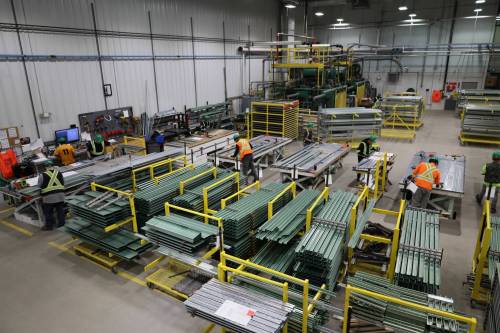
Something’s different in a Brandon plant.

Building envelope panels — or shells for homes and commercial buildings — keep being produced at Greenstone Building Products.

But the galvanized steel used by workers has been arriving later and the price is constantly increasing, according to company leadership.

“It’s just a little bit nerve-wracking for us to hear the opposite narrative,” said Tilda Fortier, Greenstone Building Products’ business manager.

Read
2:01 AM CDT