Next battle over access to abortion will focus on pills
Advertisement
Read this article for free:
or
Already have an account? Log in here »
To continue reading, please subscribe:

Digital Subscription
One year of digital access for only $205*
- Enjoy unlimited reading on winnipegfreepress.com
- Read the E-Edition, our digital replica newspaper
- Access News Break, our award-winning app
- Play interactive puzzles
*First annual payment billed as $205.00 + GST for one year. This annual subscription will automatically renew at $233.00 + GST every 52 weeks (10% off the regular annual price of $259.35). Offer available to new and qualified returning subscribers only. Cancel any time.
To continue reading, please subscribe:
Add Free Press access to your Brandon Sun subscription for only an additional
$1 for the first 4 weeks*
- Enjoy unlimited reading on winnipegfreepress.com
- Read the E-Edition, our digital replica newspaper
- Access News Break, our award-winning app
- Play interactive puzzles
*Your next Brandon Sun subscription payment will increase by $1.00 and you will be charged $17.95 plus GST for four weeks. After four weeks, your payment will increase to $24.95 plus GST every four weeks.
Read unlimited articles for free today:
or
Already have an account? Log in here »
Hey there, time traveller!
This article was published 04/05/2022 (1605 days ago), so information in it may no longer be current.
SIOUX FALLS, S.D. (AP) — It took two trips over state lines, navigating icy roads and a patchwork of state laws, for a 32-year-old South Dakota woman to get abortion pills last year.
For abortion-seekers like her, such journeys, along with pills sent through the mail, will grow in importance if the Supreme Court follows through with its leaked draft opinion that would overturn the landmark Roe v. Wade decision and allow individual states to ban the procedure. The woman, who spoke on the condition of anonymity because she was concerned for her family’s safety, said the abortion pills allowed her to end an unexpected and high-risk pregnancy and remain devoted to her two children.
But anti-abortion activists and politicians say those cross-border trips, remote doctors’ consultations and pill deliveries are what they will try to stop next.
“Medication abortion will be where access to abortion is decided,” said Mary Ziegler, a professor at Florida State University College of Law who specializes in reproductive rights. “That’s going to be the battleground that decides how enforceable abortion bans are.”
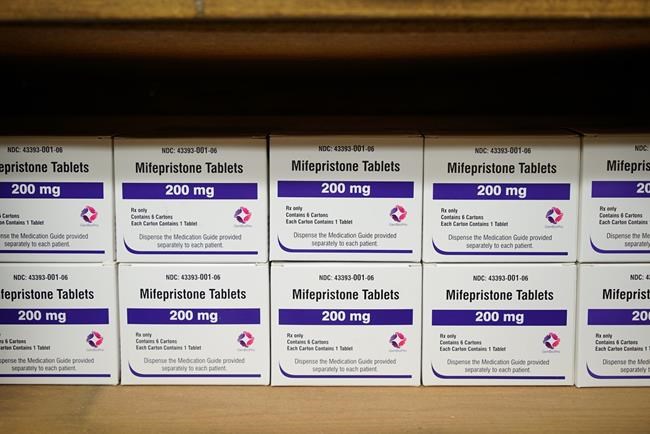
Use of abortion pills has been rising in the U.S. since 2000 when the Food and Drug Administration approved mifepristone — the main drug used in medication abortions. More than half of U.S. abortions are now done with pills, rather than surgery, according to the Guttmacher Institute, a research group that supports abortion rights.
Two drugs are required. The first, mifepristone, blocks a hormone needed to maintain a pregnancy. A second drug, misoprostol, taken one to two days later, empties the uterus. Both drugs are available as generics and are also used to treat other conditions.
The FDA last year lifted a long-standing requirement that women pick up abortion pills in person. Federal regulations now also allow mail delivery nationwide. Even so, 19 states have passed laws requiring a medical clinician to be physically present when abortion pills are administered to a patient.
South Dakota is among them, joining several states, including Texas, Kentucky, Arkansas, Ohio, Tennessee and Oklahoma, where Republicans have moved to further restrict access to abortion pills in recent months.
Those moves have spurred online services that offer information on getting abortion pills and consultations to get a prescription. After the woman in South Dakota found that the state’s only abortion clinic could not schedule her in time for a medication abortion, she found an online service, called Just The Pill, that advised her to drive across to Minnesota for a phone consultation with a doctor. A week later, she came back to Minnesota for the pills.
She took the first one almost immediately in her car, then cried as she drove home.
“I felt like I lost a pregnancy,” she said. “I love my husband and I love my children and I knew exactly what I had to say goodbye to and that was a really horrible thing to have to do.”
Besides crossing state lines, women can also turn to international online pharmacies, said Greer Donley, a professor specializing in reproductive health care at the University of Pittsburgh Law School. Some women also are having prescribed pills forwarded through states without restrictions.
“It allows for someone to have an abortion without a direct role of a provider. It’s going to be much harder for states to control abortion access,” she said, adding, “The question is how is it going to be enforced?”
Abortion law experts say it’s an unsettled question whether states can restrict access to abortion pills in the wake of the FDA’s decision.
“The general rule is that federal law preempts conflicting state law,” said Laura Hermer, a professor at the Mitchell Hamline School of Law in St. Paul, Minnesota. “There is no question that the FDA has proper authority to regulate the drugs used in medication abortions. The question is whether a state can make a viable, winning argument that, for public health purposes, it needs to further regulate access to the relevant medications.”
Hermer said she doesn’t think there is a valid public health reason because the published evidence is that the drugs are “exceptionally safe.” But if the Supreme Court overrules Roe v. Wade and a state gives embryos and fetuses full rights as people “then all bets would be off.”
The Planned Parenthood regional organization that includes South Dakota doesn’t believe it can legally mail abortion pills to patients there.
Telemedicine providers have to abide by the laws of the state where the patient is, said Dr. Sarah Traxler, chief medical officer for Planned Parenthood North Central States in St. Paul. She acknowledged that some organizations disagree. “But,” she added, “we don’t feel like we have liberty to mail pills from Minnesota to other places in the country where it’s illegal to provide medication abortion.”
Sue Leibel, the state policy director for Susan B. Anthony List, a prominent organization opposed to abortion, acknowledged that medication abortions have “crept up” on Republican state lawmakers.
“This is a new frontier and states are grappling with enforcement mechanisms,” she said, adding, “The advice that I always give — if you shut the front door, the pills are going to come in the back door.”
Leibel maintained women should not be prosecuted for seeking abortions, keeping with a long-standing principle of many abortion opponents. She suggested the next target for state enforcement should be the pharmacies, organizations and clinics that provide the abortion pills. She also said abortion-rights opponents should focus on electing a presidential candidate who would work to reverse the FDA’s decision.
The FDA said a scientific review supported broadening access to the drugs and found complications were rare. The agency has reported 26 deaths associated with the drug since 2000, though not all of those can be directly attributed to the medication due to existing health conditions and other factors.

However, with new legal battles on the horizon and abortion seekers going to greater lengths to obtain the procedure, Donley, the law school professor, worried that state lawmakers will turn their attention toward the women who get the pills.
Indeed, a Louisiana House committee advanced a bill Wednesday that would make abortion a crime of homicide for which a woman ending her pregnancy could be charged, along with anyone helping her.
“Many anti-abortion legislators might realize the only way to enforce these laws is to prosecute the pregnant person themselves,” Donley said.
___
Associated Press writer Steve Karnowski contributed from St. Paul, Minnesota.
Related Articles
Women’s Health Clinic denounces potential U.S. move against abortion rights

Advertisement Advertise With Us
Advertisement Advertise With Us