Beijing shuts 10% of subway stations to stem COVID-19 spread

Advertisement

Advertise with us

BEIJING (AP) — China's capital on Wednesday closed 60 subway stations, more than 10% of its vast system, as an additional measure against the spread of the coronavirus.

Read this article for free:


or

Already have an account? Log in here »

To continue reading, please subscribe:

Subscribe and receive a limited-edition Free Press branded hat or tote.

Digital Subscription

One year of digital access for only $205*

  • Enjoy unlimited reading on winnipegfreepress.com
  • Read the E-Edition, our digital replica newspaper
  • Access News Break, our award-winning app
  • Play interactive puzzles

*First annual payment billed as $205.00 + GST for one year. This annual subscription will automatically renew at $233.00 + GST every 52 weeks (10% off the regular annual price of $259.35). Offer available to new and qualified returning subscribers only. Cancel any time.

To continue reading, please subscribe:

Add Free Press access to your Brandon Sun subscription for only an additional

$1 for the first 4 weeks*

  • Enjoy unlimited reading on winnipegfreepress.com
  • Read the E-Edition, our digital replica newspaper
  • Access News Break, our award-winning app
  • Play interactive puzzles
Start now

*Your next Brandon Sun subscription payment will increase by $1.00 and you will be charged $17.95 plus GST for four weeks. After four weeks, your payment will increase to $24.95 plus GST every four weeks.

Hey there, time traveller!
This article was published 04/05/2022 (1616 days ago), so information in it may no longer be current.

BEIJING (AP) — China’s capital on Wednesday closed 60 subway stations, more than 10% of its vast system, as an additional measure against the spread of the coronavirus.

Forty stations were closed from the morning, and 20 more were added in the afternoon. The Beijing subway authority in a brief message said only that the mostly downtown stations were being shut as part of epidemic control measures. No date for the resumption of service was given.

Beijing has been on high alert for the spread of COVID-19, with restaurants and bars limited to takeout, gyms closed and classes suspended indefinitely. Major tourist sites in the city, including the Forbidden City and the Beijing Zoo, have closed their indoor exhibition halls and are operating at only partial capacity.
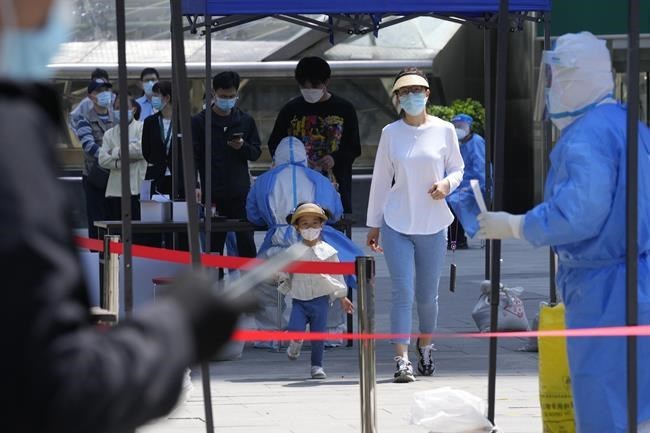
Residents line up for mass COVID-19 testing on Tuesday, May 3, 2022, in Beijing. China has stuck to its strict
Residents line up for mass COVID-19 testing on Tuesday, May 3, 2022, in Beijing. China has stuck to its strict "zero-COVID" approach that restricts travel, mass tests entire cities and sets up sprawling temporary facilities to try to isolate every infected person. (AP Photo/Ng Han Guan)

A few communities where cases were discovered have been isolated. People residing in “controlled” areas have been told to stay within city limits, including 12 areas deemed high-risk and another 35 considered medium-risk.

City residents are required to undergo three virus tests throughout the week as authorities seek to detect and isolate cases without imposing the sort of sweeping lockdowns seen in Shanghai and elsewhere. A negative test result obtained within the previous 48 hours is required to enter most public spaces.

Beijing on Wednesday recorded just 51 new cases, five of them asymptomatic.

The subway closings should have relatively little impact on city life, with China observing the Labor Day holiday this week and many commuters in the capital of 21 million already working from home.

In one downtown neighborhood categorized as high-risk on Wednesday, the streets were practically deserted apart from a few delivery drivers on scooters and an occasional pedestrian or car.

All businesses were shut except for supermarkets and fruit and vegetable stores. Outsiders generally stay away from high-risk areas to avoid the possibility of their presence registering on the tracing apps installed on virtually all mobile phones, creating potential problems for future access to public areas.

While taking a lighter touch in Beijing, China has stuck overall to its strict “zero-COVID” approach that restricts travel, tests entire cities and sets up sprawling facilities to try to isolate every infected person. Lockdowns start with buildings and neighborhoods but become citywide if the virus spreads widely.

That has caused the most disruption in Shanghai, where authorities are slowly easing restrictions that have confined most of the city’s 26 million people to their apartments, housing compounds or immediate neighborhoods for close to a month, and in some cases longer.

Shanghai reported another 4,982 cases Wednesday, all but 260 of them asymptomatic, along with an additional 16 deaths. That continues a steady decline in China’s largest city, which recorded a daily peak of 27,605 new cases on April 13.

The surprisingly low death toll amid an outbreak of more than 400,000 cases in the city that is home to China’s main stock market and biggest port has sparked questions about how such deaths are tallied.

The rigid and widely derided restrictions have led to shortages of food and medical aid along with a wider — though likely temporary — impact on the national economy. Desperate, outraged citizens have confronted authorities at barricades and online, screamed out of their windows and banged pots and pans in a sign of frustration and anger.

Communist authorities who tolerate no dissent have sought to scrub criticism from the internet and blamed the protests, including the banging of cooking implements, on agitation by unidentified “foreign anti-China forces.”
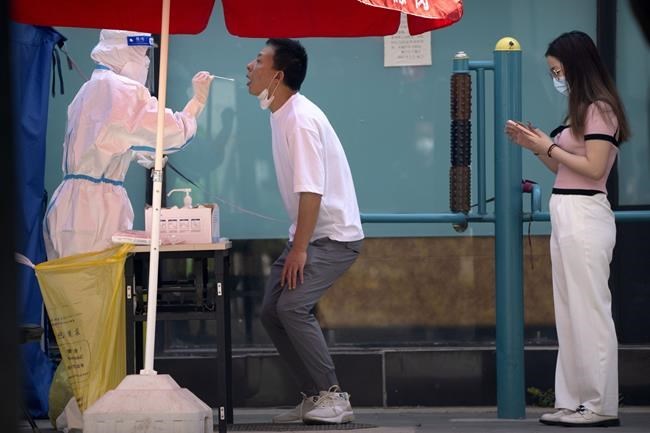
A worker wearing a protective suit swabs a man's throat for a COVID-19 test at a testing site during the second consecutive day of mass testing in Beijing, Wednesday, May 4, 2022. Beijing on Wednesday closed around 10% of the stations in its vast subway system as an additional measure against the spread of coronavirus. (AP Photo/Mark Schiefelbein)

As part of reopening, Shanghai this week began requiring health institutions to fully resume services wherever possible.

Patients filled the waiting area at downtown Huashan Hospital with lines forming outside some departments, according to a Shanghai Media Group report. While patient numbers are down by about two-thirds from before the most recent wave, their conditions tend to be more serious.

Huashan’s deputy director of dermatology, Wu Wenyu, told the Shanghai Media Group he was seeing patients who had delayed treatment because of the outbreak, some from cities outside Shanghai.

“For example, a patient suffering from (skin disease) shingles will hurt very much. He or she might have felt very bad at home, but he or she couldn’t go to the hospital due to COVID,” Wu said. “But now many patients are coming to see the doctor.”

Hospital administrators said the hospital was staggering appointments to avoid crowding.

In some residential communities, a single family member was permitted to venture out twice a week to shop, sometimes also picking up items for neighbors.

Ling Jiazhao, manager of a supermarket in the eastern Pudong district, told the Shanghai Media Group that the store was limiting customers to 50 every half hour.

“I’m hoping it won’t cause congestion. Each community has two to four hours to go out for shopping, so most members will complete that within one hour,” Ling said.

Report Error Submit a Tip

More Stories

Estate of woman who died from local anesthetic injected into blood vessel sues Morden dentist, his business, clinic

Erik Pindera 4 minute read Preview

Estate of woman who died from local anesthetic injected into blood vessel sues Morden dentist, his business, clinic

Erik Pindera 4 minute read 4:08 PM CDT

The estate of a 23-year-old woman who died after receiving a local anesthetic during a wisdom tooth extraction at a Morden dental clinic has filed a lawsuit over her death.

Virginia Blatz never returned home after she went to Boundary Trails Dental Centre to have her wisdom teeth removed on Nov. 27, 2024. An autopsy later confirmed she died from local anesthetic systemic toxicity caused by an inadvertent injection into a blood vessel, her family has previously said.

Her father, Dulaney Blatz, filed a lawsuit in the Court of King’s Bench on behalf of her estate late last month, naming Ronald David Janz — the dentist who performed the procedure — his dental corporation and the dental corporation that operates the clinic as defendants.

None of the defendants have filed statements of defence in response to the claim, which has not yet been heard in court.

Read
4:08 PM CDT

Fraudster gets six years in Shoppers Drug Mart case

Dean Pritchard 4 minute read Preview

Fraudster gets six years in Shoppers Drug Mart case

Dean Pritchard 4 minute read Monday, Aug. 10, 2026

A Calgary man has been sentenced to six years in prison for his role in a fraud ring that targeted Shoppers Drug Mart stores across four provinces.

Carlo Deguzman, 50, pleaded guilty in a Winnipeg courtroom Monday to six counts of fraud, forgery and identification theft for offences dating back more than four years.

Deguzman’s guilty pleas came on what was to be the first day of his trial — the third to be set and cancelled since his initial arrest in 2022. During that time, he hired and fired seven lawyers.

“These matters could have been dealt with years ago, but for the actions of the accused,” prosecutor Kathy Bueti told provincial court Judge Heather Pullan. “He was hoping delay would make the case harder to prove. That’s not the case. The charges weren’t going away.”

Read
Monday, Aug. 10, 2026

Uncanny acting and bittersweet script a fitting tribute to Laurel and Hardy

Randall King  4 minute read Preview

Uncanny acting and bittersweet script a fitting tribute to Laurel and Hardy

Randall King  4 minute read Friday, Feb. 1, 2019

Laurel and Hardy, arguably one of the greatest comedy teams ever to grace the Vaudeville stage and screen, enjoyed a long and fruitful partnership. In fact, it lasted so long, it might as well have been a marriage.

That is the dramatic gist of this film by Jon S. Baird (Filth), who examines the duo in their career twilight, touring the music halls and theatres of England, circa 1953.

The Lancashire-born Stan Laurel (Steve Coogan) has the advantage of being on home turf. Oliver Hardy (John C. Reilly) is hobbled by health issues. While their routines are very much rooted in the English music hall tradition, they are past their prime. Feature films are the medium of choice for comedy duos. Laurel, who has a plaintive moment staring at a freshly installed billboard for the latest Abbott and Costello movie, is trying to cut a deal for a new film based on the legend of Robin Hood. It becomes increasingly obvious that the English producer he’s trying to contact is avoiding him.

Hardy is under different stresses, including failing health and an unhealthy penchant for the vices of drinking and gambling.

Read
Friday, Feb. 1, 2019

Transgender air force member fined for 17 Wing Winnipeg protest

Nicole Buffie 4 minute read Preview

Transgender air force member fined for 17 Wing Winnipeg protest

Nicole Buffie 4 minute read 6:24 PM CDT

A transgender military member has been fined in a case where she was Tasered while fighting to have her gender identity changed on her file.

Royal Canadian Air Force Sgt. Athena Morris was fined $2,000 for unlawfully entering a restricted area at 17 Wing Winnipeg on March 31, 2025, when she demanded the gender marker on her file be changed. Morris, a transgender woman, said she had been trying to get her gender identifier changed since January of that year.

The incident was a culmination of “months of friction,” defence counsel Maj. Carlos Da Cruz told military judge Stephen Strickey Monday during a hearing at HMCS Chippawa, a Royal Canadian Navy Reserve division in Winnipeg.

Da Cruz told court Morris was misgendered by colleagues and superiors and told she wasn’t allowed to use the women’s bathrooms or showers.

Read
6:24 PM CDT

Ducks Unlimited makes province’s largest-ever conservation-land purchase

Zoe Pierce 4 minute read Preview

Ducks Unlimited makes province’s largest-ever conservation-land purchase

Zoe Pierce 4 minute read Tuesday, Aug. 11, 2026

A Manitoba landscape that helped save the Giant Canada goose from extinction has now been permanently protected in the province’s largest conservation land purchase in history.

Ducks Unlimited Canada announced Tuesday in a virtual press conference that it has acquired a conservation easement for East Meadows Ranch, a more than 8,000-acre property near Lundar in Manitoba’s Interlake region, about 80 kilometres northwest of Winnipeg, that includes wetlands, native prairie and bur oak savannah.

Ducks Unlimited called the property, now known as the Kennedy Field Station at East Meadows, one of Manitoba’s most ecologically diverse landscapes and said protecting it will contribute to the long-term health of Manitoba’s wildlife, biodiversity and natural heritage.

“The sheer size of the property is not that common in private ownership here in Manitoba, and to have that in a complete connected tract is just something that we’re not likely to see again or come available anytime soon,” said Mark Francis, Ducks Unlimited Canada’s manager of provincial operations.

Read
Tuesday, Aug. 11, 2026

Magic number for marathon man

Eric Willemsen 5 minute read Sunday, Oct. 13, 2019

VIENNA — Roger Bannister, 1954. Eliud Kipchoge, 2019?

Like the sub-four-minute mile, running a marathon in less than two hours had seemed impossible — until Saturday. But this time, there’s an asterisk: Olympic champion Kipchoge performed his feat under conditions so tightly controlled to maximize his success that it won’t appear in the record books.

The 34-year-old Kenyan completed the 42.195 kilometres (26.2 miles) in one hour, 59 minutes, 40.2 seconds at the INEOS 1:59 Challenge, an event set up for the attempt.

Ahead of the event, Kipchoge even compared the feat to being “like the first man on the moon.”