WHO: Nearly 15 million deaths associated with COVID-19

Advertisement

Advertise with us

LONDON (AP) — The World Health Organization estimates that nearly 15 million people were killed either by coronavirus or by its impact on overwhelmed health systems during the first two years of the pandemic, more than double the current official death toll of over 6 million.

Read this article for free:


or

Already have an account? Log in here »

To continue reading, please subscribe:

Subscribe and receive a limited-edition Free Press branded hat or tote.

Digital Subscription

One year of digital access for only $205*

  • Enjoy unlimited reading on winnipegfreepress.com
  • Read the E-Edition, our digital replica newspaper
  • Access News Break, our award-winning app
  • Play interactive puzzles

*First annual payment billed as $205.00 + GST for one year. This annual subscription will automatically renew at $233.00 + GST every 52 weeks (10% off the regular annual price of $259.35). Offer available to new and qualified returning subscribers only. Cancel any time.

To continue reading, please subscribe:

Add Free Press access to your Brandon Sun subscription for only an additional

$1 for the first 4 weeks*

  • Enjoy unlimited reading on winnipegfreepress.com
  • Read the E-Edition, our digital replica newspaper
  • Access News Break, our award-winning app
  • Play interactive puzzles
Start now

*Your next Brandon Sun subscription payment will increase by $1.00 and you will be charged $17.95 plus GST for four weeks. After four weeks, your payment will increase to $24.95 plus GST every four weeks.

Hey there, time traveller!
This article was published 05/05/2022 (1612 days ago), so information in it may no longer be current.

LONDON (AP) — The World Health Organization estimates that nearly 15 million people were killed either by coronavirus or by its impact on overwhelmed health systems during the first two years of the pandemic, more than double the current official death toll of over 6 million.

Most of the deaths occurred in Southeast Asia, Europe and the Americas, according to a WHO report issued Thursday.

The U.N. health agency’s director-general, Tedros Adhanom Ghebreyesus, described the newly calculated figure as “sobering,” saying it should prompt countries to invest more in their capacities to quell future health emergencies.
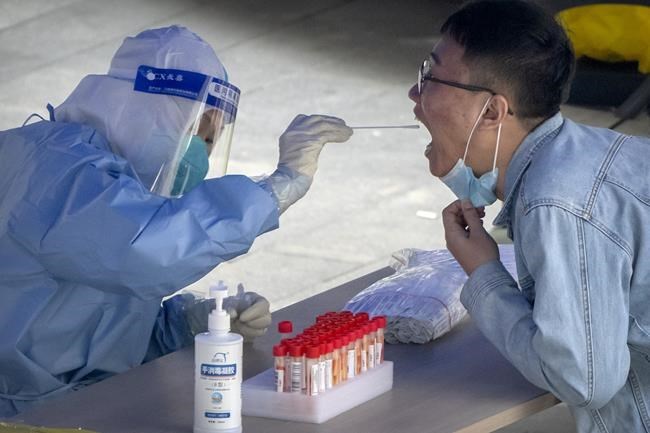
FILE - A worker in a protective suit swabs a man's throat for a COVID-19 test at a testing site in an office complex in Beijing, Friday, April 29, 2022. The World Health Organization on Thursday, May 5, 2022 is estimating that nearly 15 million people were killed either by the coronavirus or by its impact on overwhelmed health systems in the past two years, more than double the official death toll of 6 million. (AP Photo/Mark Schiefelbein, File)

WHO tasked scientists with determining the actual number of COVID-19 deaths between January 2020 and the end of last year. They estimated that between 13.3 million and 16.6 million people died either due to the coronavirus directly or because of factors somehow attributed to the pandemic’s impact on health systems, such as cancer patients who were unable to seek treatment when hospitals were full of COVID patients.

Based on that range, the scientists came up with an approximated total of 14.9 million.

The estimate was based on country-reported data and statistical modeling, but only about half of countries provided information. WHO said it wasn’t yet able to break down the data to distinguish between direct deaths from COVID-19 and those related to effects of the pandemic, but the agency plans a future project examining death certificates.

“This may seem like just a bean-counting exercise, but having these WHO numbers is so critical to understanding how we should combat future pandemics and continue to respond to this one,” said Dr. Albert Ko, an infectious diseases specialist at the Yale School of Public Health who was not linked to the WHO research.

For example, Ko said, South Korea’s decision to invest heavily in public health after it suffered a severe outbreak of MERS allowed it to escape COVID-19 with a per-capita death rate around a 20th of the one in the United States.

Accurately counting COVID-19 deaths has been problematic throughout the pandemic, as reports of confirmed cases represent only a fraction of the devastation wrought by the virus, largely because of limited testing. Government figures reported to WHO and a separate tally kept by Johns Hopkins University show more than 6.2 million reported virus deaths to date.

Scientists at the Institute of Health Metrics and Evaluation at the University of Washington calculated for a recent study published in the journal Lancet that there were more than 18 million COVID deaths from January 2020 to December 2021.

A team led by Canadian researchers estimated there were more than 3 million uncounted coronavirus deaths in India alone. WHO’s new analysis estimated that missed deaths in India alone ranged between 3.3 million to 6.5 million.

In a statement following the release of WHO’s data, India disputed the U.N. agency’s methodology. India’s Health and Family Welfare Ministry called the analysis and data collection methods “questionable” and complained that the new death estimates were released “without adequately addressing India’s concerns.”
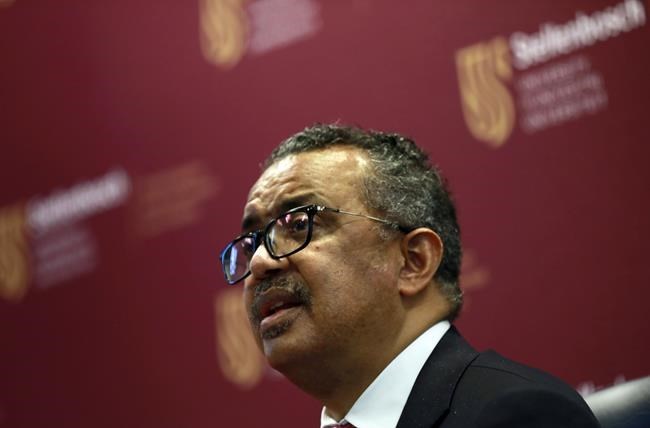
FILE - World Health Organisation (WHO) director-general Dr. Tedros Adhanom Ghebreyesus speaks at a news conference in Cape Town, South Africa, Friday, Feb. 11, 2022. The World Health Organization on Thursday, May 5, 2022 is estimating that nearly 15 million people were killed either by the coronavirus or by its impact on overwhelmed health systems in the past two years, more than double the official death toll of 6 million. (AP Photo/Nardus Engelbrecht, File)

Samira Asma, a senior WHO director, acknowledged that “numbers are sometimes controversial” and that all estimates are only an approximation of the virus’ catastrophic effects.

“It has become very obvious during the entire course of the pandemic, there have been data that is missing,” Asma told reporters during a press briefing on Thursday. “Basically, all of us were caught unprepared.”

Ko said the new figures from WHO might also explain some lingering mysteries about the pandemic, like why Africa appears to have been one of the least affected by the virus, despite its fragile health systems and low vaccination rates.

“Were the mortality rates so low because we couldn’t count the deaths, or was there some other factor to explain that?” he asked, citing the far higher mortality rates in the U.S. and Europe.

Dr. Bharat Pankhania, a public health specialist at Britain’s University of Exeter, said the world may never get close to measuring the true toll of COVID-19, particularly in poor countries.

“When you have a massive outbreak where people are dying in the streets because of a lack of oxygen, bodies were abandoned or people had to be cremated quickly because of cultural beliefs, we end up never knowing just how many people died,” he explained.

Pankhania said that while the estimated COVID-19 death toll still pales in comparison to the 1918 Spanish flu pandemic, which experts estimate caused up to 100 million deaths, the fact that so many people died despite the advances of modern medicine, including vaccines, is shameful.

He also warned that the cost of COVID-19 could be far more damaging in the long term, given the increasing burden of caring for people with long COVID.

“With the Spanish flu, there was the flu and then there were some (lung) illnesses people suffered, but that was it,” he said. “There was not an enduring immunological condition that we’re seeing right now with COVID.”
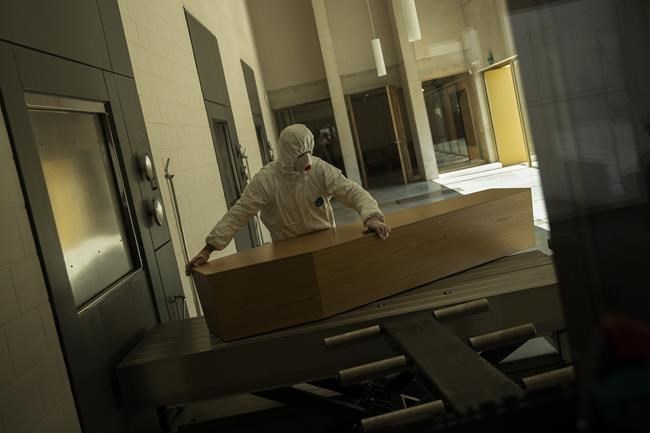
FILE - A worker, wearing full protective gear, moves the casket of a victim of COVID-19 to be cremated during a partial lockdown to prevent the spread of coronavirus at the Pontes crematorium center in Lommel, Belgium, Thursday, April 16, 2020. The World Health Organization is estimating that nearly 15 million people were killed either by the coronavirus or by its impact on overwhelmed health systems in the past two years. That is more than double its official death toll. The U.N. health agency says most of the fatalities were in Southeast Asia, Europe and the Americas. In a report released Thursday, May 5, 2022 WHO chief Tedros Adhanom Ghebreyesus describes the figure as “sobering.
FILE - A worker, wearing full protective gear, moves the casket of a victim of COVID-19 to be cremated during a partial lockdown to prevent the spread of coronavirus at the Pontes crematorium center in Lommel, Belgium, Thursday, April 16, 2020. The World Health Organization is estimating that nearly 15 million people were killed either by the coronavirus or by its impact on overwhelmed health systems in the past two years. That is more than double its official death toll. The U.N. health agency says most of the fatalities were in Southeast Asia, Europe and the Americas. In a report released Thursday, May 5, 2022 WHO chief Tedros Adhanom Ghebreyesus describes the figure as “sobering." (AP Photo/Francisco Seco, File)

“We do not know the extent to which people with long COVID will have their lives cut short and if they will have repeated infections that will cause them even more problems,” Pankhania said.

____

Krutika Pathi and Ashok Sharma in New Delhi contributed to this report.

___

Follow AP’s coverage of the pandemic at https://apnews.com/hub/coronavirus-pandemic

Report Error Submit a Tip

More Stories

Premier League would be all too relieved if Blues simply went away for a while

Jerrad Peters 6 minute read Preview

Premier League would be all too relieved if Blues simply went away for a while

Jerrad Peters 6 minute read Yesterday at 2:08 PM CDT

Manchester City will face Liverpool in the Premier League next weekend.

That is a statement of fact. The match will kick off Sunday, October 11 at 4:30 p.m. local time (10:30 a.m., CT, FuboTV) at Anfield, though the 90 minutes that follow will be more a spectacle than a game, if not a circus.

By now the football world — as well as the general news cycle and relevant authorities — has had more than a week to absorb the shock of the sport’s biggest tremor of recent times.

Man City, according to the findings of an independent commission, broke more than 100 of the Premier League’s financial rules between 2009 and 2018. Its breaches, per the ruling, were deliberate, premeditated and at industrial scale.

Read
Yesterday at 2:08 PM CDT

Alouettes not short on reasons why they want to beat Bombers

Taylor Allen 6 minute read Preview

Alouettes not short on reasons why they want to beat Bombers

Taylor Allen 6 minute read Yesterday at 7:55 PM CDT

MONTREAL — Clinching top spot in the East isn’t the only reason why Tyson Philpot is itching to beat the Winnipeg Blue Bombers.

“Obviously, my brother (Jalen) plays for the (Calgary) Stampeders, so I’d love to help push the Stampeders above them and help him get in the playoffs,” said the star receiver for the Montreal Alouettes after Friday’s walkthrough.

While the Als are sitting comfortably at 11-3, the Bombers (7-7) are trying to fend off Calgary (7-8) while also keeping pace with B.C. and Saskatchewan, who both entered the week at 8-6.

But there’s another reason that applies to everyone on the Als: they want revenge for the embarrassing 44-28 loss they suffered in Winnipeg in Week 13.

Read
Yesterday at 7:55 PM CDT

‘Detrimental to the growth of female hockey in Manitoba’

Joshua Frey-Sam 7 minute read Preview

‘Detrimental to the growth of female hockey in Manitoba’

Joshua Frey-Sam 7 minute read Yesterday at 5:16 PM CDT

She lived the best of both worlds.

For the last three years, the 17-year-old wore a sweater for two different hockey programs — her high school team and AAA club in the Manitoba Female Hockey League — and was preparing to flourish in both colours again this winter.

Recently, however, the blue-liner was disappointed to learn she is no longer eligible to play her Grade 12 season with her school owing to a new policy imposed by Hockey Manitoba that bans players from participating in the Manitoba Women’s High School Hockey League if they are rostered on a U18 AAA team.

The rule applies to all athletes who play for both Winnipeg-based and rural AAA teams.

Read
Yesterday at 5:16 PM CDT

Tibial tray connected to aerospace sector …

Aaron Epp 6 minute read Preview

Tibial tray connected to aerospace sector …

Aaron Epp 6 minute read Monday, May. 4, 2026

There are thousands — perhaps tens of thousands — of people in the United States who are walking around with Manitoba-made metal parts in their bodies.

After Winnipeg-based manufacturing solutions provider Precision ADM Inc. got started in 2015, one of its first jobs was fabricating U.S. Food and Drug Administration-approved tibial trays — a critical component for knee replacement surgery that transmits loads from the femur to the tibia, ensuring stability, alignment and durability over millions of cycles of use.

Manufacturing the tibial trays for a client in the U.S. stands out as a vivid memory for Martin Petrak, the company’s co-founder and president.

“We made something that could go into a human, that should be there for the rest of their life,” he says. “We thought, we’ve finally done something significant here as an organization, as a company, with staff that believed that we could do this.”

Read
Monday, May. 4, 2026

Musk’s gambit unlikely to end well

Gwynne Dyer 5 minute read Preview

Musk’s gambit unlikely to end well

Gwynne Dyer 5 minute read Friday, Nov. 4, 2022

Elon Musk is that rarest of things, a benign sociopath, and therefore a person of considerable value to the world. He has just made a mistake that could ruin his long-term plan, for his purchase of Twitter is almost bound to end in tears. The sharks are always circling the very rich and highly geared, and I find myself worrying about him.

Read
Friday, Nov. 4, 2022

Letters, Oct. 2

6 minute read Yesterday at 2:00 AM CDT

Are clinical psychologists next?

Re: Province hires 17 psychiatrists to work in Winnipeg, Selkirk (Sept. 25)

Manitoba’s government has shown that it knows how to solve a specialist staffing crisis in health care. Clinical psychologists are still left to wonder when it will be their turn.

The Manitoba Psychological Society (MPS) welcomes the recent announcement of 17 new psychiatrists in the public system. Any investment in mental health deserves to be celebrated, especially in light of the Canadian Alliance on Mental Illness and Mental Health’s report card that was released in August 2026. Manitoba received overall grades of F and D for mental health and substance use health, respectively. Although disappointing, this is not surprising given that Manitoba spends five to six per cent of its health budget on mental health and addictions, about half the recommended rate of 12 per cent.