WEATHER ALERT

The government has committed $5.3 billion to establish dental care. What comes next?

Advertisement

Advertise with us

OTTAWA - The Liberal budget laid out money for a new dental care program Thursday, but not necessarily a plan.

Read this article for free:


By clicking the button above, an account will be created and you will begin to receive some of our recommended newsletters. You may opt out of any newsletter by visiting your Email and Communication Preferences page or by clicking "unsubscribe" at the bottom of any email.

or

Already have an account? Log in here »

To continue reading, please subscribe:

Digital Subscription

One year of digital access for only $1.44 a week*

  • Enjoy unlimited reading on winnipegfreepress.com
  • Read the E-Edition, our digital replica newspaper
  • Access News Break, our award-winning app
  • Play interactive puzzles

*Billed as $5.77 plus GST every four weeks. After 52 weeks, price increases to the regular rate of $19.95 plus GST every four weeks. Offer available to new and qualified returning subscribers only. Cancel any time.

To continue reading, please subscribe:

Add Free Press access to your Brandon Sun subscription for only an additional

$1 for the first 4 weeks*

  • Enjoy unlimited reading on winnipegfreepress.com
  • Read the E-Edition, our digital replica newspaper
  • Access News Break, our award-winning app
  • Play interactive puzzles
Start now

*Your next Brandon Sun subscription payment will increase by $1.00 and you will be charged $17.95 plus GST for four weeks. After four weeks, your payment will increase to $24.95 plus GST every four weeks.

Hey there, time traveller!
This article was published 08/04/2022 (1669 days ago), so information in it may no longer be current.

OTTAWA – The Liberal budget laid out money for a new dental care program Thursday, but not necessarily a plan.

Now that $5.3 billion is on the table, the government has just shy of nine months to drill into the details and deliver.

Dental care for low- and medium-income families is a major tenet of the confidence and supply agreement the Liberals signed with the NDP to keep the government in power until 2025.

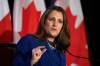
Finance Minister Chrystia Freeland tables the federal budget in the House of Commons as Prime Minister Justin Trudeau looks on in Ottawa, Thursday, April 7, 2022. The Liberal budget laid out money for a new dental care program Thursday, but not necessarily a plan. THE CANADIAN PRESS/Adrian Wyld

The terms of the deal say the government must start with children under the age of 12 in 2022, expand to under 18-year-olds, seniors and people with disabilities in 2023 and fully implement the program by 2025.

The NDP, which originally conceived of the program, envision a stand-alone, federally administered system that will be expanded over the next three years. The New Democrats have repeatedly said they expect the Liberals to remain faithful to that vision.

NDP Leader Jagmeet Singh said the benefit is that it can be implemented immediately.

“We’re just going to provide care to those who need it most immediately, and it’ll make a huge difference in peoples’ lives right away,” he said in an interview.

The Canadian Dental Association, however, wants the government to use the money to bolster existing and underfunded provincial dental plans.

When asked which direction the Liberals planned to go, Prime Minister Justin Trudeau only said the federal government would “work in partnership with provinces and territories and across jurisdictions to make sure that we’re targeting supports.”

In his first news conference since the budget was tabled, Trudeau compared the government’s new dental care ambitions to the recent childcare agreements signed with provinces and territories, in which the feds offered money to provinces to lower care costs.

“There was a lot of skepticism as to whether or not Canada would actually achieve the childcare benchmarks, but we rolled up our sleeves, we worked on something that really matters to Canadians and we got national child care right across the country,” he said.

The prime minister’s comments give dental association president Dr. Richard Holden some indication the Liberals won’t create a new program from scratch.

“If you sort of read between the lines, that would be certainly the hope that it might be along the same lines as child care, perhaps negotiating or dealing with the provinces and territories individually,” he said in an interview.

Private insurers could, for example, opt not to cover services offered by the federal plan, he said. It could also mean that people lose coverage for a period of time during the transition.

Provincial governments provide dental benefits for some lower-income families and certain members of the population, but the plans vary widely across the country.

Holden also worries a new federal program will add to the existing inequities between programs.

“That would be the concern, that you might take a step backwards,” he said.

Prime Minister Justin Trudeau speaks about Budget 2022 highlights from a podium in a family home's backyard in Hamilton, Ont., Friday, April 8, 2022. THE CANADIAN PRESS/Peter Power

The association says about 67 per cent of Canadians report having dental benefits that cover all or part of their dental treatments. Roughly 50 per cent of Canadians get their benefits from their employer.

Conservative Health critic Michael Barrett said he worries about the government’s ability to deliver a complex and expensive new program when it can’t keep up with the current health system.

“If provinces want to expand dental coverage, the federal government should increase transfer payments to the provinces instead of creating a new federal program and undervaluing existing health plans,” Barrett said in a statement.

The Liberals agreed with the NDP to start small, putting forward $300 million this year toward children under 12 whose families make an annual salary under $90,000.

Once the program is fully implemented for low- and medium-income families, the annual cost is expected to level out at about $1.7 billion per year.

The figure put forward in the budget closely mirrors a parliamentary budget officer report on the cost of the NDP’s vision for dental care in 2020.

Finance Minister Chrystia Freeland said her department worked up to come up with the figures.

“Now we have to do the work of rolling up our sleeves, working carefully with provinces and territories and figuring out exactly how we are going to implement this program,” Freeland said at the news conference with Trudeau.

“I am not going to claim it’s going to be easy or simple. A collaborative approach always takes time, and it takes lots and lots of conversations.”

It’s still too early to say which dental services will be covered or how the coverage would stack up to private plans, but the government has only until the end of the year to figure it out.

This report by The Canadian Press was first published April 8, 2022.

Report Error Submit a Tip

More Stories

Another embarrassing loss: Arniel

Mike McIntyre 7 minute read Preview

Another embarrassing loss: Arniel

Mike McIntyre 7 minute read Yesterday at 6:15 PM EST

RALEIGH — No sticks were smashed. No walls punched. And nary a naughty word was uttered.

Instead, the Winnipeg Jets filed off the ice here at Lenovo Center on Sunday afternoon much like they’d just played the preceding game against the Carolina Hurricanes — with no emotion, no passion, no urgency.

You’d have thought yet another loss, this one in truly humiliating fashion and a ninth consecutive overall, might have triggered something.

Anything.

Read
Yesterday at 6:15 PM EST

Why are Manitoba's school immunization programs so far from achieving herd immunity?

Maggie Macintosh  26 minute read Preview

Why are Manitoba's school immunization programs so far from achieving herd immunity?

Maggie Macintosh  26 minute read Saturday, May. 1, 2021

Sometimes, neither a lollipop nor a dinosaur sticker is enough to convince someone to get a needle.

Dr. Michele Feierstein, a pediatrician for more than 35 years, knows that all too well.

Feierstein has given thousands of immunizations to young patients throughout her career, but she has also had her fair share of difficult conversations with parents who are vaccine-hesitant or outright anti-vaxxers.

She does not bar families who have lukewarm feelings about or adamant views against immunization, whether they be rooted in misinformation, distrust, religious belief, or any other reason, from her practice at the Manitoba Clinic.

Read
Saturday, May. 1, 2021

Russian Olympic biathlon champion loses Sochi doping case

Graham Dunbar, The Associated Press 5 minute read Preview

Russian Olympic biathlon champion loses Sochi doping case

Graham Dunbar, The Associated Press 5 minute read Thursday, Sep. 24, 2020

GENEVA - Two-time Olympic biathlon champion Olga Zaitseva lost her appeal Thursday against disqualification from the 2014 Sochi Olympics for her part in Russia’s state-backed doping program.

The Court of Arbitration for Sport said its judges upheld the International Olympic Committee’s disciplinary ruling of 2017, which used evidence against Zaitseva from Russian whistleblower Grigory Rodchenkov.

Zaitseva’s disqualification from all her Sochi events strips Russia of its silver medal in the women’s biathlon 4x6-kilometre relay. She won — and will retain — her gold medals from the same relay event at the two previous Winter Games in 2006 and 2010.

Her lawyer in Switzerland, Yvan Henzer, said Zaitseva would appeal the CAS ruling at Switzerland’s supreme court. The federal court typically only intervenes if legal process was abused.

Read
Thursday, Sep. 24, 2020

Manitoba’s First Nations and the Indian Act

Hersh Seth 6 minute read 2:00 AM EST

On Monday in Ottawa, Manitoba Premier Wab Kinew called for the Indian Act to be abolished. Prime Minister Mark Carney said he was open to working with First Nations to reform or repeal this law, calling it racist.

The act was created in 1876 and still controls Indian status, reserve lands and band governance. It’s understandable why many people want a better relationship.

But repealing a law and building a new relationship are not the same. What would replace the act’s protections? Who decides? How do governments ensure removing federal authority gives First Nations power while the Crown keeps its promises?

Manitoba has faced these questions before. In 1971, First Nations created a document called Wahbung: Our Tomorrows, in response to then-prime minister Pierre Trudeau’s white paper on assimilation. More than 45 years later, elders and knowledge keepers met at Turtle Lodge, north of Winnipeg, to continue the conversation. Manitobans Dave Courchene Sr. and his son, Dave Courchene Jr., are generational links to the broader movement, and their story should be part of this discussion.

Today’s horoscope

Georgia Nicols 4 minute read Preview

Today’s horoscope

Georgia Nicols 4 minute read 2:00 AM EST

MOON ALERT: Avoid shopping (except food and gas) and important decisions after 6 p.m. The moon is in Leo.

ARIES (March 21-April 19)

This is a wonderful day to shmooz and socialize with others. Sporting events and fun activities with children will also appeal. Romance is definitely energized. Some people will encounter new love.

TAURUS (April 20-May 20)

Read
2:00 AM EST

Cottage communities constrained by COVID

Cassandra Szklarski, The Canadian Press 6 minute read Preview

Cottage communities constrained by COVID

Cassandra Szklarski, The Canadian Press 6 minute read Friday, May. 1, 2020

TORONTO - A springtime trickle of Manitobans entering Ontario to visit their lakeside cottages alarmed Kenora Mayor Daniel Reynard a month ago.

Now that Manitoba is poised to restart some non-essential services Monday, Reynard fears an even bigger influx — this time sun-seekers expecting amenities that are simply unavailable.

The message in Ontario is still one of restraint: Avoid non-essential travel, and do not visit your cottage. Provincial travel is not prohibited, but vacationers and day-trippers will find little to do.

Restaurants are closed, as are all beaches, golf courses, parks, trails and marinas.

Read
Friday, May. 1, 2020