Feds move forward on menstrual equity in budget, advocates want it done ‘right’

Advertisement

Advertise with us

OTTAWA - Over six months since the Liberals committed to creating a menstrual equity fund, the federal government has proposed the pilot project in its 2022 budget.

Read this article for free:


or

Already have an account? Log in here »

To continue reading, please subscribe:

Subscribe and receive a limited-edition Free Press branded hat or tote.

Digital Subscription

One year of digital access for only $205*

  • Enjoy unlimited reading on winnipegfreepress.com
  • Read the E-Edition, our digital replica newspaper
  • Access News Break, our award-winning app
  • Play interactive puzzles

*First annual payment billed as $205.00 + GST for one year. This annual subscription will automatically renew at $233.00 + GST every 52 weeks (10% off the regular annual price of $259.35). Offer available to new and qualified returning subscribers only. Cancel any time.

To continue reading, please subscribe:

Add Free Press access to your Brandon Sun subscription for only an additional

$1 for the first 4 weeks*

  • Enjoy unlimited reading on winnipegfreepress.com
  • Read the E-Edition, our digital replica newspaper
  • Access News Break, our award-winning app
  • Play interactive puzzles
Start now

*Your next Brandon Sun subscription payment will increase by $1.00 and you will be charged $17.95 plus GST for four weeks. After four weeks, your payment will increase to $24.95 plus GST every four weeks.

Hey there, time traveller!
This article was published 08/04/2022 (1642 days ago), so information in it may no longer be current.

OTTAWA – Over six months since the Liberals committed to creating a menstrual equity fund, the federal government has proposed the pilot project in its 2022 budget.

Starting in 2022, the government would give $25 million over two years to create a national pilot that helps make menstrual products available to Canadians.

Women and Gender Equality Canada will be in charge of creating the project.
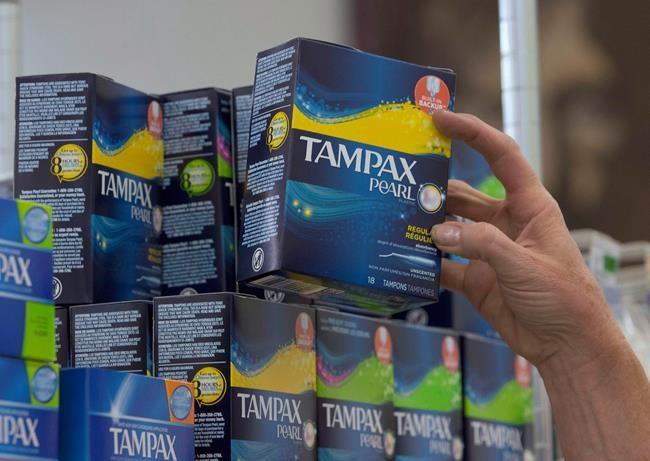
Tammy Compton restocks tampons at Compton's Market, Wednesday, June 22, 2016, in Sacramento, Calif. Advocates say that government should make menstrual products freely available for those who need them. NDP MP Leah Gazan, critic for women and gender equality, says they should be treated as an essential hygiene product, like toilet paper. (AP Photo/Rich Pedroncelli)

Kevin Hiebert, director of business development at Changing the Flow, said the groups directly affected by lack of access should lead the discussion on how to get menstrual equity right.

This would mean reaching out to people who are racialized, gender nonconforming, disabled and experience other forms of marginalization, Hiebert said.

“Go to where they are and say, ‘What does solving period poverty look like to you?'” he said.

Bhanvi Sachdeva, youth advocate for Plan International Canada, said this work should be sure to meet the needs of those groups, while also keeping the climate in mind.

This means moving away from single-use period products to reusable ones, Sachdeva said.

Palwashah Ali, advocacy co-chair for Bleed The North, said she’s noticed similar government programs are often gendered and hit the bare minimum standard for equity.

“There’s a diverse array of individuals with different gender identities, with different experiences, who go through menstruation,” said Ali.

The mandate letter for Women and Gender Equality Minister Marci Ien tasked her with creating a fund so that non-profits and shelters could make products freely available to “vulnerable women.”

The budget did away with the gendered reference and instead said the fund would help “Canadians in need.”

NDP MP Leah Gazan, critic for women and gender equality, said Monday that these products should be treated as an essential hygiene product, like toilet paper.

“It’s about dignity, and ensuring people have what they need to live in dignity, and that includes menstrual hygiene products, especially for those who can’t afford it,” Gazan said.

MP Karen Vecchio, the Conservative critic for women and gender equality, said Tuesday that she does not support a subsidy for menstrual products, and would want to approach the problem differently.

“Is that a subsidy so that we’re still paying $10 for a box of tampons, or are we going to try to start doing something different?” Vecchio said.

Vecchio said she would want to look further at the root causes that explain why menstrual products get priced so high, whether it be due to tariffs or markups along the supply chain.

“People are making money off of people who need these products. I don’t think it’s a government fix,” she said.

Ien said on March 22 in the House of Commons that she is consulting with organizations about menstrual equity to inform their work.

Riyadh Nazerally, a spokesperson in Ien’s office, said in a statement Wednesday that the minister and her team have started consulting with educational institutions, businesses, not-for-profits and other government departments.

When asked if Ien would be creating a formalized consultation process, Nazerally did not directly answer but said they will continue holding consultations “to make menstrual equity a reality.”

“Supporting people that menstruate is long overdue and is part of our government’s plan to build a more equitable Canada,” he said.

The Liberal government created a public consultation process on providing menstrual products in federally regulated workplaces that came to a close in September 2021.

Hiebert of Changing the Flow said consultations would be worth doing if they’re meant to find out what people using the fund would need, and to use those findings to better meet those needs.

“Unless that’s happening … it’s not necessary. Broadly speaking, what needs to be done is known,” he said.

Gabrielle Trépanier, another advocacy co-chair with Bleed The North, said she thinks there is absolutely a need for a full consultation, to make sure the program is successful for every type of person it is trying to reach.

The information that circulates on menstruation does not always highlight all people who experience it, Trépanier said.

“Oftentimes we have folks like Indigenous folks or people who have menstrual disabilities who get missed in these programs, because there isn’t that lengthy consultation,” she said.

This report by The Canadian Press was first published April 8, 2022.

—

This story was produced with the financial assistance of the Meta and Canadian Press News Fellowship.

Report Error Submit a Tip

More Stories

Biographer delves deep into the comedy and the tragedy of Robin Williams' troubled life

Reviewed by GC Cabana-Coldwell 6 minute read Preview

Biographer delves deep into the comedy and the tragedy of Robin Williams' troubled life

Reviewed by GC Cabana-Coldwell 6 minute read Saturday, Jun. 16, 2018

Whenever I’m asked with whom I’d love to dine, entertainer Robin Williams always tops my short list of three. Still.

It’s immaterial that we didn’t move in the same social circles. Or that our career paths never crossed, even though one of his many movies, The Big White, was partially shot in Winnipeg in 2005. Something about him — that hairy persona, those kind blue eyes, the “aw shucks” grin — had intrigued me since watching the debut of his Mork & Mindy TV sitcom in 1978. His off-the-wall goofiness simply sealed the deal.

Comedian Williams became movie-star Williams, and I bought every flick — the good, the not-so-good and the real stinkers. His raunchy standup recordings, often released between his movies, were just an added, adult-only bonus.

So I, like many, was gutted when, at age 63, Williams took his own life in 2014. I didn’t “get” it: how could an award-winning, funny guy, admired by so many for so long, get so beaten up inside that he’d off himself?

Read
Saturday, Jun. 16, 2018

House of horrors burned for TV film

By Mike McIntyre and Keith Bonnell 3 minute read Preview

House of horrors burned for TV film

By Mike McIntyre and Keith Bonnell 3 minute read Thursday, Dec. 3, 2009

The boy watched as fire began to consume the farmhouse, while a film crew taped the blaze for a movie.

As flames engulfed the two-storey farmhouse near Kipling, Sask., the boy was looking at more than a movie moment -- he was witnessing the destruction of the house of horrors where he was held prisoner and raped three years ago by one of Canada's most notorious child molesters, Peter Robert Whitmore.

"He didn't really care about the movie," the boy's father said Wednesday, recalling the blaze that bitterly cold day in February.

"We were all glad to see the place go."

Read
Thursday, Dec. 3, 2009

Botched execution revives death penalty debate

Arthur Chapman 5 minute read 2:00 AM CDT

The United States of America’s seemingly endless, often futile, search for the painless, bloodless method of executing prisoners continues. The latest horrifying chapter occurred in Tennessee on Sept. 30, when the state tried to kill convicted murderer Christa Pike by lethal injection.

It didn’t work. Pike survived two dosages of pentobarbital. She was rushed to a hospital where, according to her lawyer, she was receiving “lifesaving care”.

Tennessee governor Bill Lee has cancelled upcoming executions, but he isn’t moving away from capital punishment.

Lee said, as quoted in the New York Times: “The people of Tennessee have determined that capital punishment is the appropriate sentence for the most heinous of crimes. The people of Tennessee expect those sentences to be carried out in a manner that’s not only legal and constitutional but effective, and that didn’t happen.”

Wasteful operations should be held accountable

Barry E. Prentice 5 minute read Preview

Wasteful operations should be held accountable

Barry E. Prentice 5 minute read Yesterday at 2:00 AM CDT

Rising water bills are a top-of-mind issue for residents of Winnipeg going into the fall election. Management of the water and waste system is under question, with citizen’s groups, as well as the Free Press, calling for proper oversight of rates (Time for the PUB to review Winnipeg water rates, Editorial, Sept. 26).

The need to increase rates to build the North End sewage plant is understandable. Siphoning off utility proceeds to make up other tax revenue shortfalls is another matter. But it is not the only questionable practice. If there was Public Utilities Board oversight of Winnipeg’s water and sewer rates, it would certainly be asking why the city is spending more than $3 million annually to operate the 164-kilometre-long, Greater Winnipeg Water District railway (GWWD) on ratepayers’ behalf.

The GWWD has come to the attention of the Railway Relocation Study, led by Lloyd Axworthy. All existing rail lines within the city are under review, as is the feasibility of a new railway bypass.

The GWWD is an example of a railway that has outlived its usefulness and sits on a pocket of land close to downtown that could be converted to higher-value uses.

Read
Yesterday at 2:00 AM CDT

Feds move forward on menstrual equity in budget

Erika Ibrahim, The Canadian Press 5 minute read Preview

Feds move forward on menstrual equity in budget

Erika Ibrahim, The Canadian Press 5 minute read Friday, Apr. 8, 2022

Daily horoscope

Read
Friday, Apr. 8, 2022

City emergency crews to administer drug that stops opioid withdrawal symptoms

Joyanne Pursaga 5 minute read Preview

City emergency crews to administer drug that stops opioid withdrawal symptoms

Joyanne Pursaga 5 minute read Monday, Aug. 10, 2026

Winnipeg Fire Paramedic Service crews will soon give out a medication that stops withdrawal symptoms after someone is treated for an opioid overdose.

Emergency workers will be administering a drug called buprenorphine, after Health Canada granted WFPS permission to use the controlled substance.

“Buprenorphine is a medication that offers people who are in active addiction — so those people who have received naloxone as a result of an overdose and those that are experiencing significant and, at times, dangerous withdrawal symptoms — just a bit of a reprieve … (It) reduces cravings and prevents those immediate withdrawal symptoms, which allows more time to connect those patients to further care,” said Michelle Long, WFPS assistant chief of paramedic operations.

The treatment option is in response to a persistently high number of WFPS opioid calls.

Read
Monday, Aug. 10, 2026