Vaccine mandate ‘not an issue at all,’ CEO of Canada’s largest trucking company says
Advertisement
Read this article for free:
or
Already have an account? Log in here »
To continue reading, please subscribe:
Digital Subscription
One year of digital access for only $1.44 a week*
- Enjoy unlimited reading on winnipegfreepress.com
- Read the E-Edition, our digital replica newspaper
- Access News Break, our award-winning app
- Play interactive puzzles
*Billed as $5.77 plus GST every four weeks. After 52 weeks, price increases to the regular rate of $19.95 plus GST every four weeks. Offer available to new and qualified returning subscribers only. Cancel any time.
To continue reading, please subscribe:
Add Free Press access to your Brandon Sun subscription for only an additional
$1 for the first 4 weeks*
- Enjoy unlimited reading on winnipegfreepress.com
- Read the E-Edition, our digital replica newspaper
- Access News Break, our award-winning app
- Play interactive puzzles
*Your next Brandon Sun subscription payment will increase by $1.00 and you will be charged $17.95 plus GST for four weeks. After four weeks, your payment will increase to $24.95 plus GST every four weeks.
Read unlimited articles for free today:
or
Already have an account? Log in here »
Hey there, time traveller!
This article was published 08/02/2022 (1729 days ago), so information in it may no longer be current.
MONTREAL – Canada’s largest trucking company is virtually untouched by the vaccine mandate for truckers crossing the U.S.-Canada border, says TFI International Inc. chairman and CEO Alain Bédard.
“Vaccination at TFI is not an issue at all,” he told analysts on a conference call Tuesday.
“We have a few drivers that still say no, but what we do with them is we just keep them in Canada” — a strategy adopted by several large transport outfits but less available to smaller ones.
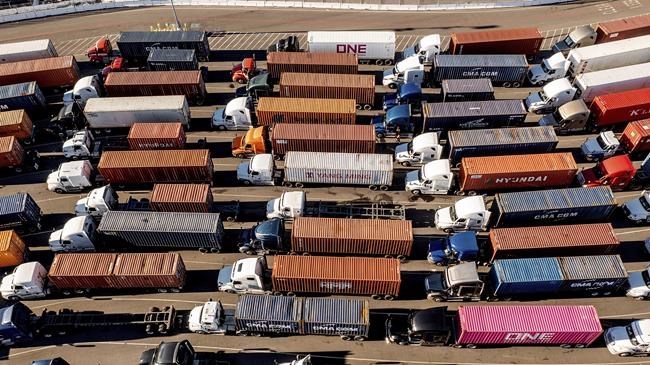
The vast majority of TFI’s Canadian drivers are inoculated against COVID-19, Bédard said, adding that an eventual end to the exemption for cross-border truckers had been predictable. It was announced by the federal government on Nov. 19 and took effect Jan. 15.
He said last month looked like “the best January ever for the company,” coming after a fourth quarter that saw profits jump by more than two-thirds and revenue leap by 91 per cent.
“The biggest issue for us really in January is sick people in the U.S. with COVID” — particularly at TForce Freight, the massive transporter of smaller packages and cargo previously known as UPS Freight that TFI bought from United Parcel Service for US$800 million last year — Bédard said.
Last month, the federal government required non-essential Canadian workers including truck drivers to be fully vaccinated if they want to avoid a 14-day quarantine upon re-entry from the United States — a rule the Canadian Trucking Alliance asked to be delayed but has now accepted. The United States imposed the same rule on American drivers a week later on Jan. 22, with Canadians who are not fully vaccinated barred from entry to the U.S. and vice versa.
The past 11 days have seen truckers bear down on Ottawa for a protest against the mandate and other pandemic restrictions, snowballing into an entrenched demonstration downtown encompassing a grab bag of grievances that has jammed streets and sparked confrontations and 60 criminal investigations. Starting Sunday, police have tried to get a firmer grip on the scene below Parliament Hill, seizing thousands of litres of diesel fuel and hauling away an oil tanker and a plywood shack.
Meanwhile, cars were moving again at border crossings in Coutts, Alta., and across the Ambassador Bridge between Windsor, Ont., and Detroit — though only northbound into the U.S.; southbound lanes into Canada remained shut down — as of Tuesday afternoon after anti-vaccine mandate demonstrations blocked traffic Monday night. The bridge typically handles about 10,000 trucks per day, according to a study published in the Journal of Transport Geography last February.
The Coutts protest had temporarily resumed after trucks and other vehicles began to gather there late last month in a show of support with rallies against pandemic measures in Ottawa and elsewhere.
The number of truckers crossing into Canada fell by 11,358 or 10.5 per cent to 97,321 the week of Jan. 17-23 compared with the week before, according to the Canada Border Services Agency. The next week marked a 2.2 per cent decrease of 2,409 truck drivers to 106,274 from the week of Jan. 10-16.
The decline, which averages out to 6.3 per cent in the two weeks after the trucker vaccine deadline, marks a steeper drop than in preceding years. But 2019 saw cross-border big-rig figures fall 5.4 per cent in the two weeks after mid-January compared with the preceding week, and 2021 also saw a slight drop in the final two weeks of the month.
“Data proves that (the) vaccine mandate has had no measurable impact on the number of truckers crossing our border. Thanks to Canadian truckers who are working around the clock, safely, to ensure that Canadians receive their essential goods,” Transport Minister Omar Alghabra said in a Twitter post last week.
Not everyone agrees.
“The trucker vaccine mandate adds to supply chain pressures and costs for small business owners,” Dan Kelly, head of the Canadian Federation of Independent Business, said in a Twitter post.
Kelly is calling for an end to the vaccine mandate as well as any border blockade, which he said “makes the problem even worse.”
A group of Canadian and U.S. trade organizations ranging from the Canadian Chamber of Commerce to the Hearth, Patio and Barbecue Association of Canada is demanding a “swift and immediate clearing” of the Ambassador Bridge blockade as well as solutions to the Coutts logjam.
TFI remains unfazed, forecasting higher than expected free cash flow of US$700 million and operating earnings per share of between US$6.25 and US$6.50 for 2022.
“Market conditions are very strong right now and there still remains attractive integration opportunities in parts of their business,” RBC Dominion Securities analyst Walter Spracklin said in an investor note.
The trucking sector continues to face hurdles including a dire labour shortage, but surging demand for consumer items, raw materials and manufacturing components has fuelled growth across the industry.
TFI’s stock rose $9.86 or 8.1 per cent Tuesday, closing at $132.16 on the Toronto Stock Exchange.
Its profits shot up to US$144.1 million in the quarter ended Dec. 31 from US$86.3 million a year earlier.

TFI, which reports in U.S. dollars, said revenue increased to US$2.14 billion in its fourth quarter from $1.12 billion during the same period in 2020. TForce Freight, whose purchase closed in April, accounted for about 81 per cent of the boost in revenue before fuel charges.
On an adjusted basis, the Montreal-based company said diluted earnings per share increased 60 per cent to $1.57 from 98 cents.
The figure registered more than one-third above analyst expectations of $1.17 per share, according to financial data firm Refinitiv.
This report by The Canadian Press was first published Feb. 8, 2022.
Companies in this story: (TSX:TFII)
Related Articles
Conservative leader Erin O’Toole got the boot. Is Jason Kenney next?
Advertisement Advertise With Us
Advertisement Advertise With Us