Quebec backtracks on taxing unvaccinated to maintain ‘social peace’

Advertisement

Advertise with us

MONTREAL - Three weeks after threatening to tax unvaccinated Quebecers, Premier François Legault abandoned the idea on Tuesday, worried about how much it had divided the province.

Read this article for free:


or

Already have an account? Log in here »

To continue reading, please subscribe:

Subscribe and receive a limited-edition Free Press branded hat or tote.

Digital Subscription

One year of digital access for only $205*

  • Enjoy unlimited reading on winnipegfreepress.com
  • Read the E-Edition, our digital replica newspaper
  • Access News Break, our award-winning app
  • Play interactive puzzles

*First annual payment billed as $205.00 + GST for one year. This annual subscription will automatically renew at $233.00 + GST every 52 weeks (10% off the regular annual price of $259.35). Offer available to new and qualified returning subscribers only. Cancel any time.

To continue reading, please subscribe:

Add Free Press access to your Brandon Sun subscription for only an additional

$1 for the first 4 weeks*

  • Enjoy unlimited reading on winnipegfreepress.com
  • Read the E-Edition, our digital replica newspaper
  • Access News Break, our award-winning app
  • Play interactive puzzles
Start now

*Your next Brandon Sun subscription payment will increase by $1.00 and you will be charged $17.95 plus GST for four weeks. After four weeks, your payment will increase to $24.95 plus GST every four weeks.

Hey there, time traveller!
This article was published 01/02/2022 (1707 days ago), so information in it may no longer be current.

MONTREAL – Three weeks after threatening to tax unvaccinated Quebecers, Premier François Legault abandoned the idea on Tuesday, worried about how much it had divided the province.

“When we see what’s happening in our society and on social media, I have a certain worry about seeing Quebecers divided,” Legault told reporters in Quebec City.

On Jan. 11, Legault said his government would break new ground by making the unvaccinated — about 10 per cent of eligible Quebecers — pay a significant financial penalty because they were overrepresented in the health-care system. It was the first proposed tax of its kind in the country.
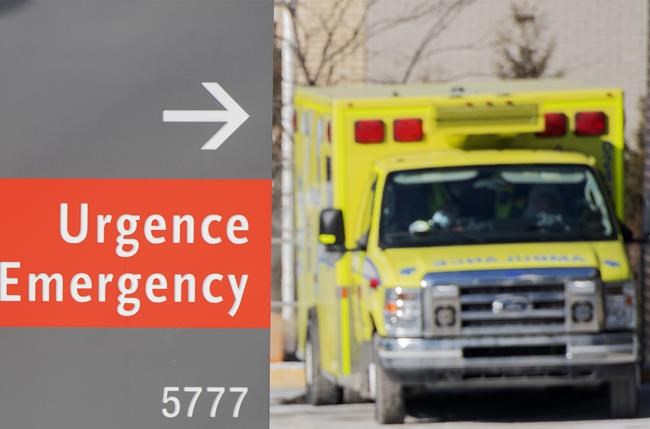
An ambulance is shown outside a hospital in Montreal, Saturday, Jan. 15, 2022, as the COVID-19 pandemic continues in Canada. THE CANADIAN PRESS/Graham Hughes

On Tuesday, the premier said Finance Minister Eric Girard had prepared a bill to tax Quebecers who refused to get vaccinated against COVID-19 without a medical reason, but Legault said the legislation would not be tabled.

Striking a more conciliatory tone, Legault said his role is to ensure a climate of “social peace and a certain social cohesion” in the province.

The premier denied he had lacked judgment by making a threat he wasn’t willing to go through with, and he defended the proposed measure as another attempt to incentivize people to get vaccinated. But he acknowledged discontent has grown in recent weeks among Quebecers, adding that his focus would be to build bridges.

“We’ll continue to try to reach those who refuse to receive their first dose,” Legault said. “But I’m also worried about the division we see in Quebec — my role is to try to bring Quebecers together, to stay united as a people.”

Quebec’s official Opposition said when the idea was first proposed it was nothing more than an empty threat. The Liberals predicted the government would adandon the tax the same way it had dropped a plan to force health-care workers to get the jab or be suspended without pay.

The Opposition had also called the government’s proposal on Jan. 11 a distraction, aimed at drawing attention away from the resignation the night prior of Dr. Horacio Arruda as public health director.

Liberal Leader Dominique Anglade on Tuesday said the decision to abandon the proposal was more improvisation by the Legault government.

“He’s managing by polls,” Anglade said. “He must have a poll that’s saying, ‘you know, this is not popular anymore.'”

Québec solidaire’s Gabriel Nadeau-Dubois said the move shows the vaccination tax was essentially a trial balloon.

“This vaccine tax was nothing more than an idea of the moment,” Nadeau-Dubois said. “It was never a serious plan, it was never something that was thought and prepared.”
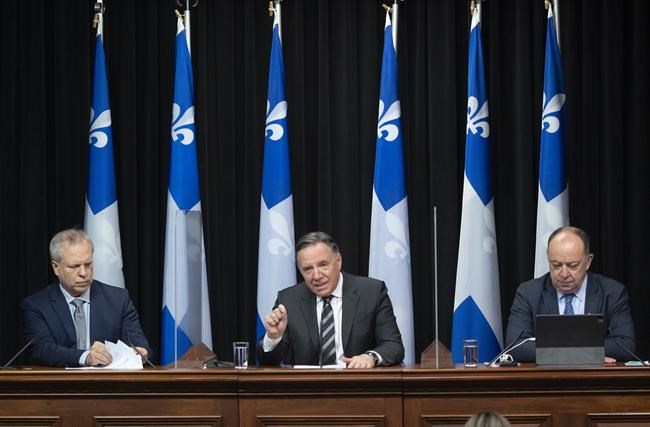
Quebec Premier Francois Legault, centre, speaks during a news conference on the COVID-19 pandemic, Tuesday, February 1, 2022 at the legislature in Quebec City. Legault is flanked by Luc Boileau, Quebec interim director of National Public Health, left, and Quebec Health Minister Christian Dube. Francois Legault says he is abandoning his threat to tax the unvaccinated. THE CANADIAN PRESS/Jacques Boissinot

Also Tuesday, Legault announced that gyms and spas would be allowed to reopen in the province on Feb. 14, but he stopped short of easing further restrictions, such as the forced closure of bars. Though the number of COVID-19 patients in hospitals dropped by 426 in one week, he said the hospital network is still under tremendous pressure.

On Monday, restaurant dinning rooms were permitted to reopen at 50 per cent capacity. The second phase of Quebec’s reopening plan is set for next week, with places of worship and entertainment and sports venues allowed to reopen Feb. 7 with capacity restrictions.

Dr. Luc Boileau, the province’s interim public health director, said decisions are being taken based on the Omicron variant’s increased transmissibility compared to the Delta variant.

“Right now, we’re looking at phases of (loosening) the measures … to make sure that it will not induce automatically a high rate of high-risk contact,” Bolieau said. “In bars, we have a lot of experience with those places and unfortunately … those are places where risk of transmission of the virus is very high.”

Boileau said he expects bars will be permitted to reopen in the near future as the situation improves and urged people to get a booster shot. About 61 per cent of Quebec adults have obtained a third dose so far, he added.

The Health Department said Tuesday COVID-19-related hospitalizations dropped by 36 from the day before, to 2,852, after 207 people were admitted to the province’s hospitals and 243 were discharged. The number of people in intensive care dropped by five, to 218. Officials reported 63 more deaths linked to the pandemic.

This report by The Canadian Press was first published Feb. 1, 2022.

Report Error Submit a Tip

More Stories

Letters, Oct. 5

7 minute read 2:01 AM CDT

Fighting the good fight

Re: Transit, roads and city council’s priorities (Oct. 2)

Many thanks to Erna Buffie for once again speaking up for transit.

When will Winnipeg finally make the shift from a car-dependent culture to a greener and more efficient way?

Thank Manitoba’s teachers by investing in students

Lillian Klausen 5 minute read 2:00 AM CDT

Manitoba’s students are settling into a new school year. Whether you graduated in 1986 or 2006, today’s classrooms look very different from the ones you remember.

Students reflect the changing makeup of our communities — differences in social, emotional, physical and cognitive abilities and socioeconomic stresses are all increasingly present and adding to the complexity of our classrooms.

Meeting these differing individual needs is no easy feat. It requires manageable class sizes, school counsellors, social workers, specialized resource teachers and investment in the systems that can help students thrive. But when those supports aren’t available, students’ needs don’t disappear. Increasingly, it falls to classroom teachers to try to fill the gaps.

When I started working as a teacher more than 30 years ago, we had budgets for resources when we needed them. Today, the needs of students have diversified and increased, but the funding for our public schools is failing to meet them.

All-Japan committee meets to promote Sapporo Olympic bid

Stephen Wade And Yuri Kageyama, The Associated Press 4 minute read Preview

All-Japan committee meets to promote Sapporo Olympic bid

Stephen Wade And Yuri Kageyama, The Associated Press 4 minute read Tuesday, May. 10, 2022

TOKYO (AP) — Yasuhiro Yamashita, the head of the Japanese Olympic Committee, acknowledged the biggest stumbling block to holding the Olympics is the billions in costs.

However, in another breath on Tuesday at a so-called “All Japan” meeting to promote Sapporo's bid for the 2030 Winter Olympics, he said that if the northern Japanese city lands the Games, little new construction will be needed — a major expense for every Olympics.

“From both inside and outside our country, there are many views about hosting the Olympic and Paralympic Games,” Yamashista said, among politicians and business leaders online — and in Sapporo — talking up the bid. “I realize there are also concerns about the huge costs involved.”

The official cost for last year's delayed Tokyo Olympics was $13.6 billion, although government audits suggest it may have been much more. At least 60% was public money.

Read
Tuesday, May. 10, 2022

Hydro’s planned outages turn out the lights for thousands across province

Nicole Buffie 4 minute read Preview

Hydro’s planned outages turn out the lights for thousands across province

Nicole Buffie 4 minute read Wednesday, Jul. 15, 2026

Business owners in the East Beaches area of Lake Winnipeg hauled out generators Wednesday after a planned Manitoba Hydro outage left thousands of residents and cottagers without power.

Lise Bourassa, who runs several stores in Grand Beach, had to rent generators to accommodate the eight-hour blackout, which affected the area from Beaconia to Victoria Beach as well as Sagkeeng First Nation, while Hydro crews fixed a pole that was damaged by fire in May .

Despite the spare power source, she was only able to open one of her stores during the outage and said it came at a bad time.

“I understand the importance of what Manitoba Hydro is doing, the problem all the businesses in this area are having is that our season is very short and to be shut down for a full day has a fairly big impact, plus they added cost of getting generators,” she wrote in a message to the Free Press. “We also had less than one week to make arrangements, find electricians and generators to be able to keep all the food safe.”

Read
Wednesday, Jul. 15, 2026

Wasteful operations should be held accountable

Barry E. Prentice 5 minute read Preview

Wasteful operations should be held accountable

Barry E. Prentice 5 minute read 2:00 AM CDT

Rising water bills are a top-of-mind issue for residents of Winnipeg going into the fall election. Management of the water and waste system is under question, with citizen’s groups, as well as the Free Press, calling for proper oversight of rates (Time for the PUB to review Winnipeg water rates, Editorial, Sept. 26).

The need to increase rates to build the North End sewage plant is understandable. Siphoning off utility proceeds to make up other tax revenue shortfalls is another matter. But it is not the only questionable practice. If there was Public Utilities Board oversight of Winnipeg’s water and sewer rates, it would certainly be asking why the city is spending more than $3 million annually to operate the 164-kilometre-long, Greater Winnipeg Water District railway (GWWD) on ratepayers’ behalf.

The GWWD has come to the attention of the Railway Relocation Study, led by Lloyd Axworthy. All existing rail lines within the city are under review, as is the feasibility of a new railway bypass.

The GWWD is an example of a railway that has outlived its usefulness and sits on a pocket of land close to downtown that could be converted to higher-value uses.

Read
2:00 AM CDT

Magic number for marathon man

Eric Willemsen 5 minute read Sunday, Oct. 13, 2019

VIENNA — Roger Bannister, 1954. Eliud Kipchoge, 2019?

Like the sub-four-minute mile, running a marathon in less than two hours had seemed impossible — until Saturday. But this time, there’s an asterisk: Olympic champion Kipchoge performed his feat under conditions so tightly controlled to maximize his success that it won’t appear in the record books.

The 34-year-old Kenyan completed the 42.195 kilometres (26.2 miles) in one hour, 59 minutes, 40.2 seconds at the INEOS 1:59 Challenge, an event set up for the attempt.

Ahead of the event, Kipchoge even compared the feat to being “like the first man on the moon.”