Hope seen once the omicron wave increases global immunity

Advertisement

Advertise with us

World health officials are offering hope that the ebbing of the omicron wave could give way to a new, more manageable phase of the COVID-19 pandemic, even as they warn of difficult weeks ahead and the possibility of another, more dangerous variant arising.

Read this article for free:


or

Already have an account? Log in here »

To continue reading, please subscribe:

Subscribe and receive a limited-edition Free Press branded hat or tote.

Digital Subscription

One year of digital access for only $205*

  • Enjoy unlimited reading on winnipegfreepress.com
  • Read the E-Edition, our digital replica newspaper
  • Access News Break, our award-winning app
  • Play interactive puzzles

*First annual payment billed as $205.00 + GST for one year. This annual subscription will automatically renew at $233.00 + GST every 52 weeks (10% off the regular annual price of $259.35). Offer available to new and qualified returning subscribers only. Cancel any time.

To continue reading, please subscribe:

Add Free Press access to your Brandon Sun subscription for only an additional

$1 for the first 4 weeks*

  • Enjoy unlimited reading on winnipegfreepress.com
  • Read the E-Edition, our digital replica newspaper
  • Access News Break, our award-winning app
  • Play interactive puzzles
Start now

*Your next Brandon Sun subscription payment will increase by $1.00 and you will be charged $17.95 plus GST for four weeks. After four weeks, your payment will increase to $24.95 plus GST every four weeks.

Hey there, time traveller!
This article was published 24/01/2022 (1707 days ago), so information in it may no longer be current.

World health officials are offering hope that the ebbing of the omicron wave could give way to a new, more manageable phase of the COVID-19 pandemic, even as they warn of difficult weeks ahead and the possibility of another, more dangerous variant arising.

In the U.S., cases have crested and are dropping rapidly, following a pattern seen in Britain and South Africa, with researchers projecting a period of low spread in many countries by the end of March. Though U.S. deaths — now at 2,000 each day — are still rising, new hospital admissions have started to fall, and a drop in deaths is expected to follow.

The encouraging trends after two years of coronavirus misery have brought a noticeably hopeful tone from health experts. Rosy predictions have crumbled before, but this time they are backed by what could be called omicron’s silver lining: The highly contagious variant will leave behind extremely high levels of immunity.
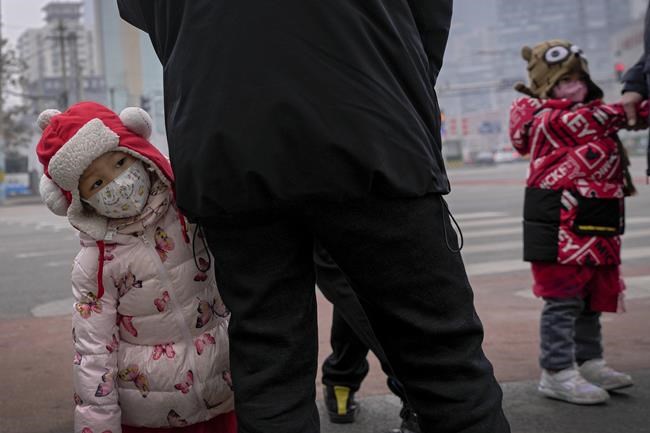
Children wearing face masks to help protect from the coronavirus stand with relatives waiting to cross a traffic intersection in the Central Business District of Beijing, Monday, Jan. 24, 2022. A fresh outbreak in Beijing has prompted authorities to test millions and impose new measures two weeks ahead of the opening of the Winter Olympics, even as Chinese officials on Monday lifted a monthlong lockdown on the northern city of Xi'an and its 13 million residents. (AP Photo/Andy Wong)

On Sunday, Dr. Anthony Fauci talked on ABC “This Week” about a “best-case scenario” where COVID-19 would fall to manageable levels so the United States could get “back to a degree of normality.”

And on Monday, the World Health Organization issued a statement anticipating an end to the “emergency phase” of the pandemic this year and saying that the omicron variant “offers plausible hope for stabilization and normalization.”

Both Fauci and the WHO’s Europe regional director, Dr. Hans Kluge, cautioned that new variants are likely to emerge, but with vaccination, new drug therapies and — during surges — testing and masks, the world could reach a less disruptive level of disease in which the virus is, as Fauci put it, “essentially integrated into the general respiratory infections that we have learned to live with.”

In the U.S., new cases are averaging a still extraordinarily high 680,000 a day, down from an all-time peak of over 800,000 a little more than a week ago.

The places in the U.S. where omicron struck first are seeing the sharpest declines. New cases in the Northeast are nose-diving, while other states — Arizona, Texas, Oregon, Kansas and North Dakota among them — are still waiting for relief.

Falling, too, are new U.S. hospital admissions of patients with confirmed COVID-19. They are averaging nearly 20,000 per day, down about 7% from the previous week, according to the Centers for Disease Control and Prevention.

Those numbers include patients who went to the hospital for other reasons and tested positive. But even after accounting for these incidental infections, the trend is hopeful.

One influential model projects that nearly all nations will be past the omicron wave by mid-March, including China and other countries with “zero COVID” policies. The wave will leave behind high levels of immunity — both from infection and vaccination — that could lead to low levels of transmission for many weeks or months.

“What do we end up with at the end of this?” said Dr. Christopher Murray of the University of Washington, who developed the closely watched Institute for Health Metrics and Evaluation model. “We end up with the highest levels of global immunity that we’ve seen in the pandemic.”

The model estimates that 57% of the world’s population already has been infected with the virus at least once.

Another research group, which combines several models and shares the projections with the White House, predicts a strong decline in U.S. infections by April, unless a new variant emerges that can sidestep the growing levels of immunity.

“It would be dangerous to forget that possibility, as it has caught us before,” said Katriona Shea of Pennsylvania State University, a leader of the team that pulls together the models.

She noted, too, that the projections show 16,000 to 98,000 more Americans dying before the omicron wave is through. The U.S. death toll stands at close to 870,000.

“Even if we project a more optimistic future, right now we still have a lot of COVID spreading, a lot of strain in our hospital systems, and our deaths have not yet peaked,” said Lauren Ancel Meyers, director of the University of Texas COVID-19 Modeling Consortium.

“There’s still a lot of pain before omicron has run its course,” she said, but added: “It’s very plausible that omicron will be a turning point in terms of our relationship with this virus.”

___

The Associated Press Health and Science Department receives support from the Howard Hughes Medical Institute’s Department of Science Education. The AP is solely responsible for all content.


Report Error Submit a Tip

More Stories

Several mayors bow out of fall’s municipal elections

Connor McDowell 3 minute read Yesterday at 2:01 AM CDT

BRANDON — A number of mayors have decided not to run for re-election in western Manitoba municipalities.

Heads of council in Dauphin, Neepawa, Boissevain-Morton and Riverdale have bowed out of the race ahead of the Oct. 28 civic election.

Final ballots were confirmed after candidate nominations closed on Tuesday.

Mayor David Bosiak is not running for re-election in the City of Dauphin after serving one term. A three-way race for the mayoral seat is underway between Coun. Steve Sobering and new candidates Keith Durston and Carter Taylor-Luke. Ten candidates entered the race for council; four are councillors running for re-election and six are new candidates. There are six council seats.

Manitoba chiefs behind renewed effort to criminalize residential school denialism

Scott Billeck 4 minute read Preview

Manitoba chiefs behind renewed effort to criminalize residential school denialism

Scott Billeck 4 minute read Wednesday, Jul. 15, 2026

First Nations chiefs from across the country have unanimously passed an emergency resolution that calls on the federal government to criminalize residential school denialism as hate speech.

The resolution was adopted Tuesday at the Assembly of First Nations annual general assembly in Ottawa. It was introduced by David Monias, chief of Pimicikamak Cree Nation in Manitoba and seconded by Manitoba Keewatinowi Okimakanak Grand Chief Garrison Settee.

“We must honour the survivors and we must honour every child who never came home,” Monias said Wednesday. “We must also support every person who was left behind and those children who never returned home. We are left to mourn those children. They would have been our grandfathers today, our grandparents.”

The federal government estimates about 150,000 Indigenous children attended residential schools.

Read
Wednesday, Jul. 15, 2026

Single budget can’t — or shouldn’t — deliver promised ’generational change’

Dan Lett 5 minute read Preview

Single budget can’t — or shouldn’t — deliver promised ’generational change’

Dan Lett 5 minute read Wednesday, Nov. 5, 2025

The world, it seems, is disappointed in Prime Minister Mark Carney’s first budget, which promised “generational” change but delivered what appears to be something entirely more modest.

What does Carney’s first budget do, and not do?

It does not abandon efforts to combat climate change, but does not really advance them. It delivers a dose of austerity, particularly when it comes to the size and scope of government, but does not ruthlessly reduce the federal civil service or spending. It ramps up spending on housing, infrastructure and defence, but without a credible plan to eliminate the deficit. It provides incentives to the private sector to invest more of its money in Canada, but in a way that may not prove to be that enticing.

Put it all together and Carney is currently being hoisted on his own hyperbole.

Read
Wednesday, Nov. 5, 2025

Perfecting profitability

Joel Schlesinger 6 minute read Preview

Perfecting profitability

Joel Schlesinger 6 minute read 2:01 AM CDT

More jaded of investors may roll their eyes at another book offering up a formula for the “perfect portfolio.”

Veteran portfolio manager Peter Lazaroff, based in St. Louis, and host of the Long Term Investor podcast understands the scepticism around his recently published book The Perfect Portfolio: a Proven Guide to Smart Investing for Long-Term Success.

Yet the chief investment officer at Plancorp Wealth Management, which has about US$10.2 billion in assets under management, has a caveat to the notion of the perfect portfolio.

“The perfect portfolio on paper is probably a lot different than the perfect portfolio for you in real life because what’s ‘perfect’ is a formula you can stick with for decades on end.”

Read
2:01 AM CDT

Fact Check

1 minute read Thursday, Nov. 30, 2023

Fact Check

Having problems with the form?Contact Us Directly |

WSO kicks off season pairing Beethoven, Tchaikovsky

Conrad Sweatman 5 minute read Preview

WSO kicks off season pairing Beethoven, Tchaikovsky

Conrad Sweatman 5 minute read 2:01 AM CDT

French fries and milkshake, watermelon and feta cheese … Beethoven’s Fifth and Tchaikovsky’s Fifth?

Few events mark the beginning of the classical concert season like the Winnipeg Symphony Orchestra’s season-opener and this year they kick things off with an unusual but satisfying pairing.

“I think that for me, the combination of these two pieces is, first of all, a celebration of great masterworks that have withstood 100 years of being probed by time for their relevancy,” says conductor Daniel Raiskin, the WSO’s music director. “It’s the quality of music, it’s the quality of narrative that attracts us to these masterworks again and again.”

Both symphonies are so hefty and canonical, one might have expected half of the concert would be devoted to a concerto, tone poem or something smaller or lesser known.

Read
2:01 AM CDT