B.C. nurses, doctors exhausted as next COVID-19 peak comes this week: spokespeople

Advertisement

Advertise with us

VANCOUVER - While the most challenging days of COVID-19 are predicted to be ahead for British Columbia’s health-care system, representatives for doctors and nurses say their members are on the verge of a possible collapse.

Read this article for free:


or

Already have an account? Log in here »

To continue reading, please subscribe:

Subscribe and receive a limited-edition Free Press branded hat or tote.

Digital Subscription

One year of digital access for only $205*

  • Enjoy unlimited reading on winnipegfreepress.com
  • Read the E-Edition, our digital replica newspaper
  • Access News Break, our award-winning app
  • Play interactive puzzles

*First annual payment billed as $205.00 + GST for one year. This annual subscription will automatically renew at $233.00 + GST every 52 weeks (10% off the regular annual price of $259.35). Offer available to new and qualified returning subscribers only. Cancel any time.

To continue reading, please subscribe:

Add Free Press access to your Brandon Sun subscription for only an additional

$1 for the first 4 weeks*

  • Enjoy unlimited reading on winnipegfreepress.com
  • Read the E-Edition, our digital replica newspaper
  • Access News Break, our award-winning app
  • Play interactive puzzles
Start now

*Your next Brandon Sun subscription payment will increase by $1.00 and you will be charged $17.95 plus GST for four weeks. After four weeks, your payment will increase to $24.95 plus GST every four weeks.

Hey there, time traveller!
This article was published 18/01/2022 (1719 days ago), so information in it may no longer be current.

VANCOUVER – While the most challenging days of COVID-19 are predicted to be ahead for British Columbia’s health-care system, representatives for doctors and nurses say their members are on the verge of a possible collapse.

Doctors of BC president Dr. Ramneek Dosanjh said it has been an overwhelming three years for her members.

“I am hearing from some doctors who are just ready to quit,” she said in an interview.
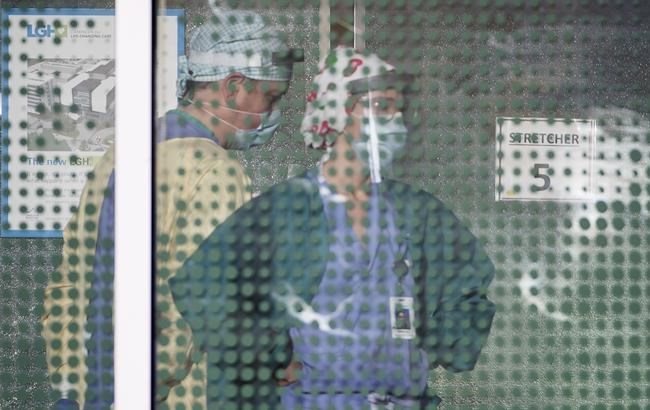
Health-care workers are pictured through the front window at the Lions Gate Hospital in North Vancouver, B.C., Monday, April 13, 2020. While the most challenging days are predicted to come for British Columbia’s health care system as COVID-19 cases peak in the latest wave, representatives for doctors and nurses say their members are already reaching a breaking point. THE CANADIAN PRESS/Jonathan Hayward

The organization represents 16,000 physicians in the province.

“People have shared their honest feelings with me and they’re feeling so consumed. They’re emotionally exhausted. They’re feeling depleted,” she said.

“They’re seeing their patients suffer. They’re also under such constraints.”

Aman Grewal, president of the BC Nurses Union, said nurses are under “incredible pressure” to balance family and work responsibilities, which doesn’t leave them with enough downtime to take care of themselves.

“They are facing verbal and physical harassment from some members of the public who are becoming increasingly frustrated with this ongoing public health crisis,” she said. The organization represents 48,000 nurses.

“This, you know, has been an ongoing issue — violence toward nurses and it’s very morally distressing to know that our members are having to face that all while they are trying to care for their patients.”

On Friday, provincial health care officer Dr. Bonnie Henry said the latest wave fuelled by the Omicron variant may have peaked in parts of B.C., but there’s a lag between infections and those who end up in hospital. That means difficult days are ahead for hospitals and their staff, Henry said.

Interior Health announced temporary changes on Tuesday to deal with staffing challenges. Inpatient services will be closed to stabilize emergency departments in some communities, overnight hours will be reduced to ensure staff is available during the day in others and some non-urgent surgeries will be rescheduled, it said in a news release.

The representatives of doctors and nurses said health-care workers are also facing a shortage of personal protective equipment, including masks.

Dosanjh said doctors need more support on the ground, like more family physicians who can share the burden, less paperwork and better infrastructure support such as universal health records so that the same tests are not repeated.

“A lot of people are seeing patients from 8 a.m. till 8 at night and then doing the paperwork. The days are usually very long for most physicians.”

On Tuesday, Health Minister Adrian Dix said B.C.’s health-care workers have been performing well under enormous pressure to get the province through the pandemic and overdose crisis.

“I am unceasingly thankful for their determination, endurance and skill.”

The week of Jan. 10-16, he said 17,958 health care workers called in sick for a variety of reasons including COVID-19. That compares with 7,573 who were sick the same week last year, he said.

B.C. Emergency Health Services, which employs 4,000 paramedics and dispatchers in the province, said there were 33 people off sick on Jan. 6 last year, while 70 people were ill this year.

Vancouver Coastal Health said in a statement its hospitals mirror what’s happening in the communities, which means they are still seeing COVID-19 cases.

Fraser Health said all emergency departments are fully operational, and while they are seeing an increased number of sick calls due to COVID-19, operational teams have a plan in place to mitigate against impact on staff and access to care.

No staff who have knowingly tested positive for COVID-19 have been called into work, said a statement from the health authority.

Grewal said there are not enough resources to help nurses deal with their own mental well-being amid the increasing fatigue, anxiety and relentless slog starting to take its toll.

A nurse working four shifts in a row might have seen one death before the pandemic, she said.

“And here these nurses are seeing several deaths and several deaths of patients who are their age. They’re not elderly who are always the ones who are dying,” she said.

“You know, our nurses are humans as well.”

It is important for everyone to pay attention to burnout, Dosanjh said, because if more health-care workers are lost to it then patients suffer.

Her father was diagnosed with pancreatic cancer in May 2020 and died last April.

“He was alone and then had to undergo his chemotherapy alone. And then he had surgery alone and was in the hospital alone,” she said.

“There’s so many factors that affect our burnout.”

Health care is a calling where doctors and nurses are seen as invincible and stoic figures, Dosanjh said.

“We have feelings. We’re real people. We share our patients’ pain, we really do,” she said. “The world needs to recognize that we’re humans, you know.”

This report by The Canadian Press was first published Jan. 18, 2022.

Report Error Submit a Tip

More Stories

What’s luck got to do with it?

Tim Kist 5 minute read 2:01 AM CDT

We all seek certainty in our daily lives. We expect if we make a decision, the outcome will be just as we planned: a direct correlation between the decision and result.

You, as a business leader, seek the same certainty from the decisions you make. And sometimes, the result is what was expected. Sometimes, it isn’t.

The big question is: why is it so difficult to achieve the business results you expect when you carefully craft your plans and seemingly make good decisions?

The truth is we cannot predict the future. This means we almost never know precisely how customers will respond to a sales quote, what competitors are planning, and a myriad of other external variables at play.

Chance the Rapper headed for Winnipeg on latest tour

Eva Wasney 6 minute read Preview

Chance the Rapper headed for Winnipeg on latest tour

Eva Wasney 6 minute read Wednesday, Jul. 8, 2026

Chance the Rapper made history in 2016 with the release of his third mixtape, Coloring Book.

The Chicago-born hip-hop artist released the album independently and exclusively through Apple Music, making it the first streaming-only album to earn a Grammy when Chance won Best Rap Album at the 2017 music awards.

The mixtape — which blends gospel with rap and features collaborations with Kanye West, Lil Wayne, Young Thug and others — also received wide critical acclaim.

Chance, 33, is touring North America this summer to celebrate the 10th anniversary of Coloring Book, including a stop at Canada Life Centre on Monday. Audiences can expect hits from that seminal project, along with music from his latest release, Star Line.

Read
Wednesday, Jul. 8, 2026

Small businesses outline election priorities

Robin Bezte 5 minute read Yesterday at 2:00 AM CDT

Since moving to Winnipeg earlier this year, I have come to know the city through its small businesses. As a new Exchange District resident, grabbing coffee at Little Sister, walking through The Forks Market and stopping at Pho Hoang for lunch have become part of my routine. These are the places that give Winnipeg’s neighbourhoods their character and have helped make a new city feel like home.

That is why an empty storefront never feels like just vacant real estate. It represents someone’s investment and hope. When a small business disappears, the community loses a piece of itself.

On Oct. 28, Manitobans in most municipalities will choose their next mayors, reeves and councillors. While city councils may not set interest rates or negotiate global trade agreements, they do have some control over many of the barriers entrepreneurs encounter day to day, from property tax bills and permit applications to public safety and construction disruptions.

Ahead of the upcoming elections, the Canadian Federation of Independent Business (CFIB) surveyed Manitoba small business owners to get a sense of their municipal priorities and concerns.

May be whiff of truth to ex’s odour ardour

Maureen Scurfield 5 minute read 2:01 AM CDT

DEAR MISS LONELYHEARTS: I ran into an old boyfriend I used to curl on a team with, and we went for drinks. We’ve been almost eight years apart, and I couldn’t remember why we broke up, as we always had such a great time together.

It wasn’t until the second date — this time on a weekend — that it came back to me, with a jolt. Pee-yew! I remembered he doesn’t use deodorant on weekends. Why? He enjoys his own body odour. I recalled that a bit too late, and it was just as awful as ever! I went home early.

Tonight, he called and I refused him another date. I said, “Think back. You remember why we broke up?” Then he said, “Oh yeah, you hated my no-deodorant weekend policy. Well, guess what? Some women don’t mind!” I said I really doubted that, and that ended the conversation. Miss L., wouldn’t any women find stinky underarms offensive?

— Sensitive Nose, Fort Richmond

Broadening prediction-market gambling a bad idea

Editorial 4 minute read Preview

Broadening prediction-market gambling a bad idea

Editorial 4 minute read 2:01 AM CDT

Let’s make a prediction: sooner or later, when Canadian governments find a way to take their own cut of the action, prediction-contract gambling on everything from sports to entertainment to political decisions is going to come to Canada.

And that’s a horrible, dangerous, pernicious idea.

Unless you have particular access to information — either inside information or strategic information based on skills or education — you’re not likely to make money at it. In fact, structurally, you’re likely to lose. In prediction markets, you basically pay an amount, plus fees from the company involved, to bet on whether something will or will not happen within a certain time frame. The amount you pay for your contract depends on how other people are also betting.

As Wealthsimple describes it, “You buy whichever side you think is right. Prices move with demand, so if the market leans towards one outcome, the more that side costs. If a lot of people are backing the TSX to finish above 38,000, yes gets more expensive and no gets cheaper.”

Read
2:01 AM CDT

Musk’s gambit unlikely to end well

Gwynne Dyer 5 minute read Preview

Musk’s gambit unlikely to end well

Gwynne Dyer 5 minute read Friday, Nov. 4, 2022

Elon Musk is that rarest of things, a benign sociopath, and therefore a person of considerable value to the world. He has just made a mistake that could ruin his long-term plan, for his purchase of Twitter is almost bound to end in tears. The sharks are always circling the very rich and highly geared, and I find myself worrying about him.

Read
Friday, Nov. 4, 2022