Canada approves Pfizer COVID drug as hospitalizations rise and kids return to school

Advertisement

Advertise with us

Health Canada added another tool to its pandemic-fighting arsenal Monday, approving Pfizer's antiviral treatment for COVID-19 as the rapid spread of the Omicron variant continued to tax the country's health-care system and millions of students returned to in-person learning.

Read this article for free:


or

Already have an account? Log in here »

To continue reading, please subscribe:

Subscribe and receive a limited-edition Free Press branded hat or tote.

Digital Subscription

One year of digital access for only $205*

  • Enjoy unlimited reading on winnipegfreepress.com
  • Read the E-Edition, our digital replica newspaper
  • Access News Break, our award-winning app
  • Play interactive puzzles

*First annual payment billed as $205.00 + GST for one year. This annual subscription will automatically renew at $233.00 + GST every 52 weeks (10% off the regular annual price of $259.35). Offer available to new and qualified returning subscribers only. Cancel any time.

To continue reading, please subscribe:

Add Free Press access to your Brandon Sun subscription for only an additional

$1 for the first 4 weeks*

  • Enjoy unlimited reading on winnipegfreepress.com
  • Read the E-Edition, our digital replica newspaper
  • Access News Break, our award-winning app
  • Play interactive puzzles
Start now

*Your next Brandon Sun subscription payment will increase by $1.00 and you will be charged $17.95 plus GST for four weeks. After four weeks, your payment will increase to $24.95 plus GST every four weeks.

Hey there, time traveller!
This article was published 17/01/2022 (1722 days ago), so information in it may no longer be current.

Health Canada added another tool to its pandemic-fighting arsenal Monday, approving Pfizer’s antiviral treatment for COVID-19 as the rapid spread of the Omicron variant continued to tax the country’s health-care system and millions of students returned to in-person learning.

The agency authorized Paxlovid for adult patients with mild or moderate COVID-19 who are also at high risk of becoming more seriously ill. Health Canada did not authorize it for use on teenagers or on patients who are already hospitalized because of COVID-19.

Hospitalizations continued to rise Monday as Ontario reported 578 COVID-19 patients in intensive care units and 3,887 in hospital overall, up from 3,595 a day before. Quebec, meanwhile, reported 3,381 hospitalized COVID-19 patients, including 286 in ICU.
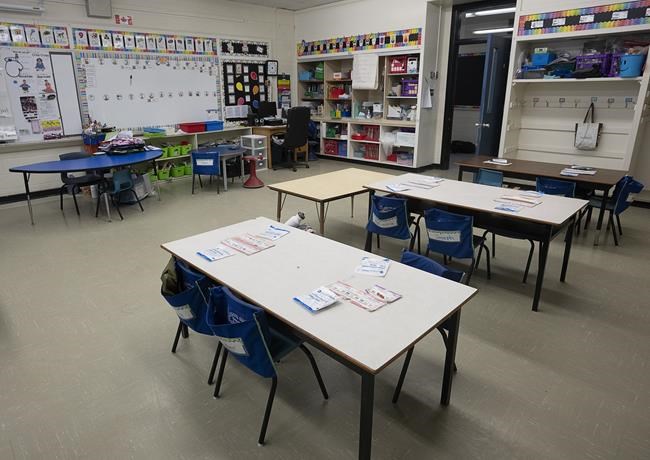
Classrooms have been prepared for the return of students next week at John MacNeil Elementary School in Dartmouth, N.S. on Thursday, Jan. 13, 2022. Millions more Canadian students will head back to school today as officials across four provinces work to keep classrooms safe from COVID-19 and the threat of Omicron-driven staff shortages. THE CANADIAN PRESS/Andrew Vaughan

Dr. Supriya Sharma, chief medical adviser with Health Canada, said authorization comes at a “crucial time in the pandemic as we’re faced with new variants.”

The drug could help alleviate pressure on health-care systems by decreasing the number of high-risk people who would require hospitalization, but health officials noted on a conference call Monday that supply would be an issue early on.

Dr. Theresa Tam, Canada’s chief medical officer, said Paxlovid’s impact likely won’t be seen right away.

“A lot of it depends on the initial supply and we all know that the supply isn’t going to be great at the start,” she said. “For the Omicron wave itself, it may contribute, but it won’t be a key contributor to the current wave.

“So it is very much another layer, another tool as we progress over the next month.”

Federal Health Minister Jean-Yves Duclos said Canada has already received its first shipment of 30,000 treatment courses of the Pfizer drug, with another 120,000 expected through March. He added that distribution to provinces and territories will begin “immediately.”

News of Paxlovid’s authorization came as Canadian students in four provinces returned to in-person learning, though a heavy winter snowstorm in parts of Ontario and Quebec meant another virtual school day for many.

Students in Nova Scotia and Manitoba also returned to class after starting the new year online because of record-high case counts. The provinces switched to remote learning to take pressure off the health-care system and give schools more time to improve safety measures.

Some Manitoba high-school students staged a walkout Monday to protest their return amid rising COVID-19 numbers.

The students called for enhanced safety measures in classrooms, better access to masks and an option for online learning.

Manitoba reported 20 COVID-19-related deaths since Friday, with hospitalization numbers reaching a record 601, including 107 in ICU.

In Newfoundland and Labrador, meanwhile, officials are waiting at least another week to relax public health restrictions following a surge in COVID-19 that began in late December. The province moved to Alert Level 4 on Jan. 4 and will stay there until at least Jan. 24.

Newfoundland and Labrador reported 15 hospitalized COVID-19 patients on Monday, one shy of its pandemic record of 16 set on Oct. 17.

In Ottawa, Procurement Minister Filomena Tassi said Monday that obtaining Paxlovid will help keep Canada’s hospitalization figures from continuing to creep upwards.

“I think the timing of this (authorization) is also very important,” she said. “The bottom line is … it keeps people potentially out of the hospitals.”

The prescription medication is meant to be taken at home within five days of the start of symptoms, timing that could prove difficult as Canada deals with a limited capacity for PCR testing.

Tam said rapid tests could also be used to determine who might receive Paxlovid.

“You can try and get the PCR test but if it’s simply not available or not available fast enough, the rapid antigen test may be used,” she said. “That’s just a very practical approach.”

Tam said provinces and territories will determine how best to use limited supply of the drug, adding that deployment to jurisdictions will be based on a per-capita basis.

She said priority for Paxlovid will be given to those who are moderately to severely immunocompromised and don’t mount enough protection against COVID-19 with vaccines; people over the age of 80 whose vaccines are not up to date; and those 60 years and older living in rural or underserved communities including First Nation, Inuit and Métis individuals whose vaccinations are not up to date.

Unvaccinated people also remain at higher risk for severe disease. But Duclos said they shouldn’t view Paxlovid as a substitute for vaccination.

“A drug is a treatment,” he said. “It’s much better not to have to be treated and the best way not to have to be treated is to be vaccinated.”

The Pfizer pill uses a combination of two antiviral drugs to prevent the virus that causes COVID-19 from replicating once it has infected a patient.

Sharma said clinical trials showed treatment with Paxlovid reduced the risk of hospitalization and death caused by COVID-19 by 89 per cent when the medications were started within three days of the beginning of symptoms, and by 85 per cent when started within five days.

Meanwhile, the National Advisory Committee on Immunization has updated its guidance on vaccination following myocarditis.

The agency says those who either had no cardiac workup or had normal cardiac investigations can receive the next dose of their vaccine once they are symptom free and at least 90 days has passed since vaccination.

This report by The Canadian Press was first published Jan. 17, 2022.

Report Error Submit a Tip

More Stories

Tokyo Olympic aftermath still being untangled a year later

Stephen Wade, The Associated Press 7 minute read Preview

Tokyo Olympic aftermath still being untangled a year later

Stephen Wade, The Associated Press 7 minute read Thursday, Jul. 21, 2022

TOKYO (AP) — The Tokyo Olympics survived the COVID-19 postponement, soaring expenses and some public opposition. A year later, the costs and benefits remain as difficult to untangle as the Games were to pull off.

In his speech at the closing ceremony, IOC President Thomas Bach said a major accomplishment of the Games was simply reaching the end.

“We did it,” Bach said. “We did it together," he repeated, crediting the athletes, Japanese government officials, and deep-pocketed broadcasters for refashioning the Games despite no fans, disappointed sponsors, and no buzz around the city.

Organizers said the Games would drive tourism, showcase Japan's technological prowess, and create memories similar to the 1964 Tokyo Olympics. The pandemic erased that.

Read
Thursday, Jul. 21, 2022

Estate of woman who died from local anesthetic injected into blood vessel sues Morden dentist, his business, clinic

Erik Pindera 4 minute read Preview

Estate of woman who died from local anesthetic injected into blood vessel sues Morden dentist, his business, clinic

Erik Pindera 4 minute read 4:08 PM CDT

The estate of a 23-year-old woman who died after receiving a local anesthetic during a wisdom tooth extraction at a Morden dental clinic has filed a lawsuit over her death.

Virginia Blatz never returned home after she went to Boundary Trails Dental Centre to have her wisdom teeth removed on Nov. 27, 2024. An autopsy later confirmed she died from local anesthetic systemic toxicity caused by an inadvertent injection into a blood vessel, her family has previously said.

Her father, Dulaney Blatz, filed a lawsuit in the Court of King’s Bench on behalf of her estate late last month, naming Ronald David Janz — the dentist who performed the procedure — his dental corporation and the dental corporation that operates the clinic as defendants.

None of the defendants have filed statements of defence in response to the claim, which has not yet been heard in court.

Read
4:08 PM CDT

The election of our discontent

Matthew Frank 7 minute read Preview

The election of our discontent

Matthew Frank 7 minute read Yesterday at 2:37 PM CDT

There’s an undercurrent of unhappiness running through the Winnipeg electorate as the municipal election day approaches.

One-half of Winnipeggers believe the city is heading in the wrong direction, according to a new Abacus Data poll, with nearly one-third unsure if Winnipeg is regressing or progressing.

Only 21 per cent of residents believe the city is on the right track, the Free Press-commissioned poll found.

That discontentment extends to how the city spends its tax dollars, with four in 10 Winnipeggers believing they receive poor value for what they pay in property taxes.

Read
Yesterday at 2:37 PM CDT

Hydro Québec faces issue we should avoid

Editorial 4 minute read Preview

Hydro Québec faces issue we should avoid

Editorial 4 minute read 2:01 AM CDT

You might be tempted to call it a canary in an electric power generation coal mine.

But instead, it’s just another heads-up into the already-obvious problem with the proliferation of data centres.

This week, Hydro-Québec went before the Régie de l’énergie, Québec’s public utilities board, to change the rules for new and existing large data centres.

Now, it was not that long ago that Hydro Québec was actively wooing data centres — offering bulk power rates to be used to lure labour-intensive, power-hungry heavy industry (think aluminum smelters) with rates substantially lower than they offer Québec’s own residential customers. It was a way to use surplus power to create jobs and drive economic activity.

Read
2:01 AM CDT

Canadian labour market still tight as economy sees slight bump in employment

Nojoud Al Mallees, The Canadian Press 5 minute read Preview

Canadian labour market still tight as economy sees slight bump in employment

Nojoud Al Mallees, The Canadian Press 5 minute read Friday, Oct. 7, 2022

OTTAWA - After sustaining three consecutive months of job losses and propelling fears of an economic slowdown, the Canadian economy posted a modest bump in employment in September, suggesting the labour market is still exceptionally tight.

The unemployment rate for the month fell to 5.2 per cent as fewer people looked for work, down from 5.4 per cent in August, Statistics Canada reported in its labour force survey released on Friday. Meanwhile,the economy added 21,000 jobs.

Economists say the latest jobs report shows employers are still eager to hire, and wages are growing accordingly.

The report showed wages were up by 5.2 per cent in September compared with a year ago, with the average hourly wage at $31.67. It marked the fourth straight month of five per cent or higher wage growth, but still falls short of the rate of inflation.

Read
Friday, Oct. 7, 2022

Mayoral candidates Klein, Vogiatzakis continue to snipe over inducement allegations

Chris Kitching and Joyanne Pursaga 5 minute read Preview

Mayoral candidates Klein, Vogiatzakis continue to snipe over inducement allegations

Chris Kitching and Joyanne Pursaga 5 minute read Updated: 3:08 PM CDT

Winnipeg mayoral candidate Mike Vogiatzakis told reporters Monday he will contact the city clerk to report his allegation that rival Kevin Klein tried to get him to drop out of the race.

Vogiatzakis and Klein both doubled down and continued to point fingers a day after accusing each other of offering the other a position at city hall, if victorious in the Oct. 28 election, in exchange for a withdrawal.

“Do I want to get him charged? Not really. I don’t want to destroy anybody’s life,” Vogiatzakis said at a campaign event.

“Kevin’s a good guy. I always liked Kevin. I thought he was a friend of mine, but he’s not. Kevin uses leverage to get ahead, and he tried to use me as leverage.”

Read
Updated: 3:08 PM CDT