Travellers who’ve forgotten to use ArriveCan app can now give details at the border

Advertisement

Advertise with us

OTTAWA - Travellers who can't access the government's ArriveCan app, or simply forget to fill it out, may start to receive some clemency at the border after Canada's public safety minister gave new instructions to border officials to allow people to provide their travel details in person.

Read this article for free:


By clicking the button above, an account will be created and you will begin to receive some of our recommended newsletters. You may opt out of any newsletter by visiting your Email and Communication Preferences page or by clicking "unsubscribe" at the bottom of any email.

or

Already have an account? Log in here »

To continue reading, please subscribe:

Digital Subscription

One year of digital access for only $1.44 a week*

  • Enjoy unlimited reading on winnipegfreepress.com
  • Read the E-Edition, our digital replica newspaper
  • Access News Break, our award-winning app
  • Play interactive puzzles

*Billed as $5.77 plus GST every four weeks. After 52 weeks, price increases to the regular rate of $19.95 plus GST every four weeks. Offer available to new and qualified returning subscribers only. Cancel any time.

To continue reading, please subscribe:

Add Free Press access to your Brandon Sun subscription for only an additional

$1 for the first 4 weeks*

  • Enjoy unlimited reading on winnipegfreepress.com
  • Read the E-Edition, our digital replica newspaper
  • Access News Break, our award-winning app
  • Play interactive puzzles
Start now

*Your next Brandon Sun subscription payment will increase by $1.00 and you will be charged $17.95 plus GST for four weeks. After four weeks, your payment will increase to $24.95 plus GST every four weeks.

Hey there, time traveller!
This article was published 06/12/2021 (1789 days ago), so information in it may no longer be current.

OTTAWA – Travellers who can’t access the government’s ArriveCan app, or simply forget to fill it out, may start to receive some clemency at the border after Canada’s public safety minister gave new instructions to border officials to allow people to provide their travel details in person.

Checking in on the app has become a mandatory part of crossing into Canada, regardless of how long the traveller has been out of the country.

It collects information about where the traveller has been, the purpose of their trip, their contact information, vaccination information, pre-travel COVID-19 test results, and their quarantine plan once they are in Canada.
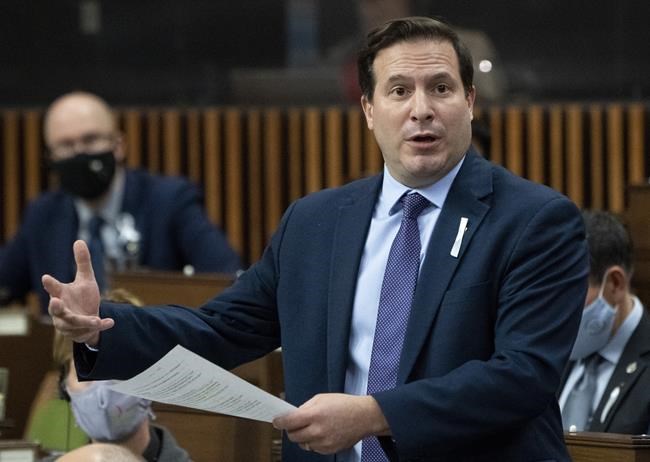
Minister of Public Safety Marco Mendicino rises during Question Period, Monday, December 6, 2021 in Ottawa. THE CANADIAN PRESS/Adrian Wyld

Foreign nationals who fail to give their information have until now been barred from boarding planes into the country. Canadians, permanent residents and others with right of entry have so far been subject to two weeks of quarantine if they fail to offer their information to the app.

Members of Parliament have received hundreds of complaints about the policy, over inaccessibility and unreliability Conservative public safety critic Raquel Dancho said Monday during question period in the House of Commons.

“The ArriveCan app has crashed for some users. Many can’t access it from poor cell service. Many seniors don’t have smartphones. For others costly data plans are out of reach for them,” she said.

Public Safety Minister Marco Mendicino told the House the government will never hesitate to put measures in place to protect Canadians at the border, particularly in light of the emergence of the new Omicron variant of COVID-19.

“With regards to ArriveCan, I want to assure my colleagues that I’ve spoken with the (Canada Border Services Agency) so that there’s additional guidance to provide the opportunity for travellers to provide the information that is necessary on ArriveCan in person at the borders,” he said.

The government created several new border restrictions in response to the spread of the Omicron variant, including closing borders to foreign nationals who spent time in 10 African countries, and instituted new testing and quarantine requirements for all incoming travellers.

This report by The Canadian Press was first published Dec. 6, 2021.

Report Error Submit a Tip

More Stories

Waiting for Cormier verdict the ‘calm before the storm’

Katie May 6 minute read Preview

Waiting for Cormier verdict the ‘calm before the storm’

Katie May 6 minute read Thursday, Feb. 22, 2018

As the jury room door closed behind the seven women and four men who are now deliberating on the evidence against Tina Fontaine’s accused killer, Thelma Favel rose from the chair she’s occupied for most of Raymond Cormier’s second-degree murder trial.

Almost every day over the past three weeks, Favel, the woman who raised 15-year-old Tina, has sat right up front, directly across from the jury box, listening, sobbing and soaking in disturbing details of the teen’s last days that have come to light over the course of Cormier’s second-degree murder trial.

On Wednesday afternoon, after Court of Queen’s Bench Chief Justice Glenn Joyal instructed the jury and sent them off to be sequestered until they decide whether 56-year-old Raymond Cormier is guilty of killing Tina, Favel got up and hugged Crown prosecutor Breta Passler. It was one of many moments, this one shielded from jurors, that have long since proven the emotional impact of the case and the lasting power of Tina’s legacy.

Tina’s death sparked a public outcry that renewed calls for a national inquiry into disproportionately high rates of missing and murdered Indigenous women and girls across Canada, and the criminal trial for the man accused of killing her hasn’t happened in a vacuum.

Read
Thursday, Feb. 22, 2018

Westman to lose sole medical oncologist

Rylee Gerrard 5 minute read Preview

Westman to lose sole medical oncologist

Rylee Gerrard 5 minute read Updated: 9:26 AM CDT

BRANDON — Western Manitoba is about to lose its only medical oncologist, leaving just 22 in the province — all of whom are in Winnipeg.

Brandon West MLA Wayne Balcaen raised the issue during question period Thursday, saying the departure of Dr. Brady Anderson will be a “major loss” for the region.

After four years working out of the Western Manitoba Cancer Centre in Brandon, Anderson’s last day will be Nov. 13.

“He literally sees hundreds of patients within the Westman area, and now those individuals will have to travel to Winnipeg to get that personal service,” Balcaen said, calling Anderson’s impending departure “catastrophic.”

Read
Updated: 9:26 AM CDT

Submit a news tip

1 minute read Monday, Mar. 16, 2026

Submit a news tip

Is Canada headed for time chaos this weekend?

Michelle Bastian 5 minute read 2:00 AM CDT

When Manitoba Premier Wab Kinew declared Sept. 17 that the province would remain on permanent daylight time, he suggested it was a historical moment people would share with their “great-great-grandkids.” But, while Sunday, Nov. 1 has been heralded as the date many Canadians will stop changing their clocks, there are rumblings behind the scenes suggesting this will actually cause more trouble than ever before.

There are, of course, the warnings from chrono-biologists and sleep scientists about the damage permanent daylight time will do. The lighter evenings will mean many more dark mornings. But there is another set of problems in the offing in the critical infrastructure that underpins our digital lives.

While it used to be common to spend the Sunday morning after a time change going around our homes updating the clocks, we now wake up to devices that have already adjusted to the new time. These automatic updates occur regularly for daylight time, as well as when we travel to new time zones.

Our clocks are able to change by themselves owing to the hard work of a group of volunteers who were recently named in a list of the people who hold up the internet. This group, led by Paul Eggert, a computer scientist at UCLA, maintains a little-known tool called the Time Zone Database. Since the 1980s, it has kept track of regional, national and international debates about clock time and provided an up-to-date table of what time it should be on our walls.

One-on-one Journalism Training

0 minute read Wednesday, Jun. 18, 2025

Science-art collaboration injects dose of emotion into cold, hard truths

Sarah Lawrynuik 5 minute read Preview

Science-art collaboration injects dose of emotion into cold, hard truths

Sarah Lawrynuik 5 minute read Wednesday, Apr. 28, 2021

Looking at spreadsheets and map plots of trees is far beyond Rhian Brynjolson’s typical day as a visual artist, but she became entranced and inspired by data collected by Canadian scientists for a new art project.

Her hope is to try and bring the numbers, map dots and statistics to life in a new way to help the public better connect to climate science.

Falcon Lake’s Brynjolson is one of 12 Canadian artists who participated in an art-science collaboration exhibit, co-ordinated by the Global Water Futures program out of the University of Saskatchewan. The project saw the artists paired with researchers and scientists across the country who then engaged in conversations to try to inspire a new angle to their art.

“The whole idea behind it is: water is life,” says Louise Arnal, the project lead, and a post-doctoral fellow at the Centre for Hydrology and Coldwater Laboratory.

Read
Wednesday, Apr. 28, 2021