O’Toole carries virtual campaign into election, backs away from promise to defund CBC
Advertisement
Read this article for free:
or
Already have an account? Log in here »
To continue reading, please subscribe:
Digital Subscription
One year of digital access for only $1.44 a week*
- Enjoy unlimited reading on winnipegfreepress.com
- Read the E-Edition, our digital replica newspaper
- Access News Break, our award-winning app
- Play interactive puzzles
*Billed as $5.77 plus GST every four weeks. After 52 weeks, price increases to the regular rate of $19.95 plus GST every four weeks. Offer available to new and qualified returning subscribers only. Cancel any time.
To continue reading, please subscribe:
Add Free Press access to your Brandon Sun subscription for only an additional
$1 for the first 4 weeks*
- Enjoy unlimited reading on winnipegfreepress.com
- Read the E-Edition, our digital replica newspaper
- Access News Break, our award-winning app
- Play interactive puzzles
*Your next Brandon Sun subscription payment will increase by $1.00 and you will be charged $17.95 plus GST for four weeks. After four weeks, your payment will increase to $24.95 plus GST every four weeks.
Read unlimited articles for free today:
or
Already have an account? Log in here »
Hey there, time traveller!
This article was published 17/08/2021 (1901 days ago), so information in it may no longer be current.
TORONTO – When Erin O’Toole packed his bags for the federal campaign the Conservative leader borrowed some things from his leadership run, while leaving others behind.
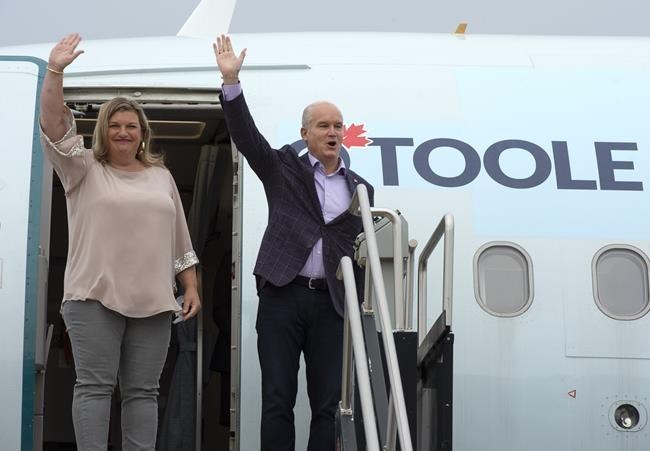
He and his wife, Rebecca, left Ottawa Tuesday for the first time since the election race started Sunday, making him the last of the major federal party leaders to hit the road.
His campaign had been limited to a stage in an empty hotel conference room in downtown Ottawa that has been transformed into a broadcast studio in anticipation of an election.
The sparse set is a familiar scene for O’Toole, whose leadership run last year was interrupted by the COVID-19 pandemic, forcing him to move his run from inside crowded rooms to Zoom.
But with many health restrictions lifted and businesses reopening, O’Toole is an outlier among party leaders for choosing to connect with people virtually through telephone town halls rather than in the flesh, as is typical for any election.
That trend continued Tuesday, despite his campaign travelling to downtown Toronto.
Once again O’Toole arrived at a hotel, and once again the Tory leader walked onto an empty stage, save a pyramid of kids’ toys built next to his microphone to serve as a prop for his election promise of waving GST on certain retail purchases for December.
No one stood behind him and there was no apparent accompanying whistle stops at nearby businesses and no elbow bumps with regular voters.
Despite the lack of actual people being around him, O’Toole,said he believes he’s still connecting with them.
“In the last few days, we’ve spoken to over 50,000 Canadians directly. I’ve taken their questions directly, many of whom we’ve never met before and they’re not party supporters in an office,” O’Toole said of his virtual town halls.
In terms of how a virtual O’Toole town hall works, people in a specific region are called and asked to join in. Those who do speak to moderators ahead of time and then test their audio.
He added the approach his campaign is taking also ensures that the in-person events that do happen proceed safely.
O’Toole did, however, seem to get a boost of energy from hosting his first in-person event, an indoor rally with supporters and Conservative candidates in the GTA riding of Richmond Hill, Ont.
“I hear real claps,” he said, standing on stage in front of a mask-wearing group, which produced laughter from the crowd and more applause.
“I’m the COVID-era leader. I’m used to speaking to empty rooms and having rallies on Zooms and I prefer this so much more,” he shouted to cheers from the floor.
In contrast to O’Toole, who is more unknown to regular Canadians compared to his competitors, Trudeau’s campaign has been far more traditional, with public events in public spaces from day one, including stops at restaurants, and thus far one visit to a local campaign office.
But in all cases they are largely being held outside the venues, or on patios, rather than indoors, while Trudeau wears a mask.
In most cases the crowds that materialized were unplanned — throngs of fans who crowded him for selfies in his home riding of Papineau in Montreal were those who happened to be on the street, not expecting to see the prime minister who had arrived there intending to take his kids for ice cream.
In Cobourg, Ont., Monday night, where a couple of hundred supporters showed up to see him outside the local campaign office, only a small number were officially invited. The others, including anti-vaccine protesters, came because the event was publicized on his daily tour schedule.
And while O’Toole is now taking his party’s platform on the road, it’s missing one of his signature pledges.
Defunding the CBC was one of the promises he made while running as the “true blue” candidate to court the party’s base in last year’s leadership contest.
He pledged an O’Toole government would modernize and reform CBC by ending funding for its digital operations and slashing the CBC English TV budget by 50 per cent.
He said his goal was to make CBC English TV private within his first mandate.
But the recently released Conservative platform only states he plans to “review the mandate” of CBC English TV, CBC News Network and CBC English digital news.
It says such a review would happen to “assess the viability of refocusing the service on a public interest model like that of PBS in the United States, ensuring that it no longer competes with private Canadian broadcasters and digital providers.”
On Tuesday, O’Toole defended that his position has not changed as he wants to protect the public interest under CBC’s mandate while making sure the broadcaster is not unfairly competing with the media private sector.
“I’ve always said it’s time that we look at modernizing the CBC,” he said.

“I think all Canadians want, particularly where we see options out there, to make sure that the state-owned broadcaster is not competing too much against the private sector, particularly in English television and digital.”
Some Conservatives have called O’Toole’s “true blue” credentials into question after his win last August, when he turned his attention to bringing in more support for the Tories in hopes that will drum up the votes needed to defeat Trudeau.
One change he made was the adoption of a carbon price — a Liberal policy deeply unpopular with Western Conservatives and one he promised to cancel.
This report by The Canadian Press was first published Aug. 17, 2021.
— With files from Mia Rabson
Related Articles
Election focus shifts to high inflation
Advertisement Advertise With Us
Advertisement Advertise With Us