Alberta keeping COVID-19 measures for another six weeks as cases spike
Advertisement
Read this article for free:
or
Already have an account? Log in here »
To continue reading, please subscribe:

Digital Subscription
One year of digital access for only $205*
- Enjoy unlimited reading on winnipegfreepress.com
- Read the E-Edition, our digital replica newspaper
- Access News Break, our award-winning app
- Play interactive puzzles
*First annual payment billed as $205.00 + GST for one year. This annual subscription will automatically renew at $233.00 + GST every 52 weeks (10% off the regular annual price of $259.35). Offer available to new and qualified returning subscribers only. Cancel any time.
To continue reading, please subscribe:
Add Free Press access to your Brandon Sun subscription for only an additional
$1 for the first 4 weeks*
- Enjoy unlimited reading on winnipegfreepress.com
- Read the E-Edition, our digital replica newspaper
- Access News Break, our award-winning app
- Play interactive puzzles
*Your next Brandon Sun subscription payment will increase by $1.00 and you will be charged $17.95 plus GST for four weeks. After four weeks, your payment will increase to $24.95 plus GST every four weeks.
Read unlimited articles for free today:
or
Already have an account? Log in here »
Hey there, time traveller!
This article was published 13/08/2021 (1875 days ago), so information in it may no longer be current.
The Alberta government is walking back its decision to eliminate isolation requirements for people who test positive for COVID-19 after weeks of pressure from local leaders, physicians and families.
Dr. Deena Hinshaw, the province’s chief medical officer of health, said the United Conservative government will also extend a masking mandate for public transit and continue testing for any symptomatic individuals as cases spike.
All public health restrictions were to lift Monday, but will now stay in place for another six weeks.
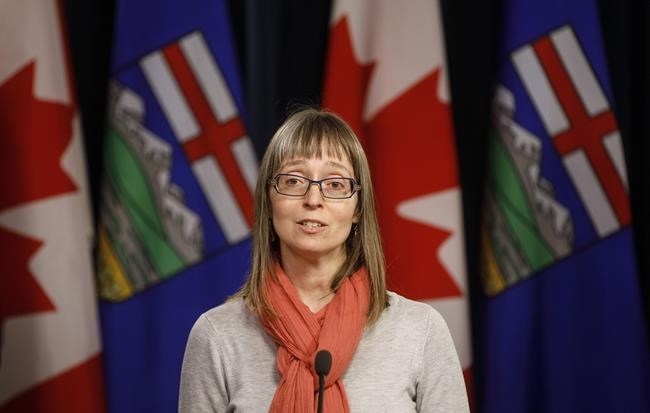
“We are not going backwards. We are pausing to monitor and assess before taking a step forward,” Hinshaw said Friday.
“If monitoring confirms our original expectations that a rise in cases will not lead to high levels of hospitalizations and we do not see evidence of increased risk for severe disease for children, we will proceed with implementing this next set of changes after Sept. 27.”
Hinshaw said an unexpected rise in hospitalizations and emerging data from the United States on pediatric cases linked to the highly contagious Delta variant are behind the pause.
Based on internal modelling, Hinshaw said they expected 90 cases in hospital at this time compared with the 143 people in hospital — an increase of 62 per cent, as of Thursday.
Hinshaw said the initial plan to remove all restrictions was partly based on evidence from the United Kingdom on the Delta variant, but emerging data from the U.S. shows different outcomes.
“In the U.S., unfortunately, hospitalizations in children have started to rise, most significantly in states with lower overall immunization rates,” said Hinshaw.
“It seems most likely that the reason for the difference between these two settings is the level of adult immunization, which is protective for children by reduced household and other community transmission.”
Alberta’s adult vaccination rate falls between that of the U.K. and poorly performing U.S. states, she said.
Many in the province have expressed concerns about children returning to classrooms in September, especially since those under the age of 12 are not yet eligible for COVID-19 vaccines.
“I want to further monitor these trends,” said Hinshaw. “To date, we have not seen a similar rise in severe cases in youth here in Alberta. Since July 1, we have only had seven cases in hospital under the age of 18.”
Other than a six-week time frame, the province did not outline specific benchmarks that need to be met in order to initiate the final lifting of restrictions.
David Shepherd, the Opposition NDP health critic, said clear indicators are necessary.
“I’m concerned that the (Jason) Kenney government is simply kicking the can down the road and Alberta may be back in the same absurd position in late September if cases, hospitalizations and ICU admissions continue to rise,” said Shepherd.
Alberta currently has the highest active COVID-19 case count in Canada with 4,438 infected after 582 new cases were reported Friday.
Hinshaw also said the province will make vaccines available to students in grades 7 to 12, and staff, through temporary school clinics starting Sept. 7.
The province will not mandate masks in classrooms and there will be no requirement for Alberta Health Services or schools to alert others of positive cases, she said.
Hinshaw said schools will have the ability to implement additional safety measures, such as masking or physical distancing, if they choose.
Jason Schilling, president of the Alberta Teachers’ Association, said he’s pleased the government kept some public health measures but that it is unfairly passing on responsibility to school boards.
“We know that this issue has become unnecessarily divisive and political,” said Schilling, noting school boards will now have to “make tough decisions and take the heat.”
The government should have developed a provincewide plan based on public consultation, he said.
Critics of the province’s plan have included the Canadian Paediatric Society, federal Health Minister Patty Hajdu and the Alberta Medical Association. There have also been protests.
Rallies continued in three cities Friday, calling for additional resources for schools.

“We know that (the) provincial government still has not done enough to mitigate risks in schools,” Support Our Students Alberta, an advocacy group behind the recent protests, said in a statement. “They are still lifting protocols such as masking, distancing and cohorting.”
Changes that took effect on July 29 remain in place.
Close contacts of people who test positive for COVID-19 are not mandated to isolate and they aren’t being alerted by contact tracers. Asymptomatic testing is also no longer recommended.
The province has said Albertans must do their own contact tracing if they are infected outside a high-risk setting.
This report by The Canadian Press was first published Aug. 13, 2021.
Related Articles
Most Manitobans will keep wearing masks: survey
Advertisement Advertise With Us
Advertisement Advertise With Us