‘Toughest Olympic event’: What it took Canada’s Damian Warner to win the decathlon

Advertisement

Advertise with us

Dr. Lisa Fischer watched in awe this week as Damian Warner gracefully leapt over hurdles, sprinted past competitors and vaulted his body over a pole nearly five metres off the ground.

Read this article for free:


or

Already have an account? Log in here »

To continue reading, please subscribe:

Subscribe and receive a limited-edition Free Press branded hat or tote.

Digital Subscription

One year of digital access for only $205*

  • Enjoy unlimited reading on winnipegfreepress.com
  • Read the E-Edition, our digital replica newspaper
  • Access News Break, our award-winning app
  • Play interactive puzzles

*First annual payment billed as $205.00 + GST for one year. This annual subscription will automatically renew at $233.00 + GST every 52 weeks (10% off the regular annual price of $259.35). Offer available to new and qualified returning subscribers only. Cancel any time.

To continue reading, please subscribe:

Add Free Press access to your Brandon Sun subscription for only an additional

$1 for the first 4 weeks*

  • Enjoy unlimited reading on winnipegfreepress.com
  • Read the E-Edition, our digital replica newspaper
  • Access News Break, our award-winning app
  • Play interactive puzzles
Start now

*Your next Brandon Sun subscription payment will increase by $1.00 and you will be charged $17.95 plus GST for four weeks. After four weeks, your payment will increase to $24.95 plus GST every four weeks.

Hey there, time traveller!
This article was published 05/08/2021 (1888 days ago), so information in it may no longer be current.

Dr. Lisa Fischer watched in awe this week as Damian Warner gracefully leapt over hurdles, sprinted past competitors and vaulted his body over a pole nearly five metres off the ground.

Seeing an athlete excel at one Olympic sport is impressive enough, but a gold medal in the 10-discipline decathlon is special, she said.

Warner, a 31-year-old from London, Ont., set an Olympic decathlon record with 9,018 points, including personal bests along the way, to win gold at the Tokyo Games on Thursday after two exhausting days of competition.
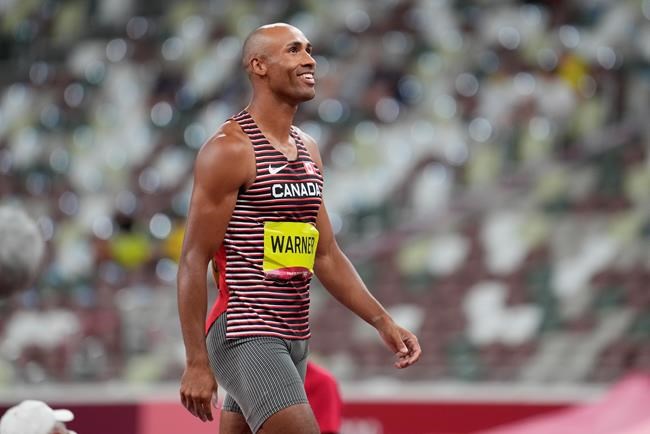
Canada's Damian Warner reacts after his first javelin throw in the decathlon event during the Tokyo Olympics in Tokyo, Japan on Thursday, August 5, 2021. THE CANADIAN PRESS/Frank Gunn

Some, including Fischer, have described the decathlon as the “toughest Olympic event” because of the number of disciplines involved and the toll it takes on competitors, both physically and mentally.

So what does an athlete need to have decathlon success on the Olympic stage?

Fischer, a sports medicine director at the Fowler Kennedy Clinic and an assistant professor at Western University who’s worked with Warner for eight years, said decathletes require specific qualities — strength, speed, co-ordination, balance — and while some of those are there to start with, a staff of coaches, physiotherapists and nutritionists need to coax their development.

“It’s like taking out a Lamborghini and learning how to drive it properly,” she said from London, Ont. “Every part of your physical being has to be fine-tuned and conditioned.”

While most athletes spend hours training in one specific discipline, multievent competitors like decathletes and heptathletes require a more well-rounded approach.

Jessica Zelinka, a former Olympic heptathlete from London, Ont., who’s now a coach and consultant in Calgary, said combined-event athletes tend to focus on their strengths first, then attempt to improve on their weaker disciplines.

It can be tough to find the right balance though, Zelinka said, and tougher for some to realize they’ll likely never win all 10 events in a single competition.

Warner won just three in Tokyo — the 100 metres, long jump and hurdles — but performed well enough in the other seven to secure his Olympic title.

Zelinka said the way he dominated his three winning events made the overall first-place finish more impressive. Warner’s 100-metre time of 10.12 seconds would have qualified him for the 100-metre final, while his 8.24-metre long jump would have won him the bronze medal in the stand-alone long jump event.

“You need speed and power and timing and coordination to the ultimate level because everything is measured by the millisecond and the centimetre,” Zelinka said. “But not every athlete can do that, even if they’re fast and powerful.

“It takes a lot of skill and really good coaching, and also a lot of maintenance.”

Zelinka, whose brother-in-law is a physiotherapist on Warner’s team in Tokyo, said she watched most of Warner’s events from her Calgary home, including the final 1,500-metre race on Thursday morning.

As most of the athletes stumbled to the ground in exhaustion after crossing the finish line, Zelinka could relate to their physical anguish, thinking back on her own experience finishing seventh at the London Olympics in 2012.

“I didn’t lie on the track because I didn’t want to have to get myself back up,” Zelinka said with a laugh.

“It was a bit different for me because I was disappointed, but there’s a sense of relief for sure. There’s a lot of built-up tension before that last event…. You’re dreading it (before it starts) but then it’s like: ‘That was amazing. Let’s do this again.'”

Brianne Theisen-Eaton, the 2016 Olympic heptathlon bronze medallist, said the end of a big competition is “one of the best feelings you can experience in your life.”

But while multidiscipline sports are physically taxing, they can also take a mental toll on competitors, Theisen-Eaton added.

A tough result in one of the disciplines can send athletes into a tailspin while they wait for the next event to start, and external factors like weather and scheduling can also mess with performance.

“It’s super long days and (Tokyo) was exceptionally hot,” Theisen-Eaton said. “So for (Warner) to keep his head in the game and stay composed … I mean it just shows the level of athlete he is.”

Theisen-Eaton of Humboldt, Sask., retired from competition in 2017, but she and husband Ashton Eaton, the 2016 Olympic decathlon champion, woke up early each morning in Portland, Ore., to watch Warner in Tokyo.

Eaton held the Olympic record, set in Rio five years ago, before Warner beat it. But Theisen-Eaton said there was no disappointment in their household.

“Ashton was jumping up and down and was so excited for him,” she said. “He’s a big believer in pushing these records and making them better for the next generation.”

This report by The Canadian Press was first published Aug. 5, 2021.

Report Error Submit a Tip

More Stories

With a bang, B.C. applauds health-care workers

Amy Smart, The Canadian Press 4 minute read Preview

With a bang, B.C. applauds health-care workers

Amy Smart, The Canadian Press 4 minute read Wednesday, Mar. 25, 2020

VANCOUVER - At the same time each night, Rev. Gary Paterson and about half a dozen other neighbours have begun gathering at least two metres apart on the rooftop patio of their building in Vancouver's west end.

They don't know who will signal the beginning, and everyone's clocks are slightly different, but just before 7 p.m., they hear clapping in the distance.

"It's usually at about two minutes to seven, like people can't restrain their enthusiasm, and then it starts to move like a wave," he said on Wednesday.

The applause is for health-care workers and other essential service providers on the frontlines of the COVID-19 pandemic.

Read
Wednesday, Mar. 25, 2020

Botched execution revives death penalty debate

Arthur Chapman 5 minute read 2:00 AM CDT

The United States of America’s seemingly endless, often futile, search for the painless, bloodless method of executing prisoners continues. The latest horrifying chapter occurred in Tennessee on Sept. 30, when the state tried to kill convicted murderer Christa Pike by lethal injection.

It didn’t work. Pike survived two dosages of pentobarbital. She was rushed to a hospital where, according to her lawyer, she was receiving “lifesaving care”.

Tennessee governor Bill Lee has cancelled upcoming executions, but he isn’t moving away from capital punishment.

Lee said, as quoted in the New York Times: “The people of Tennessee have determined that capital punishment is the appropriate sentence for the most heinous of crimes. The people of Tennessee expect those sentences to be carried out in a manner that’s not only legal and constitutional but effective, and that didn’t happen.”

Real journalists matter in an AI world

Paul Deegan 4 minute read Preview

Real journalists matter in an AI world

Paul Deegan 4 minute read 2:00 AM CDT

An algorithm can decide what you see, but it doesn’t report the news. Nunatsiaq News, an award-winning newspaper in Nunavut, recently reported that a so-called “news” website was posting AI-generated articles about the north by stealing real news stories produced by real journalists.

The articles were supposedly written by Nunavut correspondent Leah Qammaniq — a fake journalist, with a fake photo and a fake bio.

Governor General Louise Arbour warned us of fake news in her installation speech in June. She said, “We must continue to protect the public space in which our national debates take place: from schools and universities to the media, political parties, unions and civil society organizations …With instant access to vast amounts of information, it is very tempting to pay little attention to the reliability of sources. The lines between knowledge and belief, between truth and falsehood, between facts and assumptions, are increasingly blurred. AI could be threatening not only the way we live and work, but also the control we exercise over our own destiny.”

The Government of Canada has recognized the problem as well. Its recent discussion paper, Enhancing trust in artificial intelligence through increased transparency, stated, “Canadians encounter news reporting, product reviews, and audio-visual content across the internet, often without any indication of whether it was written by a person, generated by an AI system, or produced through some combination of both … A particular concern within this broader landscape is that generative AI greatly enables the creation and dissemination of deceptive or misleading content.”

Read
2:00 AM CDT

Three Manitoba nurses censured for inappropriate behaviour

Morgan Modjeski 3 minute read Yesterday at 8:38 PM CDT

A Manitoba nurse has been disciplined for inappropriate behaviour towards students including what is being described as unwanted touching.

The College of Registered Nurses of Manitoba listed three recent censures of Manitoba nurses. The most recent details a supervising nurse’s unprofessional conduct while he worked as a clinical education facilitator at the University of Manitoba in 2023.

The behaviour, examined by a college complaints committee, included reports from several students of unwanted touching, violating the confidentiality of students in a group chat and failing to properly report a needlestick injury.

The committee made the decision of censure — a discipline record applied to a nurse’s license — on April 9.

Banning controversial songs is a tone-deaf solution

Jen Zoratti  10 minute read Preview

Banning controversial songs is a tone-deaf solution

Jen Zoratti  10 minute read Friday, Dec. 7, 2018

Along with sipping egg nog and trimming trees, Canadians engaged in another reliable holiday tradition this week: debating whether or not Baby, It’s Cold Outside promotes date rape.

On Tuesday, three of the country’s major broadcasters — CBC, Rogers and Bell Media — announced they’d be putting the chill on the contentious duet, written by American songwriter Frank Loesser in 1944, and would not be playing it on their radio stations this year.

Several American radio stations have also put the song on their naughty lists, arguing it has no place in the #MeToo era. 

Through a modern lens, it’s not hard to see how some people might view this song as a woman being pressured into sex by a guy who won’t take no for an answer. 

Read
Friday, Dec. 7, 2018

Band keeps plight of MMIWG close to heart on new track

Ben Waldman 6 minute read Preview

Band keeps plight of MMIWG close to heart on new track

Ben Waldman 6 minute read 2:00 AM CDT

Gabrielle Fontaine won’t stop talking about them and neither will her bandmates.

As a teenager, the Winnipeg songwriter — whose late father Vince was the passionate leader of musical projects including Eagle & Hawk — would volunteer at Wiping Away the Tears, an annual gathering hosted by Ka Ni Kanichihk that offers space for healing, ceremony and support for relatives of missing and murdered Indigenous women, girls and two-spirit people.

Though Indigenous people make up less than five per cent of the Canadian population, Indigenous women make up 16 per cent of all female homicide victims and 11 per cent of missing women, according to the Assembly of First Nations.

Seeking a way to help in the community, Fontaine regularly volunteered as a child-minder during memorial events, an experience she says shaped her outlook as a musical storyteller.

Read
2:00 AM CDT