Brutal beauty: Is artistic swimming Tokyo’s toughest sport?
Advertisement
Read this article for free:
or
Already have an account? Log in here »
To continue reading, please subscribe:
Digital Subscription
One year of digital access for only $1.44 a week*
- Enjoy unlimited reading on winnipegfreepress.com
- Read the E-Edition, our digital replica newspaper
- Access News Break, our award-winning app
- Play interactive puzzles
*Billed as $5.77 plus GST every four weeks. After 52 weeks, price increases to the regular rate of $19.95 plus GST every four weeks. Offer available to new and qualified returning subscribers only. Cancel any time.
To continue reading, please subscribe:
Add Free Press access to your Brandon Sun subscription for only an additional
$1 for the first 4 weeks*
- Enjoy unlimited reading on winnipegfreepress.com
- Read the E-Edition, our digital replica newspaper
- Access News Break, our award-winning app
- Play interactive puzzles
*Your next Brandon Sun subscription payment will increase by $1.00 and you will be charged $17.95 plus GST for four weeks. After four weeks, your payment will increase to $24.95 plus GST every four weeks.
Read unlimited articles for free today:
or
Already have an account? Log in here »
Hey there, time traveller!
This article was published 01/08/2021 (1919 days ago), so information in it may no longer be current.
SYDNEY (AP) — To those who dare doubt the brutality of her sport, Australian artistic swimmer Amie Thompson tells a story: About the day a teammate accidentally landed on Thompson’s face, breaking her nose and filling the water with blood.
Focused as they were on preparing for the Rio Olympics in 2016, none of Thompson’s teammates — including one who would head to Rio with a broken toe — initially even noticed.
“I took the afternoon off and was back in the pool the next day,” says Thompson, who is competing again this year in Tokyo.
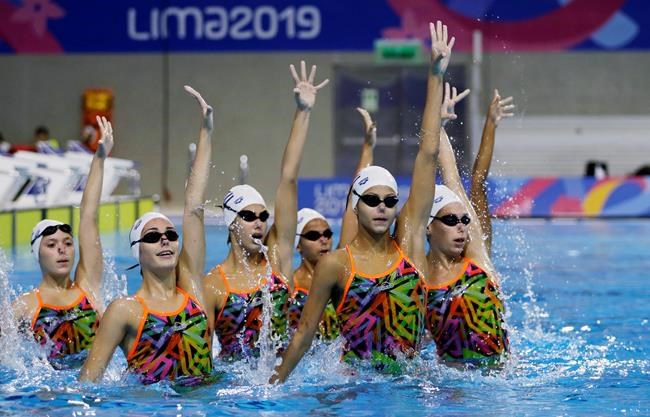
Forget boxing or rugby. The most hardcore sport at the Tokyo Games may just be artistic swimming.
Long misunderstood and maligned as a frothy performative spectacle, the sport once known as synchronized swimming has rapidly evolved into one of the most physically grueling specialties at the Olympics, with athletes training up to 10 hours a day.
“It’s definitely the most underappreciated athletic talent in sport, but I think it’s truly the most demanding sport that there is in the Olympic program,” says Adam Andrasko, CEO of USA Artistic Swimming. “It’s very, very difficult even for high-level athletes to comprehend what it takes to be an artistic swimmer.”
So what does it take? The strength and power of weightlifters, the speed and lung capacity of distance swimmers, the flexibility and skill of gymnasts and the ability to perform in perfect sync with the music and each other. All while making it look easy — and without ever touching the bottom of the pool.
“Imagine sprinting all-out, while underwater, chlorine in your eyes, holding your breath and trying to be in line with seven of your other colleagues,” says Kim Davis, president of Artistic Swimming Australia.
As for swimmers without perfect vision? Sync or swim, baby. Unlike other swimming events at the Olympics, goggles are banned in synchro. And because artistic swimmers are also critiqued on presentation and maintaining eye contact with the judges (which is why they wear heavy eye makeup highlighting their expressions) they can’t exactly surface from the water squinting and rubbing their eyes.
A few artistic swimmers have found ways to get their contact lenses to stick in place while underwater, which also helps protect their eyes from the chlorine burn. But in general, they’re flying — er, swimming — blind.
An increasing focus in recent years on making the routines more difficult in a bid to score higher points has made the moves faster and the lifts higher, and has shrunk the distance between swimmers from a few feet to a few inches.
Amid all the flying limbs, kicks to the head are common, and, consequently, so are concussions. At the elite level, each team generally deals with a couple of concussions a year, Davis says.
The frequency of concussions stunned Bill Moreau, who served as vice president of sports medicine for the United States Olympic Committee from 2009 to 2019. During his tenure, he attended a training camp for the U.S. artistic swimming team in Colorado Springs. In just two weeks, 50 percent of the team sustained a concussion, an incidence rate that surpasses both U.S. and Australian rules football concussion rates over a similar timespan, he says.
“This sport is much more than the aesthetics that all of us can see above the water,” Moreau said by e-mail. “Under the water they are battling gravity to execute their routine. These swimmers truly are athletes, and they should be receiving the same level of respect as other sports that produce more revenue and television coverage.”
The intensity of the routines and the long stretches that swimmers must hold their breath for has resulted in some athletes passing out during performances.
Swimming’s global governing body, FINA, now warns in its judging manual that artistic swimmers who hold their breaths for more than 45 seconds risk hypoxia.
Though the sport focuses less on breath holding skills than it once did, swimmers still spend a significant chunk of their performances below the surface. The Australian team, for example, is underwater for a total of 2 minutes and 20 seconds of their 4-minute routine, Thompson says.
In June, U.S. artistic swimmer Anita Alvarez briefly lost consciousness at the end of her duet routine during the Olympic qualifier in Barcelona.
After spotting the 24-year-old slipping beneath the surface, coach Andrea Fuentes yanked her mask down and dove, fully clothed, into the pool to rescue her.
Alvarez, who has undergone a battery of medical tests since then, says she still doesn’t know exactly why she fainted that day. But she suspects it was a mixture of physical and emotional exhaustion, plus the specific movements at the end of the routine.
Drained from the performance, set to Billie Eilish’s “Bad Guy,” Alvarez and her partner emerged from an underwater upside-down spin, then snapped their heads back in a final flourish.
“It was a super intense and stressful competition,” says Alvarez, who will compete in the duet event in Tokyo. The day before the fainting incident, she and her team had missed qualifying for the team event in Tokyo by a slim 0.2 points.

She had barely slept, and had just had a string of extremely long days in the pool. The free duet, which runs 3 1/2 minutes, is also one of their hardest routines.
But pushing their bodies to the limit is all part of the deal for artistic swimmers, Alvarez says. Just consider their typical training regimen, which involves an hour of strength training and stretching exercises on land, followed by another 8 hours — or more — in the water.
“Whenever anyone who doesn’t know about our sport hears what our daily training is, they think we’re insane,” Alvarez says. “Even other professional athletes think we’re insane. Just knowing what we do in a day alone is enough to see how intense and really difficult it is.”
___
More AP Olympics: https://apnews.com/hub/2020-tokyo-olympics and https://twitter.com/AP_Sports
Related Articles
Canada's Gingras races to Paralympic bronze






Advertisement Advertise With Us
Advertisement Advertise With Us