Pfizer, Moderna vaccines now preferred second dose for AstraZeneca recipients: NACI

Advertisement

Advertise with us

OTTAWA - The National Advisory Committee on Immunization said Thursday people who got the Oxford-AstraZeneca vaccine as their first dose should get Pfizer-BioNTech or Moderna for their second shot.

Read this article for free:


By clicking the button above, an account will be created and you will begin to receive some of our recommended newsletters. You may opt out of any newsletter by visiting your Email and Communication Preferences page or by clicking "unsubscribe" at the bottom of any email.

or

Already have an account? Log in here »

To continue reading, please subscribe:

Digital Subscription

One year of digital access for only $1.44 a week*

  • Enjoy unlimited reading on winnipegfreepress.com
  • Read the E-Edition, our digital replica newspaper
  • Access News Break, our award-winning app
  • Play interactive puzzles

*Billed as $5.77 plus GST every four weeks. After 52 weeks, price increases to the regular rate of $19.95 plus GST every four weeks. Offer available to new and qualified returning subscribers only. Cancel any time.

To continue reading, please subscribe:

Add Free Press access to your Brandon Sun subscription for only an additional

$1 for the first 4 weeks*

  • Enjoy unlimited reading on winnipegfreepress.com
  • Read the E-Edition, our digital replica newspaper
  • Access News Break, our award-winning app
  • Play interactive puzzles
Start now

*Your next Brandon Sun subscription payment will increase by $1.00 and you will be charged $17.95 plus GST for four weeks. After four weeks, your payment will increase to $24.95 plus GST every four weeks.

Hey there, time traveller!
This article was published 17/06/2021 (1961 days ago), so information in it may no longer be current.

OTTAWA – The National Advisory Committee on Immunization said Thursday people who got the Oxford-AstraZeneca vaccine as their first dose should get Pfizer-BioNTech or Moderna for their second shot.

On June 1, NACI had said AstraZeneca recipients “could” get Pfizer or Moderna for their second shot if they wanted, but Thursday went further to say an mRNA vaccine was the “preferred” choice.

“Since NACI first looked at mixed vaccine schedules, new evidence is starting to emerge suggesting immune responses are better when a first dose of the AstraZeneca vaccine is followed by an mRNA vaccine as a second dose,” said NACI vice-chair Dr. Shelley Deeks, in the new guidance documents.
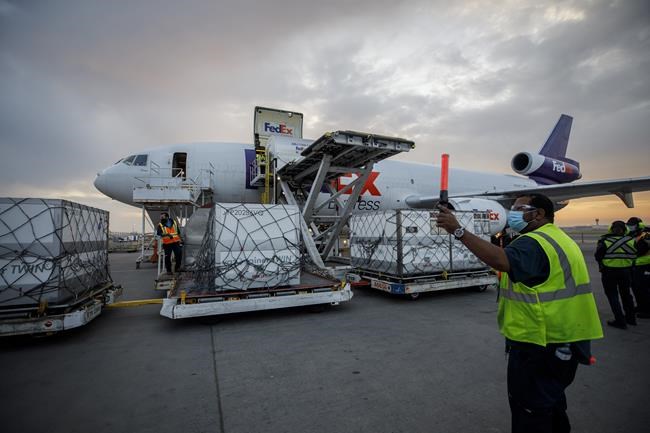
Workers unload a shipment of the Moderna COVID‑19 vaccine at the FedEx hub at Pearson International Airport in Toronto on Thursday, May 20, 2021. THE CANADIAN PRESS/Cole Burston

NACI also updated its previous recommendation that people at high risk of exposure to, or serious illness from, COVID-19, could opt to get AstraZeneca rather than waiting for Pfizer or Moderna. Now NACI says everyone should always get the mRNA vaccines first, unless they are allergic to them.

Deeks said the advice is based on the growing supply of Pfizer and Moderna, and the risk of vaccine-induced blood clots associated with AstraZeneca. But she is still trying to reassure people who got one or two doses of AstraZeneca’s vaccine that they are nevertheless well protected.

“Anyone who has already received two doses of AstraZeneca/Covishield can rest assured that they are protected, particularly against severe illness,” she said. “There is no need for a third dose at this time.”

Dr. Theresa Tam, the chief public health officer of Canada, said the new evidence in favour of mixing different types of vaccines included four studies in Germany.

“It’s really the immunogenicity, that immune response, after that mixed-dose schedule that’s resulted in NACI updating this recommendation, because all the accumulated studies essentially suggest that immune response is a better response,” said Tam at a news conference in Ottawa.

One of those studies from Germany’s Saarland University, published early data Wednesday saying giving Pfizer as the second dose after AstraZeneca, or two doses of Pfizer only, generated far more antibodies and T cells as two doses of AstraZeneca.

The mixed-dose schedule was slightly better than two doses of Pfizer at producing the neutralizing antibodies and killer T cells that are critical to preventing infection or serious illness.

Quebec was not moving to follow NACI’s advice. Health Minister Christian Dubé, who got two doses of AstraZeneca himself, said Quebec is still saying people can opt for a mixed schedule or two doses of AstraZeneca, depending on their personal choice.

Almost 25 million Canadians have now received at least one dose of vaccine, and almost six million are now fully vaccinated.

As of June 5, 2.1 million people had received one dose of AstraZeneca, and 15,186 had received two doses.

Canada has received 56 reports of blood clots following an AstraZeneca vaccination, and 38 are now confirmed as vaccine-induced thrombotic thrombocytopenia, or VITT.

There are no further shipments of AstraZeneca currently scheduled, but there are about 600,000 doses still left from previous deliveries.

There are 14 million doses of Pfizer-BioNTech and Moderna being delivered this week and next, including a donation of one million doses of Moderna’s COVID-19 vaccine from the United States that was to arrive in Canada Thursday night.

The donation won’t cost Canada anything, and will be on top of the 44 million doses Canada has purchased directly from Moderna.

It comes less than a week after Canada promised to donate 13 million doses to the COVAX vaccine-sharing alliance, which will entirely come from the remaining share of doses Canada had purchased from COVAX itself.

Canada has been heavily criticized for buying three times as many doses of COVID-19 vaccine than it needs and not sharing any doses from its own direct purchase agreements with vaccine makers. The World Health Organization has made repeated pleas for wealthier countries to share more doses with developing countries, some of whom have vaccinated very few people at all.

Canada expects to have fully vaccinated 75 per cent of all eligible Canadians — everyone over the age of 12 — by the end of July, and has administered 78 doses for every 100 Canadians. Across Africa, nations have given out three doses for every 100 people.

“Taking vaccines at a time when we are nearing complete vaccination when many developing countries are so far behind makes Canada a vaccine hoarder and leaves Canadians vulnerable to dangerous variants,” said NDP health critic Don Davies.

This report by The Canadian Press was first published June 17, 2021.

Report Error Submit a Tip

More Stories

Heg

Rylee Gerrard 5 minute read Preview

Heg

Rylee Gerrard 5 minute read 2:01 AM CDT

BRANDON — Western Manitoba is about to lose its only medical oncologist, leaving just 22 in the province — all of whom are in Winnipeg.

Brandon West MLA Wayne Balcaen raised the issue during question period Thursday, saying the departure of Dr. Brady Anderson will be a “major loss” for the region.

After four years working out of the Western Manitoba Cancer Centre in Brandon, Anderson’s last day will be Nov. 13.

“He literally sees hundreds of patients within the Westman area, and now those individuals will have to travel to Winnipeg to get that personal service,” Balcaen said, calling Anderson’s impending departure “catastrophic.”

Read
2:01 AM CDT

A fond farewell to the Hercules

Editorial 4 minute read Preview

A fond farewell to the Hercules

Editorial 4 minute read 2:00 AM CDT

Fans at the NHL’s outdoor Heritage Classic game last weekend were no doubt thrilled by the sight and sound of two CF-18 Hornet fighter jets conducting a flyover at Princess Auto Stadium shortly before the puck was dropped for the much-anticipated Winnipeg Jets/Montreal Canadiens matchup.

Flyovers such as these always create a spectacular scene, as the speed and power of the jets are on full display for the brief moments they’re in view above the stadium bowl. But fans who maintained their skyward gaze for a few seconds after the Hornets’ blink-and-you’ll-miss-it appearance were treated to a much more poignant aeronautical exhibition, as a CC-130H Hercules aircraft passed over the stadium in the fighter jets’ wake.

Compared to the supersonic CF-18s, the massive, propeller-driven transport plane probably seemed to be doing more of a “crawl-over”; what most folks at the outdoor game probably didn’t realize, however, was that this was almost certainly the last time they’ll see one of these ubiquitous Canadian Forces aircraft in the sky.

The CC-130H is being retired after more than half a century as the RCAF’s combat, rescue and transport workhorse. The “Herc” will be replaced by more modern aircraft, including the smaller and more nimble CC-295 Kingfisher, which will be used for search-and-rescue missions out of 17 Wing Winnipeg, beginning next month.

Read
2:00 AM CDT

Science-art collaboration injects dose of emotion into cold, hard truths

Sarah Lawrynuik 5 minute read Preview

Science-art collaboration injects dose of emotion into cold, hard truths

Sarah Lawrynuik 5 minute read Wednesday, Apr. 28, 2021

Looking at spreadsheets and map plots of trees is far beyond Rhian Brynjolson’s typical day as a visual artist, but she became entranced and inspired by data collected by Canadian scientists for a new art project.

Her hope is to try and bring the numbers, map dots and statistics to life in a new way to help the public better connect to climate science.

Falcon Lake’s Brynjolson is one of 12 Canadian artists who participated in an art-science collaboration exhibit, co-ordinated by the Global Water Futures program out of the University of Saskatchewan. The project saw the artists paired with researchers and scientists across the country who then engaged in conversations to try to inspire a new angle to their art.

“The whole idea behind it is: water is life,” says Louise Arnal, the project lead, and a post-doctoral fellow at the Centre for Hydrology and Coldwater Laboratory.

Read
Wednesday, Apr. 28, 2021

Today’s horoscope

Georgia Nicols 4 minute read Preview

Today’s horoscope

Georgia Nicols 4 minute read 2:00 AM CDT

MOON ALERT: There are no restrictions to shopping or important decisions today. The moon is in Cancer.

ARIES (March 21-April 19)

Avoid heated discussions regarding kids, social plans, shared expenses or dealing with authority figures. (This covers a wide swath.) People are touchy! Pull in your reins and tread carefully. You don’t have to be right. You don’t even have to be wrong.

TAURUS (April 20-May 20)

Read
2:00 AM CDT

Brian Bowman wins mayoral battle

Aldo Santin and Mary Agnes Welch 6 minute read Preview

Brian Bowman wins mayoral battle

Aldo Santin and Mary Agnes Welch 6 minute read Thursday, Oct. 23, 2014

In the end, it wasn’t even close.

A mayoral race that was supposed to be a head-to-head battle between privacy lawyer Brian Bowman and former NDP MP and MLA Judy Wasylycia-Leis turned into a rout on election night. Wasylycia-Leis, the experienced politician, had held what looked like an unassailable lead for months, but Bowman, the outsider who promised Winnipeggers a better, prosperous future, chipped doggedly away at it.

“I’m excited to tell you that positive change is coming to city hall,” Bowman told roaring supporters at the Inn At The Forks after making his way into the small ballroom accompanied by his wife and two young sons.

He said he hadn’t expecting such a landslide victory, but had believed that the campaign was building momentum.

Read
Thursday, Oct. 23, 2014

The volatile U.S. midterms

Allan Levine 5 minute read Preview

The volatile U.S. midterms

Allan Levine 5 minute read 2:00 AM CDT

The last time the Democratic Party had 218 or more seats — the number required to control the U.S. House of Representatives — was from 2021 to 2023, following the election of Democrat Joe Biden as president. During that same period, the Democrats also had the edge in the Senate. Despite a 50-50 split with the Republicans, Democrats were able to control the Senate with the help of Vice-President Kamala Harris, who cast the key vote in a tie. From 2023 to 2025, the Democrats had a slim 51 to 49 Senate majority.

If history repeats itself and the latest polls are fairly accurate, on Tuesday, Nov. 3, the Democratic Party will take back the House and (probably) the Senate from the Republicans, who have controlled both legislative bodies since the 2024 election. In the House, the Democrats have to gain at least three more seats. In the Senate, they have to win four more, which is entirely doable, though they almost certainly have to win a seat in Texas, Ohio, Kansas or Alaska, each of which currently has two Republican senators.

The prospect of a Democratic victory has President Donald Trump in a tizzy. For the past two years, he has abused his executive power to impose illegal tariffs on Canada and other countries; started a war with Iran; cozied up to Russian president Vladimir Putin and turned his back on Ukrainian president Volodymyr Zelenskyy; and increased the national debt through questionable tax cuts — to list only a few of his more egregious actions. He has been able to get away with this mainly because Republicans in the Senate and the House refuse to even question his decisions.

With the Democrats in charge, Trump’s brazen actions won’t be completely halted, but he will face significant legislative challenges and obstacles not easily dismissed. His controversial appointees, such as Attorney General Todd Blanche, who perceives himself as Trump’s private lawyer rather than the legal representative of the people, won’t get a free pass in committee hearings.

Read
2:00 AM CDT