Unbeatable backstrokers: Murphy looks to extend US dominance
Advertisement
Read this article for free:
or
Already have an account? Log in here »
To continue reading, please subscribe:

Digital Subscription
One year of digital access for only $205*
- Enjoy unlimited reading on winnipegfreepress.com
- Read the E-Edition, our digital replica newspaper
- Access News Break, our award-winning app
- Play interactive puzzles
*First annual payment billed as $205.00 + GST for one year. This annual subscription will automatically renew at $233.00 + GST every 52 weeks (10% off the regular annual price of $259.35). Offer available to new and qualified returning subscribers only. Cancel any time.
To continue reading, please subscribe:
Add Free Press access to your Brandon Sun subscription for only an additional
$1 for the first 4 weeks*
- Enjoy unlimited reading on winnipegfreepress.com
- Read the E-Edition, our digital replica newspaper
- Access News Break, our award-winning app
- Play interactive puzzles
*Your next Brandon Sun subscription payment will increase by $1.00 and you will be charged $17.95 plus GST for four weeks. After four weeks, your payment will increase to $24.95 plus GST every four weeks.
Read unlimited articles for free today:
or
Already have an account? Log in here »
Hey there, time traveller!
This article was published 10/06/2021 (1937 days ago), so information in it may no longer be current.
ATLANTA (AP) — The last time the American men lost a backstroke race at the Olympics, 25-year-old Ryan Murphy wasn’t even born.
It’s likely up to him to keep the streak alive.
Murphy already did his part in Rio de Janeiro, sweeping both backstroke races to extend a run that started after the 1992 Barcelona Games, where the American men settled for silver and bronze in the 100 and failed to make the podium in the 200.
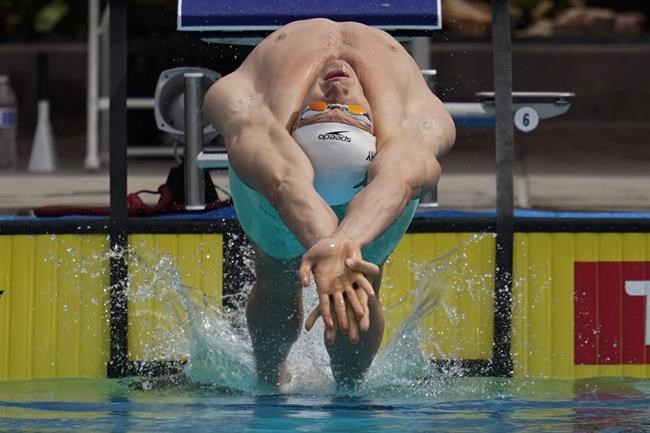
Since then, it’s been nothing but gold for the red, white and blue — a winning streak that encompasses 12 events, eight swimmers and six Olympics.
Heading into the U.S. Olympic trials, which begin Sunday in Omaha, Nebraska, Murphy insisted that he’s feeling no extra pressure to keep the streak alive.
“Because we’ve always been really good in backstroke, that pressure is spread out over multiple people,” he said in a recent interview in Atlanta, where he took part in his final warmup meet before trials. “It’s not a lock that I even make the Olympic team. So if I’m not there, someone else has to take the mantle. Even if I’m there, someone else might take the mantle.”
But rest assured: Murphy is the one the Americans are banking on in Tokyo to extend their two-decade-long stretch of backstroke perfection, even after the games were delayed a year by the coronavirus pandemic.
Bring it on, Murphy said.
“I’m super-motivated,” he said with a smile. “I don’t need anything else to motivate me. I’m about as dialed in as I can be this year.”
Lenny Krayzelburg, who swept the backstroke golds at the 2000 Sydney Olympics, has become good friends with Murphy.
They also share a bond, along with everyone who has contributed to a streak that began with Jeff Rouse and Brad Bridgewater touching first on their backs at the 1996 Atlanta Games.
Krayzelburg followed four years later before passing the torch to Aaron Peirsol, who swept the back at the 2004 Athens Olympics and won another gold in 2008. Ryan Lochte captured the other men’s backstroke gold in Beijing, before Matt Grevers and Tyler Clary kept things rolling at the 2012 London Games.
“There’s a lot of pride in the history of the U.S. backstroke,” Krayzelburg said. “There’s an unspoken rule if you’re a backstroker in the United States to carry on this legacy. There’s added pressure. I think we all welcome the pressure. We all thrive on the pressure. I think that’s why we’ve been able to be the torch bearers from generation to generation.”
Murphy would face a stiff challenge in Tokyo to keep the streak going from backstrokers such as Russia’s Evgeny Rylov, China’s Xu Jiayu, Australia’s Mitch Larkin and Japan’s home-country favorite, Ryosuke Irie.
Murphy goes into the Olympic swimming trials with only the ninth-fastest time in the world this season in the 100 and the seventh fastest in the 200.
But this, of course, is the event he’s been building for all year.
Actually, for the last two years thanks to the pandemic, which forced Murphy and all other Olympic-aspiring athletes to essentially restart their preparations.
“When the initial decision (to postpone the Olympics) came down, it was pretty hard,” he said. “But after taking about a week or two to get away from the sport, take some time off and really reset, I’ve felt good about it ever since.”
Murphy, who was born in Chicago and moved to Jacksonville, Florida, when he was just a few months old, now trains in Berkeley, California. He learned to embrace the pandemic restrictions on travel, meets and appearances, which allowed him to train with more focus than ever before.
“I was always in Berkeley,” he said. “I never missed a practice because I never had anywhere else to be. So that served me pretty well.”
There are some worrisome signs for America’s continued dominance in the backstroke.
Murphy failed to win gold in either of the Olympic distances at the last two world championships, settling for silver and bronze at Budapest, Hungary, in 2017 before another silver and a fourth-place finish two years ago at Gwangju, South Korea.
Then again, he also turned in a disappointing performance at the 2015 worlds in Kazan, Russia, where he qualified for the U.S. team in only one event and finished fifth. The very next year, he was on top of the world in Rio.
“I have this belief now that when I really put my mind to my goals, I feel I can achieve them,” Murphy said. “That’s a really powerful thing that 2016 gave me.”
Murphy and coach Dave Durden experimented with some new training methods and techniques ahead of the 2019 worlds. While the results weren’t what they hoped for, the swimmer believes it will serve him well in Tokyo.
“We learned a lot over that year,” Murphy said. “There’s a lot of things we experimented with in 2019, and that’s good. I think it’s always good to try to push the envelope different ways in practice, do things in a different way. We learned some things that work well for us. And we learned some things that really don’t work well for us.”
Murphy is trying to pull off a historic double. Since a second backstroke event was added to the men’s program in 1968, East Germany’s Roland Matthes is the only backstroker to sweep both races at two straight Olympics.
Murphy is a better swimmer than he was heading into the Rio Games, according to Durden, but it’s the mental side where he really stands out.
“He’s very thoughtful,” Durden said. “If there’s things he wants to tweak or adjust, he gives good feedback on that. Really, what separates him from others is there’s a level of analytical-ness to what he’s doing, but it’s not too much that it hinders his passion for racing or his passion to win.”
Away from the pool, Murphy is a huge fan of the Jacksonville Jaguars. He moved to Florida the same year the NFL expansion franchise was launched, so he feels like they grew up together.
After some lean years — in a way, the team has been the antithesis of the American backstrokers — he can’t wait to see how they perform with new coach Urban Meyer and No. 1 overall draft pick quarterback Trevor Lawrence.
“They took kind of a gamble on the head coach. That’s kind of boom or bust,” Murphy said. “I think Trevor Lawrence is a little more a sure thing than the coach. But it’s gonna be sweet. Everyone I’ve talked to, everyone is excited. The city is excited. I can’t wait to watch ’em.”
But first, there’s a streak to preserve.
For the American men, the backstroke is their baby.

“We’ve always been good at it,” Murphy said. “Those guys that have won before, they’re idols for me. It’s cool to be a part of that group. Hopefully we can keep it going.”
___
Follow Paul Newberry on Twitter at https://twitter.com/pnewberry1963 His work can be found at https://apnews.com/search/paulnewberry
___
More AP Olympic coverage: https://www.apnews.com/OlympicGames and https://twitter.com/AP_Sports
Related Articles
Canada's Nikola Girke gears up for fifth Games








Advertisement Advertise With Us
Advertisement Advertise With Us