IOC VP: Tokyo Olympics go ahead even if state of emergency

Advertisement

Advertise with us

TOKYO (AP) — The IOC vice president in charge of the postponed Tokyo Olympics said Friday the games would open in just over two months even if the city and other parts of Japan were under a state of emergency because of rising COVID-19 cases.

Read this article for free:


By clicking the button above, an account will be created and you will begin to receive some of our recommended newsletters. You may opt out of any newsletter by visiting your Email and Communication Preferences page or by clicking "unsubscribe" at the bottom of any email.

or

Already have an account? Log in here »

To continue reading, please subscribe:

Digital Subscription

One year of digital access for only $1.44 a week*

  • Enjoy unlimited reading on winnipegfreepress.com
  • Read the E-Edition, our digital replica newspaper
  • Access News Break, our award-winning app
  • Play interactive puzzles

*Billed as $5.77 plus GST every four weeks. After 52 weeks, price increases to the regular rate of $19.95 plus GST every four weeks. Offer available to new and qualified returning subscribers only. Cancel any time.

To continue reading, please subscribe:

Add Free Press access to your Brandon Sun subscription for only an additional

$1 for the first 4 weeks*

  • Enjoy unlimited reading on winnipegfreepress.com
  • Read the E-Edition, our digital replica newspaper
  • Access News Break, our award-winning app
  • Play interactive puzzles
Start now

*Your next Brandon Sun subscription payment will increase by $1.00 and you will be charged $17.95 plus GST for four weeks. After four weeks, your payment will increase to $24.95 plus GST every four weeks.

Hey there, time traveller!
This article was published 20/05/2021 (1991 days ago), so information in it may no longer be current.

TOKYO (AP) — The IOC vice president in charge of the postponed Tokyo Olympics said Friday the games would open in just over two months even if the city and other parts of Japan were under a state of emergency because of rising COVID-19 cases.

John Coates, speaking from Australia in a virtual news conference with Tokyo organizers at the end of three days of meetings, said this would be the case even if local medical experts advised against holding the Olympics.

“The advice we have from the WHO (World Health Organization) and all other scientific and medical advice that we have is that — all the measures we have outlined, all of those measures that we are undertaking are satisfactory and will ensure a safe and secure games in terms of health,” Coates said. “And that’s the case whether there is a state of emergency or not.”
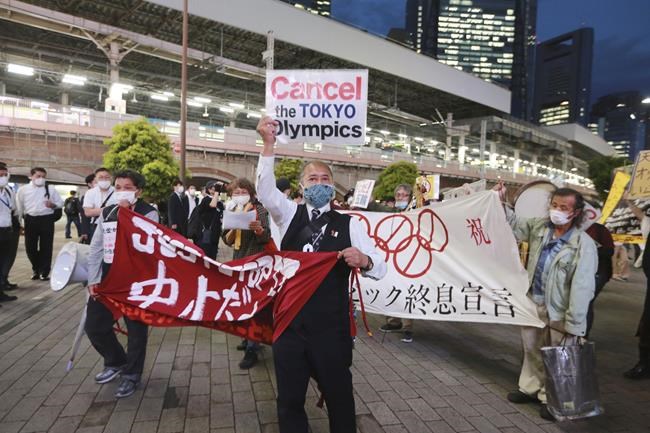
FILE - In this May 17, 2021, file photo, demonstrators protest against the Tokyo 2020 Olympics in Tokyo. The IOC and Tokyo Olympic organizers start three days of virtual meetings Wednesday, May 19, 2021 and will run into some of the strongest medical-community opposition so far with the games set to open in just over eight weeks. (AP Photo/Koji Sasahara, File)

Public opinion is Japan has been running at 60-80% against opening the Olympics on July 23, depending on how the question is phrased. Coates suggested public opinion might improve as more Japanese get fully vaccinated. That figure is now about 2%.

“If it doesn’t then our position is that we have to make sure that we get on with our job,” Coates said. “And our job is to ensure these games are safe for all the participants and all the people of Japan.”

IOC officials say they expect more than 80% of the residents of the Olympic Village, located on Tokyo Bay, to be vaccinated and be largely cut off from contact with the public. About 11,000 Olympic and 4,400 Paralympic athletes are expected to attend.

Coates said about 80% of spots in the Olympics would be awarded from qualifying events, with 20% coming from rankings.

Coates left no doubt that the Switzerland-based International Olympic Committee believes the Tokyo Games will happen. The IOC gets almost 75% of its income from selling broadcast rights, a key driver in pushing on. And Tokyo has officially spent $15.4 billion to organize the Olympics, though a government audit suggests the real number is much higher.

Tokyo, Osaka and several other prefectures are currently under a state of emergency and health-care systems are being stretched. Emergency measures are scheduled to end on May 31, but they are likely to be extended.

“If the current situation continues, I hope the government will have the wisdom not to end the emergency at the end of May,” Haruo Ozaki, head of the Tokyo Medical Association, told the weekly magazine Aera.

Ozaki has consistently said government measures to control the spread of COVID-19 have been insufficient. About 12,000 deaths in Japan have been attributed to the virus, and the situation is exacerbated since so few in Japan have been fully vaccinated.

Ozaki warned that if the emergency conditions are not extended, the virus and contagious variants will spread quickly.

“If that happens, there will be a major outbreak, and it is possible that holding the games will become hopeless,” he added.

Ozaki is not alone with this warning.
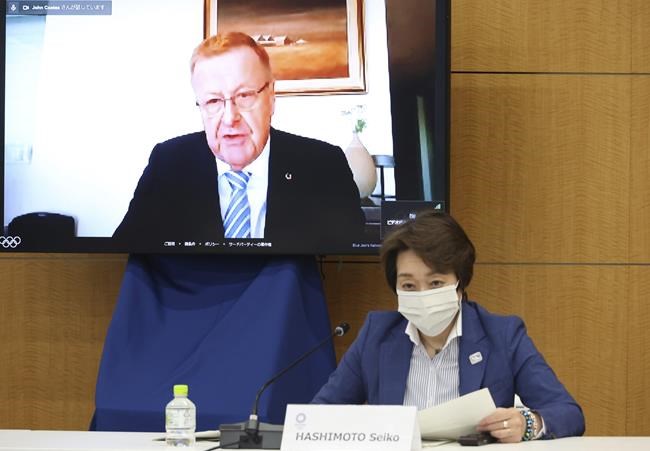
Intrernational Olympic Committee (IOC vice president John Coates speaks on a screen while Tokyo 2020 Olympics organizing committee president Seiko Hashimoto listens at a meeting of the IOC Coordination Commission for the Tokyo 2020 Olympics in Tokyo on Wednesday, May 19, 2021. IOC president Thomas Bach, Hashimoto, Japanese Olympic Minister Tamayo Marukawa and Tokyo Gov. Yuriko Koike attended a three-day meeting. (Yoshikazu Tsuno/Pool Photo via AP)

The 6,000-member Tokyo Medical Practitioners’ Association called for the Olympics to be canceled in a letter sent last week to Prime Minister Yoshihide Suga, Tokyo Governor Yuriko Koike, Olympic Minister Tamayo Marukawa, and Seiko Hashimoto, the head of the organizing committee.

“We believe the correct choice is to cancel an event that has the possibility of increasing the numbers of infected people and deaths,” the letter said.

Hashimoto addressed the worry of ordinary Japanese.

“At present there are not a few people who feel uneasy about the fact the games are going to be held where a lot of people are coming from abroad,” she said. “There are other people who are concerned about the possible burden on the medical system of Japan.”

She said the number of “stakeholders” coming to Japan from abroad had been reduced from 180,000 to about 80,000. She said Olympic “stakeholders” would amount to 59,000, of which 23,000 were Olympic family and international federations. She said an added 17,000 would involve television rights holders, with 6,000 more media.

She also said 230 physicians and 310 nurses would be needed daily, and said about 30 hospitals in Tokyo and outside were contacted about caring for Olympic patients. Organizers have said previously that 10,000 medical workers would be needed for the Olympics.

Hashimoto said retired nurses might also be called in. Separately, the IOC has said it will make available an unspecified number of medical personnel from unnamed national Olympic committees.

Fans from abroad were banned months ago. Hashimoto said the number of spectators — if any — at venues would “depend on the spread of the infection.” She has promised a decision on venue capacity next month.

Kaori Yamaguchi, a bronze medalist in judo at the 1988 Seoul Olympics and a member of the Japanese Olympic Committee, hinted in an interview with the Kyodo news agency this week that organizers were cornered. She has been skeptical about going ahead.

“We’re starting to reach a point where we can’t even cancel anymore,” she said.

The IOC’s most senior member, Richard Pound, said in an interview with Japan’s JiJi Press that the final deadline to call off the Olympics was still a month away.
Nicolas Datiche / The Associated Press

“Before the end of June, you really need to know, yes or no,” JiJi quoted Pound as saying.

Pound repeated — as the IOC has said — that if the games can’t happen now they will be canceled, not postponed again.

IOC President Thomas Bach now plans to arrive in Tokyo only July 12. He was forced to cancel a trip to Japan this month because of rising COVID-19 cases.

___

Kantaro Komiya contributed to this report.

___

More AP Olympics: https://apnews.com/hub/olympic-games and https://twitter.com/AP_Sports

Report Error Submit a Tip

More Stories

Court ruling concludes Canadian Wheat Board saga

Laura Rance-Unger 4 minute read Preview

Court ruling concludes Canadian Wheat Board saga

Laura Rance-Unger 4 minute read 2:01 AM CDT

It remains to be seen whether the recent court ruling in a lawsuit filed after Canadian Wheat Board’s dissolution in 2012 puts the whole debate to rest, as some no doubt hope.

But either way, the dust has settled on the post-CWB world. The sun still rises and a new generation of farmers on the land only knows by name an institution that for generations influenced every aspect of Prairie grain farming.

The first Rural Revival column I wrote for this newspaper more than 30 years ago was about a thousand farmers from Western Canada demonstrating in support of the Wheat Board. It was in the aftermath of the Western Grain Marketing Panel report, one of several efforts that eventually included a plebiscite to help the federal government decide what to do about a vocal minority of farmers who wanted marketing “freedom.”

The polls at the time suggested about two-thirds of farmers were comfortable enough with the single-desk system for food wheat and barley to keep it around. It served as a counterbalance to canola, which they sold on the open market. They essentially had a dual market.

Read
2:01 AM CDT

SNC planned U.S. move if no deal: documents

Jordan Press and Christopher Reynolds, The Canadian Press 5 minute read Preview

SNC planned U.S. move if no deal: documents

Jordan Press and Christopher Reynolds, The Canadian Press 5 minute read Thursday, Mar. 28, 2019

OTTAWA - SNC-Lavalin warned federal prosecutors last fall about a possible plan to split the company in two, move its offices to the United States and eliminate its Canadian workforce if it didn't get a deal to avoid criminal prosecution, newly obtained documents show.

The documents, part of a PowerPoint presentation obtained by The Canadian Press, describe something called "Plan B" — what Montreal-based SNC might have to do if it can't convince the government to grant a so-called remediation agreement to avoid criminal proceedings in a fraud and corruption case related to projects in Libya.

Under that plan, SNC would move its Montreal headquarters and corporate offices in Ontario and Quebec to the U.S. within a year, cutting its workforce to just 3,500 from 8,717, before eventually winding up its Canadian operations.

“The government of Canada needs to weigh the public interest impact of the prosecution of SNC-Lavalin," the presentation reads.

Read
Thursday, Mar. 28, 2019

Olympics Overnight: Speedskater Blondin wins silver in the mass start, Bowman narrowly misses podium in halfpipe skiing, Jamaica returns to bobsled track

Richie Assaly - Toronto Star, Toronto Star 6 minute read Preview

Olympics Overnight: Speedskater Blondin wins silver in the mass start, Bowman narrowly misses podium in halfpipe skiing, Jamaica returns to bobsled track

Richie Assaly - Toronto Star, Toronto Star 6 minute read Saturday, Feb. 19, 2022

Here’s what you missed overnight at Day 15 of the 2022 Beijing Olympics.

Read
Saturday, Feb. 19, 2022

Haunted houses aren’t the only places to find jump scares

Jen Zoratti 3 minute read Preview

Haunted houses aren’t the only places to find jump scares

Jen Zoratti 3 minute read 2:01 AM CDT

C’est l’Halloween, to quote the 1981 elementary school French class banger by Matt Maxwell, but you know what’s already plenty scary? Life.

We all have our personal haunted houses, so to speak, hence the popularity of the “a haunted house but it’s just…” meme that pops up every October. Sample: “a haunted house but it’s just a bunch of men telling you you’d be prettier if you smiled.”

In the spirit of the season, I thought I’d offer up a few jump scares of my own.

A haunted house but it’s just Gate E25

Read
2:01 AM CDT

Has the political wind changed?

Gwynne Dyer 5 minute read 2:01 AM CDT

It has been quite a week. First we had “Lula” – Luiz Inácio da Silva (as nobody but his mother ever called him) – defying everybody’s expectations. After winding up two million votes behind his challenger, Flávio Bolsonaro, in the first round of the Brazilian presidential election, he made a “miraculous” comeback in the second.

It was like a man going into a revolving door behind you and coming out in front. At the end of the first round, Lula was two million votes behind; at the end of the second round on Oct. 25 he was four million votes ahead. So how did he win a fourth term without cheating?

That’s what Bolsonaro claims he did, having fled to the United States; Trump, Flávio’s mentor, hints at the same. But Lula’s victory was not miraculous. He only learned to read when he was 10, and at 80 he still refused to have a mobile phone. His team finally made him get one and use it.

He wouldn’t do social media videos, so they created a WhatsApp channel called Lula’s Army, and made him appear on it at least daily. The channel went from zero to 10.8 million viewers in two weeks, and Lula won.

Letters, Oct. 31

6 minute read 2:01 AM CDT

Civic election a missed opportunity

The outcome of the latest municipal election in Winnipeg is nothing short of baffling. The decline of what was once a proud, beautiful prairie hub is impossible to ignore.

Winnipeg is rapidly sliding into a state of structural and social dilapidation, yet voters have inexplicably chosen to hand incumbent Mayor Scott Gillingham a second term. The decision smells of complacency, and sadly, it represents a massive missed opportunity for real urban renewal.

Walking through downtown Winnipeg today is an exercise in heartbreak. A city centre that should be a bustling economic and cultural core has instead transformed into an absolute eyesore. Encampments and tents are permitted to dot the heart of the city. Streets that used to thrive are now dominated by the tragic, visible reality of severe addiction, with individuals wandering and staggering through public spaces without adequate intervention or care.