Canada’s death toll from COVID-19 surpasses 20,000 as new flight restrictions begin

Advertisement

Advertise with us

Canada's official COVID-19 death toll surpassed 20,000 on Sunday as flights to major sun destinations were grounded in an effort to limit further spread of the virus.

Read this article for free:


By clicking the button above, an account will be created and you will begin to receive some of our recommended newsletters. You may opt out of any newsletter by visiting your Email and Communication Preferences page or by clicking "unsubscribe" at the bottom of any email.

or

Already have an account? Log in here »

To continue reading, please subscribe:

Digital Subscription

One year of digital access for only $1.44 a week*

  • Enjoy unlimited reading on winnipegfreepress.com
  • Read the E-Edition, our digital replica newspaper
  • Access News Break, our award-winning app
  • Play interactive puzzles

*Billed as $5.77 plus GST every four weeks. After 52 weeks, price increases to the regular rate of $19.95 plus GST every four weeks. Offer available to new and qualified returning subscribers only. Cancel any time.

To continue reading, please subscribe:

Add Free Press access to your Brandon Sun subscription for only an additional

$1 for the first 4 weeks*

  • Enjoy unlimited reading on winnipegfreepress.com
  • Read the E-Edition, our digital replica newspaper
  • Access News Break, our award-winning app
  • Play interactive puzzles
Start now

*Your next Brandon Sun subscription payment will increase by $1.00 and you will be charged $17.95 plus GST for four weeks. After four weeks, your payment will increase to $24.95 plus GST every four weeks.

Hey there, time traveller!
This article was published 31/01/2021 (2100 days ago), so information in it may no longer be current.

Canada’s official COVID-19 death toll surpassed 20,000 on Sunday as flights to major sun destinations were grounded in an effort to limit further spread of the virus.

The sobering figure emerged after Quebec and Ontario reported 31 and 43 new fatalities respectively related to the virus. That tally climbed later in the day when Manitoba and Saskatchewan each logged four new associated deaths, and Alberta added eight.

Canada has now recorded 20,032 deaths since the first case of COVID-19 surfaced in the country just over a year ago. The country’s first COVID-19 death was reported on March 9, 2020.
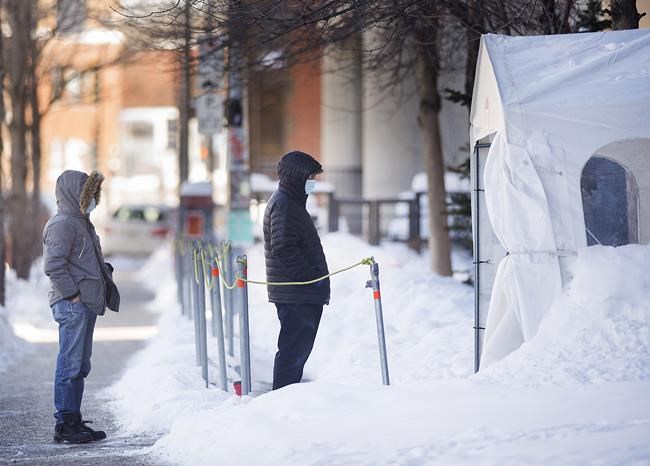
People wear face masks as they wait to be tested for COVID-19 at a clinic in Montreal, Sunday, January 31, 2021, as the COVID-19 pandemic continues in Canada and around the world. THE CANADIAN PRESS/Graham Hughes

An average of 138 people with COVID-19 have died each day over the past week.

Dr. Theresa Tam, Canada’s chief public health officer, has said the number of new daily cases is trending downward.

But she’s warned that it’s still too soon to lift widespread public health restrictions, saying the virus is still spreading rapidly across parts of the country.

She issued a statement on Sunday urging Canadians to follow public health rules in order to support front line health workers, who she said are at risk of psychological distress and burnout due to stress, long hours, the difficult medical decisions they have to make.

“In the face of these challenges, frontline health workers may feel tremendous personal, organizational or societal pressure to be superheroes – to not appear vulnerable, tired, worn down, or weak,” she wrote.

“All of these pressures may prevent them from seeking the care, treatment and supports they need for their own mental health.”

The United Kingdom, Czechia and Italy lead the world in deaths per 100,000, according to a tracking tool provided by the Coronavirus Resource Center at Johns Hopkins University. Canada falls 16th on the list of the 20 countries that are most affected worldwide,

As of Jan. 31, there has been a total of 102,083,344 confirmed cases of COVID-19, and 2,209,195 deaths reported to the World Health Organization.

Quebec and Ontario together account for about 80 per cent of Canada’s COVID-19 fatalities, even as new cases and hospitalizations have been declining.

On Sunday, Quebec Health Minister Christian Dube said there were 200 fewer COVID-19 hospitalizations compared to a week prior, which would allow the province to restart surgeries that had been delayed due to the pandemic.

Nova Scotia and Newfoundland and Labrador reported no new cases each, while harder-hit New Brunswick reported 26.

The new numbers were reported as new limits on travel were coming into effect in the hopes of slowing transmission and limiting the importation of potentially more infectious COVID-19 variants.

Four of Canada’s major airlines suspended service to Mexico and the Caribbean as of Sunday.

Prime Minister Justin Trudeau announced Friday that Air Canada, WestJet, Sunwing and Air Transat had agreed to the measure in a bid to slow the spread of COVID-19.

The restriction will last until April 30, and Trudeau said the airlines will help arrange the return of customers currently on a trip.

It’s one of a suite of new government measures aimed at preventing Canadians from travelling abroad during the doldrums of February and throughout spring break.

As of this Thursday, all international passenger flights must land at one of four airports — Vancouver, Toronto, Calgary or Montreal.

And in the coming weeks, all air travellers arriving in Canada will have to stay at a government-approved hotel for three nights and take a COVID-19 test — all at their own expense.

The travel restrictions come amid a temporary slowdown of vaccine deliveries from Canada’s two approved vaccine manufacturers, Pfizer and Moderna, and fear that the importation of new variants could derail the progress made against the disease in recent weeks.

Ontario has already confirmed 58 cases of a U.K. variant of COVID-19, including a new case on Sunday linked to a Waterloo care home.

Meanwhile, the federal government has begun reviewing a new COVID-19 vaccine that has been submitted for regulatory approval.

Maryland-based Novavax quietly applied on Friday for Health Canada to approve its vaccine, which studies have suggested is effective against the British and South African variants of the virus.

The application comes less than two weeks after Ottawa finalized an agreement with the company for 52 million doses of the vaccine, with an option to purchase another 24 million.

Novavax is the fifth vaccine maker to submit an application for rolling review. AstraZeneca, Pfizer-BioNTech and Moderna all submitted in early October, and Johnson and Johnson at the end November.

Health Canada approved the Pfizer-BioNTech vaccine Dec. 9, and Moderna on Dec. 23, both about three weeks after the companies both completed their phase three trials. A decision on AstraZeneca is expected in the coming weeks.

This report by The Canadian Press was first published Jan. 31, 2021

— with files from Lee Berthiaume and Holly McKenzie-Sutter.

Report Error Submit a Tip

More Stories

Letters, Oct. 31

6 minute read 2:01 AM CDT

Civic election a missed opportunity

The outcome of the latest municipal election in Winnipeg is nothing short of baffling. The decline of what was once a proud, beautiful prairie hub is impossible to ignore.

Winnipeg is rapidly sliding into a state of structural and social dilapidation, yet voters have inexplicably chosen to hand incumbent Mayor Scott Gillingham a second term. The decision smells of complacency, and sadly, it represents a massive missed opportunity for real urban renewal.

Walking through downtown Winnipeg today is an exercise in heartbreak. A city centre that should be a bustling economic and cultural core has instead transformed into an absolute eyesore. Encampments and tents are permitted to dot the heart of the city. Streets that used to thrive are now dominated by the tragic, visible reality of severe addiction, with individuals wandering and staggering through public spaces without adequate intervention or care.

Defunding police ‘illogical step’: Pallister

Carol Sanders 5 minute read Preview

Defunding police ‘illogical step’: Pallister

Carol Sanders 5 minute read Tuesday, Jun. 9, 2020

Manitoba Premier Brian Pallister says he’s open to channelling justice funding to preventive programs, but questions whether defunding police is the best approach — warning there will always be criminals taking advantage of vulnerable people.

“I think the motivation that lies in frustrations of the actions of some police services — not necessarily here in Winnipeg exclusively, but elsewhere — is justifiable and understandable, and I get it,” Pallister said Tuesday, when asked to comment on the 30,000 signatures collected for a Justice 4 Black Lives Winnipeg petition calling for the abolition of the city police.

“But then moving to defunding police is, to me, an illogical step from that one. Don’t let your frustration lose your common sense... There’s a lot of people out there in vulnerable communities who depend on the police to protect them and make sure they’re safe from the action of criminals.”

There has been a widespread call to restructure police funding in the wake of George Floyd’s death May 25 in Minneapolis.

Read
Tuesday, Jun. 9, 2020

Actor-director Cooper takes new approach to familiar tale

Randall King 4 minute read Preview

Actor-director Cooper takes new approach to familiar tale

Randall King 4 minute read Thursday, Oct. 4, 2018

TORONTO — In his self-directed version of A Star Is Born, Bradley Cooper plays a rock star named Jackson Maine.

Note the name: it marks the character as a member of a cinematic lineage that descends all the way to 1937.

That year, the first A Star Is Born was made, with Frederick March in the role of alcoholic actor Norman Maine. The name stayed in 1954, when James Mason took over the role of an actor who first nurtures the career of Judy Garland’s up-and-coming star Vicki Lester before his drunken shenanigans threaten to derail it. By 1976, Kris Kristofferson played the role of musician John Norman Howard, a rock singer with a musical stake in the ascent of Barbra Streisand’s Esther Hoffman.

Cooper, 43, remembered the Maine name, but also brought his own vision as a first-time feature filmmaker to the new version, which opens Thursday, Oct. 4, opposite Lady Gaga after the originally designated director, Clint Eastwood, dropped out. While actors might not want to see different interpretations of a role, Cooper embraced the opportunity to see all the past iterations.

Read
Thursday, Oct. 4, 2018

Brandon manufacturer says Canadian steel in demand, but high costs, long delivery times hit hard

Gabrielle Piché 6 minute read Preview

Brandon manufacturer says Canadian steel in demand, but high costs, long delivery times hit hard

Gabrielle Piché 6 minute read 2:01 AM CDT

Something’s different in a Brandon plant.

Building envelope panels — or shells for homes and commercial buildings — keep being produced at Greenstone Building Products.

But the galvanized steel used by workers has been arriving later and the price is constantly increasing, according to company leadership.

“It’s just a little bit nerve-wracking for us to hear the opposite narrative,” said Tilda Fortier, Greenstone Building Products’ business manager.

Read
2:01 AM CDT

Court ruling concludes Canadian Wheat Board saga

Laura Rance-Unger 4 minute read Preview

Court ruling concludes Canadian Wheat Board saga

Laura Rance-Unger 4 minute read 2:01 AM CDT

It remains to be seen whether the recent court ruling in a lawsuit filed after Canadian Wheat Board’s dissolution in 2012 puts the whole debate to rest, as some no doubt hope.

But either way, the dust has settled on the post-CWB world. The sun still rises and a new generation of farmers on the land only knows by name an institution that for generations influenced every aspect of Prairie grain farming.

The first Rural Revival column I wrote for this newspaper more than 30 years ago was about a thousand farmers from Western Canada demonstrating in support of the Wheat Board. It was in the aftermath of the Western Grain Marketing Panel report, one of several efforts that eventually included a plebiscite to help the federal government decide what to do about a vocal minority of farmers who wanted marketing “freedom.”

The polls at the time suggested about two-thirds of farmers were comfortable enough with the single-desk system for food wheat and barley to keep it around. It served as a counterbalance to canola, which they sold on the open market. They essentially had a dual market.

Read
2:01 AM CDT

Two U.S. presidents, and America’s decline

Editorial 4 minute read Preview

Two U.S. presidents, and America’s decline

Editorial 4 minute read Friday, Sep. 25, 2026

“Let us have faith that right makes might, and in that faith, let us, to the end, dare to do our duty as we understand it.” — Abraham Lincoln in his Cooper Union address, given in New York City in 1860.

“When you add the United States and Venezuela together, we have more than 60 per of the oil in the world. So it’s perhaps the biggest deal. It was a war, but it’s perhaps the biggest deal ever made. To the victor belong the spoils.” — U.S. President Donald Trump, speaking to the United Nations on Tuesday. (And a point of clarification — combining U.S. and Venezuelan oil would amount to 22 per cent of global oil reserves.)

It is quite the juxtaposition: Lincoln speaking in one of his strongest speeches, making the case that slavery should not be extended to the Northern Territories of the U.S. It was a sentence — the closing line in his speech, in fact — which argued that moral truth and justice will prevail against brute force, and that moral behaviour will, in itself, become power.

Donald Trump essentially argued that the obverse is true: that brute force justifies all behaviour — saying that might is right. The end of seizing control justifies the means, the means in this case being an invasion of Venezuela and the end being gaining de facto control of an independent nation’s resources.

Read
Friday, Sep. 25, 2026