Ontario to receive 53,000 Moderna COVID-19 vaccine doses by end of December

Advertisement

Advertise with us

TORONTO - Ontario says it expects to receive approximately 53,000 doses of the newly approved Moderna COVID-19 vaccine by the end this month.

Read this article for free:


By clicking the button above, an account will be created and you will begin to receive some of our recommended newsletters. You may opt out of any newsletter by visiting your Email and Communication Preferences page or by clicking "unsubscribe" at the bottom of any email.

or

Already have an account? Log in here »

To continue reading, please subscribe:

Digital Subscription

One year of digital access for only $1.44 a week*

  • Enjoy unlimited reading on winnipegfreepress.com
  • Read the E-Edition, our digital replica newspaper
  • Access News Break, our award-winning app
  • Play interactive puzzles

*Billed as $5.77 plus GST every four weeks. After 52 weeks, price increases to the regular rate of $19.95 plus GST every four weeks. Offer available to new and qualified returning subscribers only. Cancel any time.

To continue reading, please subscribe:

Add Free Press access to your Brandon Sun subscription for only an additional

$1 for the first 4 weeks*

  • Enjoy unlimited reading on winnipegfreepress.com
  • Read the E-Edition, our digital replica newspaper
  • Access News Break, our award-winning app
  • Play interactive puzzles
Start now

*Your next Brandon Sun subscription payment will increase by $1.00 and you will be charged $17.95 plus GST for four weeks. After four weeks, your payment will increase to $24.95 plus GST every four weeks.

Hey there, time traveller!
This article was published 23/12/2020 (2137 days ago), so information in it may no longer be current.

TORONTO – Ontario says it expects to receive approximately 53,000 doses of the newly approved Moderna COVID-19 vaccine by the end this month.

Premier Doug Ford says the new vaccine, which was approved by Health Canada on Wednesday, is a “‘game-changer.”

A spokeswoman for Ontario’s health minister says the province expects to receive the doses next week and they will first be taken to long-term care homes.
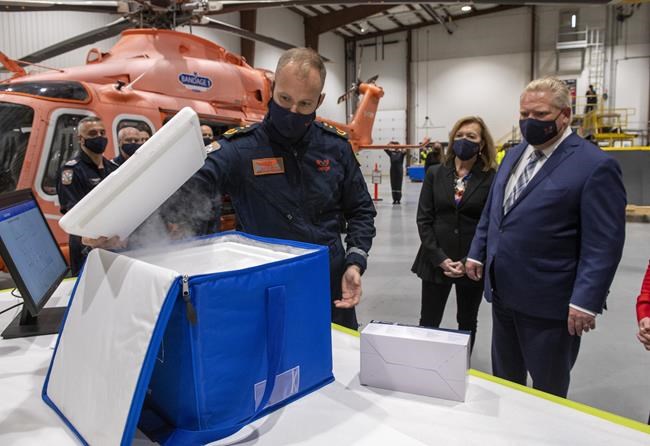
ORNGE Chief Paramedic Justin Smith, left, demonstrates a Remote Cold Storage Monitoring insulated container for Ontario Premier Doug Ford, right, and Health Minister Christine Elliott at Toronto Island Airport, Wednesday, Dec. 16, 2020. Ontario says it expects to receive approximately 53,000 doses of the newly approved Moderna COVID-19 vaccine by the end this month. THE CANADIAN PRESS/Frank Gunn

She says the province is working with public health units on a plan to start administering the shots in long-term care facilities during the first week of January.

Ford says the Moderna vaccine can be more easily transported than the Pfizer-BioNtech dose – the only other immunization approved by Health Canada – which is why it will be taken to long-term care homes first.

The premier says other priority groups, including Indigenous communities and residents of retirement homes, will also receive the Moderna vaccine soon.

“We are taking another step towards ending this terrible pandemic,” Ford said of the vaccine’s approval in Canada while noting the need for residents to keep heeding public health advice.

“As we await the arrival of more vaccines, I continue to ask all Ontarians to remain vigilant and keep following the public health measures.”

Ontario began administering the Pfizer-BioNtec vaccine to health-care workers on Dec. 14. The government has noted, however, that COVID-19 immunizations aren’t expected to be more broadly available to the general public until April.

The Moderna doses are set to arrive shortly after Ontario enters a provincewide lockdown on Boxing Day in an effort to bring soaring COVID-19 cases under control.

Ontario reported 2,408 new cases of COVID-19 on Wednesday, as well as 41 more deaths from the virus.

Health Minister Christine Elliott said 629 of the new cases were in Toronto, 448 in Peel Region, 234 in Windsor-Essex, and 190 in York Region.

The government said 1,002 people are currently hospitalized with COVID-19. That number includes 275 people in intensive care, and 186 on ventilators.

The province’s lockdown that begins Dec. 26 is set to last 28 days for southern Ontario but will lift for northern Ontario on Jan. 9.

It will shutter all non-essential businesses, ban indoor gatherings, close restaurant dining rooms, and see all schools move classes online for the first week of the new year. It also means Ontarians are advised to stay home as much as possible.

This report by The Canadian Press was first published Dec. 23, 2020.

Report Error Submit a Tip

More Stories

A timeline of the WE Charity controversy

The Canadian Press 9 minute read Wednesday, Aug. 19, 2020

OTTAWA - A timeline of events regarding the Canada Student Service Grant program, based on public documents, events and statements from cabinet ministers, government officials, and WE Charity:

March 6, 2020: WE Charity staff prepare a concept paper on service learning for public servants at Employment and Social Development Canada.

April 5: Finance Minister Bill Morneau and Prime Minister Justin Trudeau talk over the phone about how to help students whose summer job and volunteer opportunities were vanishing due to the COVID-19 pandemic. Finance Department officials are tasked with considering options the next morning.

April 7: Small Business Minister Mary Ng and WE co-founder Craig Kielburger have an introductory phone call in which Ng asks WE to send what it calls a ``pre-established proposal'' to help young people launch businesses.

Is Canada headed for time chaos this weekend?

Michelle Bastian 5 minute read 2:00 AM CDT

When Manitoba Premier Wab Kinew declared Sept. 17 that the province would remain on permanent daylight time, he suggested it was a historical moment people would share with their “great-great-grandkids.” But, while Sunday, Nov. 1 has been heralded as the date many Canadians will stop changing their clocks, there are rumblings behind the scenes suggesting this will actually cause more trouble than ever before.

There are, of course, the warnings from chrono-biologists and sleep scientists about the damage permanent daylight time will do. The lighter evenings will mean many more dark mornings. But there is another set of problems in the offing in the critical infrastructure that underpins our digital lives.

While it used to be common to spend the Sunday morning after a time change going around our homes updating the clocks, we now wake up to devices that have already adjusted to the new time. These automatic updates occur regularly for daylight time, as well as when we travel to new time zones.

Our clocks are able to change by themselves owing to the hard work of a group of volunteers who were recently named in a list of the people who hold up the internet. This group, led by Paul Eggert, a computer scientist at UCLA, maintains a little-known tool called the Time Zone Database. Since the 1980s, it has kept track of regional, national and international debates about clock time and provided an up-to-date table of what time it should be on our walls.

Ontario to receive 53,000 Moderna vaccine doses

Shawn Jeffords, The Canadian Press 3 minute read Preview

Ontario to receive 53,000 Moderna vaccine doses

Shawn Jeffords, The Canadian Press 3 minute read Wednesday, Dec. 23, 2020

TORONTO - Ontario says it expects to receive approximately 53,000 doses of the newly approved Moderna COVID-19 vaccine by the end this month.

Premier Doug Ford says the new vaccine, which was approved by Health Canada on Wednesday, is a "'game-changer."

A spokeswoman for Ontario's health minister says the province expects to receive the doses next week and they will first be taken to long-term care homes.

She says the province is working with public health units on a plan to start administering the shots in long-term care facilities during the first week of January.

Read
Wednesday, Dec. 23, 2020

Fact Check

1 minute read Thursday, Nov. 30, 2023

Fact Check

Having problems with the form?Contact Us Directly |

Transit driver killed in knife attack on U of M campus

8 minute read Preview

Transit driver killed in knife attack on U of M campus

8 minute read Tuesday, Feb. 14, 2017

A Winnipeg Transit driver was killed early this morning after he was stabbed by the only passenger on his bus at the University of Manitoba campus.

Irvine Jubal Fraser, 58, was rushed to hospital in critical condition but later died, police said.

The attack occurred at about 2 a.m. in the area of Dafoe Road West and Gillson Street.

Witnesses pointed officers led by the canine unit in the direction of the Red River, where a 22-year-old suspect trying to cross to the St. Vital side was arrested and taken into custody.

Read
Tuesday, Feb. 14, 2017

Health officials ponder next steps as COVID cases surge in Southern Health region

Katie May 5 minute read Preview

Health officials ponder next steps as COVID cases surge in Southern Health region

Katie May 5 minute read Wednesday, Nov. 3, 2021

Public-health officials say they're trying to avoid ordering another lockdown in southern Manitoba, where COVID-19 infection rates are surging.

Deputy chief provincial public health officer Dr. Jazz Atwal told a news conference Wednesday he doesn't anticipate more lockdowns and suggested he will prioritize keeping schools open when considering future restrictions.

But he couldn't say what the next step will be in an area of the province where hospitalizations among unvaccinated residents are on the rise.

Average daily case counts in the southern part of the province are higher now than they were before lockdown measures went into effect last November, and officials are still figuring out what to do.

Read
Wednesday, Nov. 3, 2021