‘A bombshell’: Canadians stuck in U.K. face uncertainty after Canada shuts air travel

Advertisement

Advertise with us

MONTREAL - Mark Sultana says Canada's decision to halt most air travel from the United Kingdom, where a mutated strain of COVID-19 has been discovered, landed "like a bombshell."

Read this article for free:


By clicking the button above, an account will be created and you will begin to receive some of our recommended newsletters. You may opt out of any newsletter by visiting your Email and Communication Preferences page or by clicking "unsubscribe" at the bottom of any email.

or

Already have an account? Log in here »

To continue reading, please subscribe:

Digital Subscription

One year of digital access for only $1.44 a week*

  • Enjoy unlimited reading on winnipegfreepress.com
  • Read the E-Edition, our digital replica newspaper
  • Access News Break, our award-winning app
  • Play interactive puzzles

*Billed as $5.77 plus GST every four weeks. After 52 weeks, price increases to the regular rate of $19.95 plus GST every four weeks. Offer available to new and qualified returning subscribers only. Cancel any time.

To continue reading, please subscribe:

Add Free Press access to your Brandon Sun subscription for only an additional

$1 for the first 4 weeks*

  • Enjoy unlimited reading on winnipegfreepress.com
  • Read the E-Edition, our digital replica newspaper
  • Access News Break, our award-winning app
  • Play interactive puzzles
Start now

*Your next Brandon Sun subscription payment will increase by $1.00 and you will be charged $17.95 plus GST for four weeks. After four weeks, your payment will increase to $24.95 plus GST every four weeks.

Hey there, time traveller!
This article was published 21/12/2020 (2137 days ago), so information in it may no longer be current.

MONTREAL – Mark Sultana says Canada’s decision to halt most air travel from the United Kingdom, where a mutated strain of COVID-19 has been discovered, landed “like a bombshell.”

The 52-year-old Canadian entrepreneur, who has called London home for the better part of two decades, said the move announced late Sunday has been especially disconcerting for Canadians who had planned to visit family and friends back home over the holidays.

“We can’t go anywhere — any of us,” Sultana, an administrator of the Facebook group “Canadians in London” said in an interview Monday. “We’re landlocked on this island, and it’s lots of Canadians who are affected.”
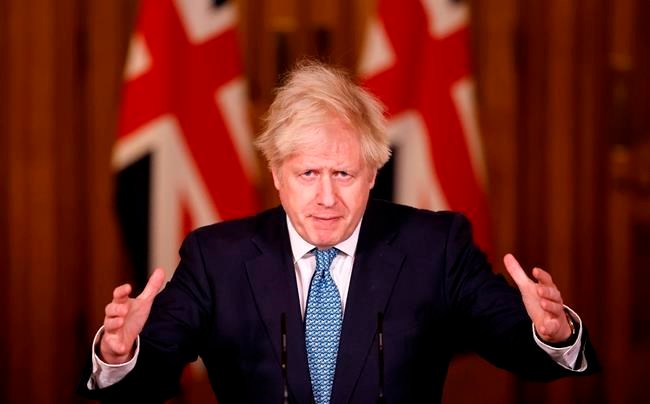
Britain's Prime Minister Boris Johnson speaks during a media briefing in Downing Street, London, Monday Dec. 21, 2020. THE CANADIAN PRESS/Tolga Akmen/Pool via AP

Originally from the Greater Toronto Area, Sultana said members of the 6,800-person Facebook group have reported their flights being cancelled. He said confusion and surprise reigned in the hours after Canada’s decision.

“They were prepared to quarantine and do the things that they needed to do to get back home, but now they’re completely stuck,” Sultana said.

The federal government said late Sunday that passenger flights from the U.K. into Canada would be suspended for 72 hours in an attempt to keep out a new strain of COVID-19 discovered by British health officials.

“These additional measures will allow public health officials time to gather further evidence and help reduce the spread of the virus that causes COVID-19,” Health Minister Patty Hajdu said in a statement announcing the border restrictions.

Canada is one of several countries to ban travel from the U.K. due to the new strain of the virus, which British officials said appears to be 70 per cent more transmissible.

British Prime Minister Boris Johnson said on Saturday that London and the southeast of England would be placed under stricter, “tier 4” COVID-19 restrictions due to a surge in cases and concerns over the new variant. British Health Secretary Matt Hancock said the strain is “out of control” in those areas.

This isn’t the first time London has been under lockdown, however, said 32-year-old Julien Gagnon, a native of Saint-Lambert, Que., who has lived in the U.K. for 10 years, including nearly five years in the British capital.

He said people have been hunkering down in London for weeks, but that the largest impact of “tier 4” restrictions will be felt in the coming days, as holiday gatherings between people from different households now are banned.

“I’m pretty sure that for the very vast majority of people, it feels exactly the same way that it must feel in Canada right now,” he said in an interview. “We can’t do anything. We need to stay inside. We can’t see friends, we can’t see family, we can’t celebrate Christmas.”

In that way, Gagnon said daily life in London seems similar to his home province of Quebec, where Premier Francois Legault this month reversed plans to allow holiday gatherings over four days. Quebec has recorded over 6,200 new COVID-19 cases over the past three days and additional restrictions, namely the closure of non-essential businesses, are coming into effect on Dec. 25.

“We were going to have a bit more freedom around Christmas than in Quebec; now it’s exactly the same thing,” said Gagnon, adding that he plans to do a Zoom call with his family in Canada.
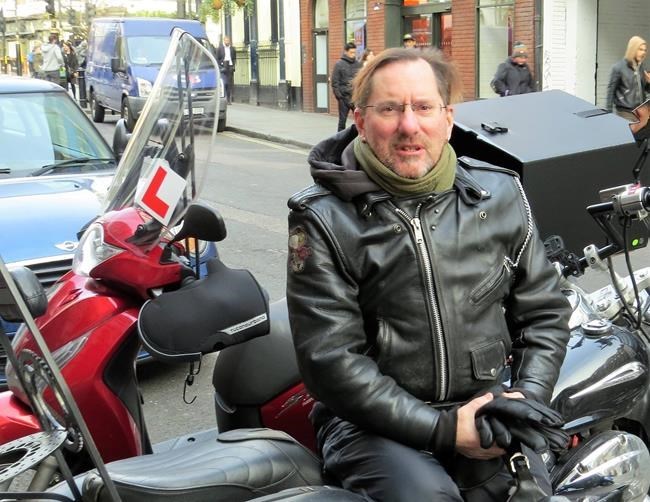
Bobby Demers, shown recent handout image from London, U.K. Demers, a Toronto native who has lived in the U.K. since 1988, said many people were out shopping in London on Monday, fuelled in part by fears that fresh produce will run out as the borders close. THE CANADIAN PRESS/HO-MANDATORY CREDIT

Bobby Demers, a Toronto native who has lived in the U.K. since 1988, said many people were out shopping in London on Monday, fuelled in part by fears that fresh produce will run out as the borders close.

“I went to the local supermarket this morning … and the lineup, with cars, was outside the shopping centre itself,” he said.

The U.K. is less than two weeks away from the final stage of its exit from the European Union and the British government has not yet reached a trade deal with the 27-member bloc.

“This almost is like a precursor of what’s going to happen in two weeks when (the) lorries and the trucks and the planes are not going to be able to go back and forth very easily between England and Europe,” Demers said in an interview.

An administrator of a Facebook group called “Canadians in the U.K.,” which has 5,300 members, Demers said people are banding together and offering words of support amid the uncertainty. “The empathy that as Canadians we have for each other has really come out,” he said.

“People have this view of London as (a place where) people don’t talk to each other, people avoid eye contact, but when things get tight and in times of emergency, people here do tend to come together.”

This report by The Canadian Press was first published Dec. 21, 2020.

— With files from The Associated Press.

Report Error Submit a Tip

More Stories

The importance of political trust

Paul G. Thomas 5 minute read 2:00 AM CDT

Political trust refers to people’s positive expectations that the political system, the institutions which comprise it and the actors who participate in its operations will do what they have said they will do, that they will act in the public interest and that they will conduct themselves in a manner which does not disrespect the democratic process.

Political scientists use the terms “diffuse” and “specific” to differentiate between trust in the political system as a whole, and trust in individual actors. Asked to rank occupations in terms of trustworthiness, respondents typically place politicians at or near the bottom of the list. Individuals who have first-hand experience dealing with politicians tend to have more positive viewpoints.

Unfortunately, systematic surveys on trust levels in Manitoba are rare, so any discussion must be based on national results.

Beginning in the late 1960s, a slow erosion of trust in Canadian politicians and political institutions began, with only occasional, short-lived upticks. In the summer of 2025, a national Environics survey found that only a minority of Canadians had a lot of trust in political actors and institutions, such as the political parties and Parliament. The survey report also revealed that trust levels had held steady over the past 15 years.

Railways report more accidents with dangerous goods

Dylan Robertson 6 minute read Preview

Railways report more accidents with dangerous goods

Dylan Robertson 6 minute read Monday, Jan. 20, 2020

OTTAWA — The number of rail accidents involving dangerous goods more than doubled in Canada in 2018.

There were 25 accidents involving dangerous goods in 2018, involving one death, according to Transport Canada data published Monday.

There were 11 accidents recorded a year prior, and five in 2016.

These accidents involve dangerous goods — flammable or corrosive substances — that either exploded or leaked.

Read
Monday, Jan. 20, 2020

Woman with schizophrenia pleads guilty to stabbing caretaker in neck

Dean Pritchard 5 minute read Preview

Woman with schizophrenia pleads guilty to stabbing caretaker in neck

Dean Pritchard 5 minute read 2:00 AM CDT

A Winnipeg woman previously found not criminally responsible for stabbing three people is now facing a possible prison sentence for stabbing her apartment caretaker in the neck while in the grip of a psychotic delusion.

Victoria Nuoi, 34, has pleaded guilty to one count of aggravated assault for the April 2025 attack.

At a hearing Tuesday, Crown attorney Marla Bettencourt recommended Nuoi, who lives with schizophrenia, be sentenced to four years in prison, while her lawyer Chris Gamby urged provincial court Judge Dale Harvey to sentence her to three years supervised probation.

Harvey reserved his decision, saying he needed time to consider the widely disparate recommendations.

Read
2:00 AM CDT

Opportunity knocks, and we must answer

Adrian Deer 5 minute read Yesterday at 2:00 AM CDT

Imagine being a young athlete who loves volleyball but attends a school without a net or even a ball.

For many students in Winnipeg, access to basic sporting equipment is something they rarely think about.

However, during my visit to Red Sucker Lake First Nation in northern Manitoba, I witnessed a very different reality. The local school did not have volleyball nets or balls. As someone who has had the opportunity to compete in volleyball across Canada and internationally, this experience made me realize how easily we take these opportunities for granted.

How can we expect young Indigenous athletes to discover their potential when they don’t even have the basic equipment needed to play? Talent and determination can exist in every community but without access to opportunities, that potential may never be realized.

Wheat City mayoral candidates hit streets

Alex Lambert 4 minute read Preview

Wheat City mayoral candidates hit streets

Alex Lambert 4 minute read Updated: 7:31 AM CDT

BRANDON — The two mayoral candidates made their final pushes Tuesday to woo voters in Manitoba’s second-largest city.

Incumbent Jeff Fawcett said he and his team have been to nearly every doorstep in the city, while challenger Len Isleifson, a former Tory MLA, said he has covered most parts of Brandon and was even on a second go-round in some areas.

“I’m working my tail off to try to make sure that people do get out to vote, and the people I speak to, I feel fairly optimistic,” said Fawcett, who is running for his second term. “But people have to vote.”

The Brandon Sun joined both Fawcett and Isleifson as they went door knocking one day before Manitoba’s elect new municipal councils.

Read
Updated: 7:31 AM CDT

Lula’s historic Brazilian election victory

Peter McKenna 5 minute read Preview

Lula’s historic Brazilian election victory

Peter McKenna 5 minute read Yesterday at 2:01 AM CDT

This was supposed to go down as one of the closest presidential elections in Brazilian history — until it wasn’t. In the end, 80-year-old leftist President Luiz Inácio (Lula) da Silva of the Workers Party bested (by some four million votes) Flávio Bolsonaro, the hard-right Liberal Party leader and senator, by a lopsided 3.5 per cent of the popular vote.

Speaking of Brazilian history, it rarely happens that the second-place finisher in the first round ends up winning the second, run-off contest in such a decisive manner. More significant, Lula has now won an unprecedented (non-consecutive) fourth term as an elected Brazilian president.

While Bolsonaro has waffled on making a concession speech (like his father in 2022), the writing on the wall shows clearly that he lost badly. He has evidently taken issue with a ruling by a justice of the Supreme Court that extended polling hours country-wide by an additional two hours in light of high voter turnout and other interruptions.

Flávio’s supporters, many galvanized around the “never Lula” camp, were desperate for change — even if it meant the kind of change that could turn Brazil on its head. So Lula resorted to one of the oldest political tricks in the campaign handbook — namely, using fear of an anti-democratic Bolsonaro to swing voters to his side (along with a host of last-minute announcements involving financial incentives to Brazilians). With a right-leaning Congress, voters were understandably worried that Flávio would go about systematically dismantling Brazil’s democratic ethos and institutions.

Read
Yesterday at 2:01 AM CDT